
Aethina tumida
Murray, 1867
Small Hive Beetle, SHB
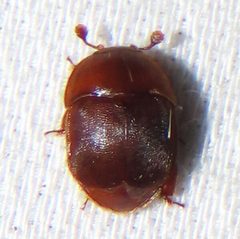
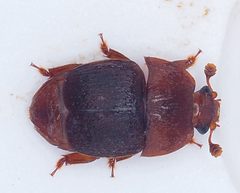
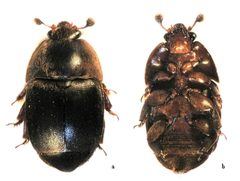
is an pest native to sub-Saharan Africa that has spread globally, causing significant damage to European honey bee (Apis mellifera) colonies. are small, reddish-brown to dark brown beetles with clubbed . Females can lay up to 2,000 , and larvae feed on , honey, and pollen, producing that promotes fungal fermentation and creates a slimy, unusable mess in hives. The has demonstrated potential for beneficial use in circular economy applications, converting excess bee pollen into animal feed and biomanure.
Pronunciation
How to pronounce Aethina tumida: //ˈaɪ.θɪ.nə/ /ˈtuː.mɪ.də//
These audio files are automatically generated. While they are not always 100% accurate, they are a good starting point.
Identification
Small, oval beetles approximately 5–7 mm in length. range from reddish-brown to nearly black in color. are distinctly clubbed (), a characteristic feature of the Nitidulidae. Larvae are whitish, -like, and can be distinguished from other hive pests by their size and . When disturbed, adults exhibit characteristic defensive behaviors: running rapidly, hiding in crevices, dropping from surfaces, and retracting legs beneath the body.
Images
Habitat
Primarily associated with colonies (Apis mellifera), including active hives, stored equipment, and abandoned nests. Larvae leave colonies to pupate in surrounding soil. In its native African range, primarily infests weak or stressed colonies; in introduced ranges, attacks healthy commercial colonies.
Distribution
Native to sub-Saharan Africa. Introduced and established in North America (first detected in Florida, 1998; now present throughout USA), Australia, Central America ( Rica, Nicaragua, El Salvador, Guatemala), and other regions. Detected in Egypt and poses threat to European . Spread facilitated by international trade in bees and products, and natural by .
Diet
and larvae consume and larvae, honey, pollen, and beebread. Larvae are particularly destructive, tunneling through combs and causing fermentation through accumulation. Has been successfully reared on excess stored pollen in controlled settings.
Host Associations
- Apis mellifera - primary European honey bee; severe pest in commercial colonies
- African subspecies of Apis mellifera - native minor pest of weak or stressed colonies in native range
- Bombus impatiens - potential documented potential for shift to bumblebee colonies
Life Cycle
Complete with four stages: , larva, pupa, . Females lay eggs in cracks and crevices within hives. Larvae pass through multiple instars, feeding within the colony before exiting to pupate in soil. occurs underground. Adults can live for extended periods and are attracted to hive odors from long distances.
Behavior
exhibit several evasion to avoid defense: rapid running, hiding in hive crevices, dropping from surfaces, and leg retraction. Adults have been observed soliciting food from bees by antennal contact with . Larvae crawl long distances to locate sites. Strong capability enables between colonies.
Ecological Role
In native range: minor pest, primarily affecting weak colonies; part of natural dynamics. In introduced range: significant pest causing colony destruction and economic losses in apiculture. Potential beneficial role in waste conversion: larvae efficiently convert excess pollen into protein-rich and nitrogen-dense for animal feed and fertilizer.
Human Relevance
Major economic pest of commercial , causing millions of dollars in damage through colony destruction, honey spoilage, and equipment . Subject to including cultural controls, trapping, chemical treatments, and using . Research interest in circular economy applications for waste valorization. International trade regulations and biosecurity measures focus on limiting spread.
Sources and further reading
- BugGuide
- GBIF taxonomy match
- iNaturalist taxon
- NCBI Taxonomy
- National Moth Week: Here's One Moth that Beekeepers Won't Celebrate | Bug Squad
- Another Pest of Pollinators: Small Hive Beetle Management in Honey Bee Colonies
- Circular Economics: Honey Bee Pest Turns Excess Pollen Into Food
- Why Human Behavior is Hurting Honey Bees
- An Inordinate Fondness #9 | Beetles In The Bush
- An Inordinate Fondness | Beetles In The Bush
- Small hive beetle [SHB], Aethina tumida
- Biological beetle small cell (Aethina tumida: Nitidulidae: Coleoptera )
- Small Hive Beetle, Aethina tumida Murray (Insecta: Coleoptera: Nitidulidae)
- Strategies for detection and monitoring of the small hive beetle (Aethina tumida) in Africanized honeybee colonies in Costa Rica Estrategias para la detección y monitoreo del Pequeño Escarabajo de la Colmena (Aethina tumida) en colonias de abejas africanizadas en Costa Rica Estratégias para a detecção e monitoramento do Pequeno Besouro da Colmeia (Aethina tumida) em colônias de abelhas africanizadas na Costa Rica”
- Spatial Distribution Patterns of a Newly Invaded Honeybee Pest, Aethina tumida Murray, 1867 (Coleoptera: Nitidulidae) in an Apiary Where it was First Detected
- To the skies and underground : Ecological and behavioural aspects of dispersal and pupation of the small hive beetle (Aethina tumida Murray; Coleoptera: Nitidulidae) as an invasive species
- Distribución del Pequeño Escarabajo de la Colmena, Aethina tumida, en abejas africanizadas (Apis mellifera) en diferentes zonas apícolas de Costa Rica Distribution of small hive beetles, Aethina tumida, in Africanized honey bees (Apis mellifera) in different beekeeping areas of Costa Rica
- Ultrastructure morphology of antennae and mouthparts of in-vasive pest Aethina tumida (Coleoptera: Nitidulidae)
- Sex-specific gut bacteria manipulation impacts offspring production in the honeybee parasite small hive beetle, Aethina tumida Murray
- The effects of three acaricides on the developmental biology of small hive beetles (Aethina tumida).
- Quo vadis Aethina tumida? Biology and control of small hive beetles
- Fungal-insect symbiosis: Exploring the relationship between the yeast,Kodamaea ohmeriand its host, the small hive beetle,Aethina tumida
- Potential host shift of the small hive beetle (Aethina tumida) to bumblebee colonies (Bombus impatiens)
- Detection and characterization of kodamaea ohmeri associated with small hive beetle Aethina tumida infesting honey bee hives.