
Naupactus cervinus
Boheman, 1840
Fuller rose beetle, Fuller's rose weevil
Naupactus cervinus is a flightless, parthenogenetic broad-nosed weevil native to South America that has become a globally agricultural pest. First reported in the continental United States in 1879, it now occurs in at least 30 US states and numerous countries worldwide. The reproduces via obligate ; no males have ever been found in any . Genetic studies indicate that 97% of introduced specimens carry a single prevalent invader , suggesting a general-purpose genotype capable of thriving across diverse environmental conditions. The weevil is highly , feeding on fruit trees, citrus roots, ornamental plants, and legumes, causing significant economic damage and creating barriers for exported fruit.
Pronunciation
How to pronounce Naupactus cervinus: //nɔːˈpæktəs sərˈvaɪnəs//
These audio files are automatically generated. While they are not always 100% accurate, they are a good starting point.
Identification
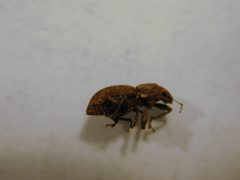
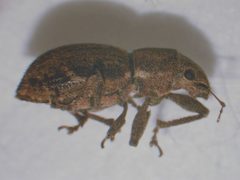
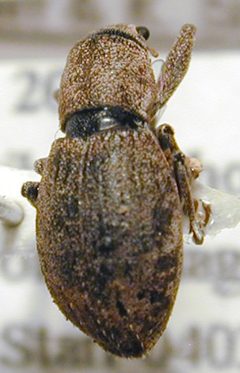
Distinguished from other Naupactus by its uniformly grayish-brown coloration and the characteristic white fringe of setae along the elytral margins. May be confused with Naupactus leucoloma (white-fringed weevil), which shares the fringed but typically shows more contrasting light and dark patterning. N. cervinus is generally more uniformly colored. The flightless condition and parthenogenetic are diagnostic at the level in introduced ranges, though these traits require laboratory confirmation. In the native South American range, identification to species level requires examination of genitalia and comparison with closely related species in the N. cervinus .
Images
Appearance
A medium-sized broad-nosed weevil with a relatively slender, elongate body form. are typically grayish-brown to brown in coloration. The exhibits in body shape: females are broader and more robust, while males (rarely if ever encountered in introduced ) are narrower. Like other Naupactus species, it possesses a distinct white fringe of setae along the outer margin of the , a characteristic feature of the . The rostrum is relatively short and broad compared to many other weevil groups. Adults are flightless, with reduced or absent metathoracic wings.
Habitat
Native occur in the Paranaense forest, Atlantic Forest, and Argentine Plains ecoregions of South America. Introduced populations thrive in diverse environments including agricultural areas, orchards, nurseries, and urban gardens. In the United States, established populations have been documented in Florida, Georgia, California (Tulare and Kern counties in the Central Valley), and at least 27 additional states. The shows remarkable environmental , capable of establishing in areas previously considered climatically unsuitable.
Distribution
Native to South America: Argentina (Buenos Aires, Córdoba, Corrientes, Entre Ríos, Mendoza, Misiones, Tucumán, Jujuy), Brazil (Paraná, Rio Grande do Sul, Santa Catarina). Introduced and established worldwide: continental United States (first reported 1879, now in at least 30 states), Hawaii, Australia, New Zealand, Pacific Islands (French Polynesia, Azores: Corvo, Faial, Flores, Graciosa, Pico), Europe, and Chile/Easter Island. The continental United States may serve as a secondary source for introductions to other regions.
Diet
Highly ; feeds on fruit trees, citrus crop roots, ornamental plants, and legumes. -specific patterns have been documented: individuals feeding on legumes show up-regulated immune defense, detoxification, and host detection genes compared to those feeding on other hosts. The exhibits transcriptional plasticity that allows to diverse plant defenses.
Host Associations
- fruit trees - feeds onprimary in agricultural settings
- citrus crops - feeds on rootssignificant economic impact
- ornamental plants - feeds onimportant in nursery trade
- legumes - feeds ontriggers distinct patterns
- Oestrophasia (Diptera: Tachinidae) - offirst dipteran reported for this ; found in Argentina
- Microctonus (Hymenoptera: Braconidae) - ofmultiple identified; shares wNau5 strain with , suggesting potential
Life Cycle
Reproduces via obligate (thelytoky). Males have never been detected in any introduced , and is believed to have ceased approximately 70 years ago even in the native range. The flightless condition (aptery) restricts to and human-mediated transport. All populations are infected with the endosymbiont pipientis, specifically the wNau5 strain. Demographic advantages of parthenogenesis include the ability of a single virgin female to found a new population.
Behavior
Flightless; disperses by or human-mediated transport. Capable of modifying regimes in response to stressful situations and plant defenses. Shows transcriptional plasticity with -specific expression patterns. Can establish in areas of unsuitable environmental conditions due to general-purpose . When disturbed, may drop from vegetation and feign death. Larvae are soil-dwelling and feed on roots.
Ecological Role
Agricultural pest causing severe economic losses in fruit production and ornamental plant industries. laid on fruit create barriers for export to East Asian markets, resulting in rejected shipments and trade restrictions. As an , it can degrade functions and services in invaded areas. Serves as for and flies that are under investigation for potential.
Human Relevance
Major economic pest of citrus, stone fruits, and ornamental plants. regulations in Japan and other East Asian markets reject fruit with visible weevil , causing significant export losses. Subject to ongoing research, including investigation of (Microctonus spp.) and flies (Oestrophasia spp.) from its native range. Management in agricultural settings relies on monitoring, , and applications. The ' parthenogenetic and genetic uniformity make it a model for studying invasion and general-purpose .
Similar Taxa
- Naupactus leucolomaAlso called white-fringed weevil; shares fringed and South American origin. N. leucoloma typically shows more contrasting light and dark elytral patterning, while N. cervinus is more uniformly grayish-brown. Both are in North America and .
- Naupactus xanthographusSouth American fruit tree weevil in the same ; similar associations and native range. N. xanthographus has distinct yellowish markings and is not parthenogenetic; males are common. Not established in North America.
- Pantomorus cervinusHistorically confused due to similar names and weevil ; distinct in Curculionidae with different geographic distribution and .
More Details
Genetic uniformity
A 2023 study of 71 specimens from 13 localities across Georgia, Florida, and California found that 97% carried the same prevalent invader (B-V or B-VII) previously identified worldwide. This extreme genetic depauperation, combined with , may actually facilitate invasion success by maintaining linkage of adaptive genetic variants.
Wolbachia infection
All harbor the endosymbiont pipientis (wNau5 strain). The shared Wolbachia strain with its braconid Microctonus raises questions about parasitoids as vehicles for of this bacterium.
Taxonomic history
Until 1995, this and related Naupactus were placed in the Graphognathus based on reduced humeri and flightlessness. Lanteri and Marvaldi (1995) synonymized Graphognathus with Naupactus, deeming these characters insufficient for generic distinction.
Sources and further reading
- BugGuide
- Wikipedia
- GBIF taxonomy match
- NCBI Taxonomy
- Catalogue of Life
- Curculionidae | Beetles In The Bush | Page 3
- An Inordinate Fondness #9 | Beetles In The Bush
- Anthribidae | Beetles In The Bush
- An Inordinate Fondness | Beetles In The Bush
- New host-parasitoid interactions in Naupactus cervinus (Coleoptera, Curculionidae) raise the question of Wolbachia horizontal transmission
- Genetically Depauperate and Still Successful: Few Multilocus Genotypes of the Introduced Parthenogenetic Weevil Naupactus cervinus (Coleoptera: Curculionidae) Prevail in the Continental United States