
Cionus
Clairville, 1798
Target Weevils
Species Guides
1- Cionus scrophulariae(Common Figwort Weevil)
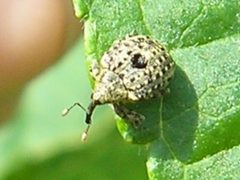
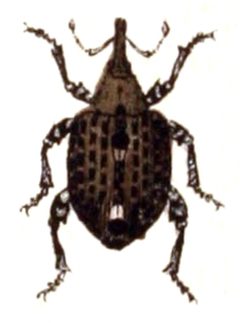
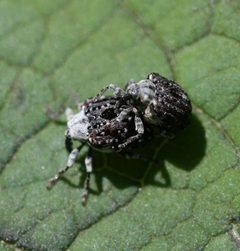
Cionus is a of weevils in the Curculionidae, tribe Cionini, established by Clairville in 1798. The genus is distributed across the Palaearctic, Afrotropical, and Oriental regions, with over 100 recognized including 61 Palaearctic and 52 Afrotropical species. Several species are associated with plants in the family Scrophulariaceae, particularly genera Scrophularia and Verbascum.
Pronunciation
How to pronounce Cionus: //ˈsaɪ.oʊ.nəs//
These audio files are automatically generated. While they are not always 100% accurate, they are a good starting point.
Images
Distribution
Palaearctic region; Afrotropical region including continental subregions and Madagascar; Oriental region
Diet
Several feed on plants in the Scrophulariaceae; Cionus hortulanus has been observed feeding on both Scrophularia and Verbascum; Cionus olivieri is associated with Verbascum songaricum; Cionus meleagris is associated with Dolichandrone falcata (Bignoniaceae)
Host Associations
- Scrophularia nodosa - plantfor Cionus scrophulariae and Cionus tuberculosus
- Verbascum nigrum - plantfor Cionus hortulanus
- Verbascum songaricum - plantfor Cionus olivieri
- Dolichandrone falcata - plantfor Cionus meleagris
- Scrophularia - plant for multiple
- Verbascum - plant for multiple
Life Cycle
Cionus meleagris has a total developmental period from to of 22–33 days under laboratory conditions; larvae have been described for some with diagnostic features including reduced numbers of setae on the epicranium and epipharyngeal lining, and dentate or angulate internally near the base
Behavior
Cionus scrophulariae and Cionus tuberculosus exhibit -dependent rates between plant patches; rates differ between due to different movement rates in small patches; Cionus hortulanus sequesters iridoid glycosides (aucubin and catalpol) from host plants with patterns dependent on local host plant
Similar Taxa
- StereonychusOther in tribe Cionini; larvae share diagnostic features including one-segmented labial palpi, absent labral rods, swollen pedal areas forming large lobes or , and reduced numbers of epipharyngeal setae
- MecininiHypothesized sister tribe to Cionini; larvae have been compared in morphological studies but differ in setal patterns and other features
Sources and further reading
- BugGuide
- Wikipedia
- GBIF taxonomy match
- iNaturalist taxon
- NCBI Taxonomy
- Catalogue of Life
- Atopopsyllus-cionus - Entomology Today
- Atopopsyllus cionus Archives - Entomology Today
- New Flea Genus and Species Found in 20-million-year-old Amber
- Host Dependent Iridoid Glycoside Sequestration Patterns in Cionus hortulanus
- Revision of Palaearctic species of the genus Cionus Clairville (Coleoptera: Curculionidae: Cionini)
- A TAXONOMIC REVISION OF THE AFROTROPICAL SPECIES OF THE WEEVIL GENUS CIONUS (COLEOPTERA: CURCULIONIDAE)
- Description and biological notes of the larva of Cionus olivieri Rosenschoeld, 1838 (Coleoptera, Curculionidae), with a comparison with other species of the tribe Cionini
- What shapes local density? The importance of migration rates and local growth for density‐patch size relationships in two Cionus weevils
- Redescription and Life History Characteristics of <i>Cionus meleagris</i> Marshall (Coleoptera: Curculionidae) on its Host Plant, <i>Dolichandrone falcata</i> (Wall. Ex DC.) Seem
- A Taxonomic Revision of the Genus Cionus (Coleoptera, Curculionidae) from the Oriental Region.