
Mecinini
Genus Guides
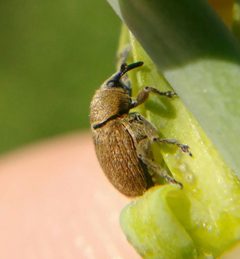
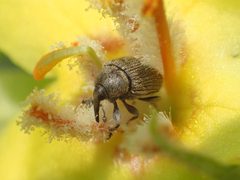
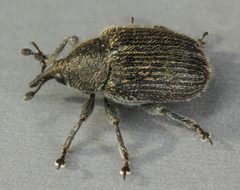
3Mecinini is a tribe of true weevils (Curculionidae: Curculioninae) comprising six : Cleopomiarus, Gymnetron, Mecinus, Miarus, Rhinumiarus, and Rhinusa. The tribe is distributed across the Palaearctic, Afrotropical, and Neotropical regions, with most diversity in the Palaearctic. are specialized herbivores, primarily associated with Campanulaceae, Scrophulariaceae, and Plantaginaceae. Several species have been introduced to North America as agents for toadflax (Linaria spp.).
Pronunciation
How to pronounce Mecinini: /mɛ.sɪˈniː.niː/
These audio files are automatically generated. While they are not always 100% accurate, they are a good starting point.
Identification
Larvae of Miarus possess a diagnostic maxillary mala with six finger-like marginal setae (dms) of two distinct sizes—one or two very long and the remainder medium length—a feature apparently unique among weevils. Larvae of Rhinusa are distinguished by: indistinct pronotal shield; small or thoracic prodorsal fold; high abdominal postdorsal folds (often conical on segments III–VII); abdominal densely covered with asperities and lacking dark pigmentation; suboval ; usually with two anterolateral setae (als); short or absent dorsal epicranial setae 1 (des1); and usually absent or minute frontal setae 1–3 (fs1-3). Pupae of Rhinusa exhibit: stout body; head protuberances always present; pronotal protuberances (when present) wider than high and separated at bases; usually present wide or round abdominal protuberance; usually with single femoral seta (fes); and short or vestigial urogomphi.
Images
Habitat
occupy dry, warm including fields, land, roadsides, gravel pits, moors, rock , sunny thickets, pastures, sunlit slopes, sandbars, and uncultivated strips between fields. Larvae develop within plant tissues: roots, shoots, leaves, flowers, and seed capsules.
Distribution
Palaearctic region: Cleopomiarus, Gymnetron, Mecinus, Miarus, Rhinusa. Afrotropical region: Cleopomiarus, Gymnetron; Mecinus pascuorum recorded from South Africa. South America: Rhinumiarus only. Introduced : Rhinusa neta in United States (1937) and Canada (1957) for .
Diet
Herbivorous; larvae feed internally on plant tissues causing organ swelling or gall formation. Rhinusa neta larvae consume seeds inside seed capsules of Linaria . Cleopomiarus and Miarus species feed exclusively on Campanulaceae. Mecinus species associate with Plantaginaceae. Gymnetron and Rhinusa species occur on both Scrophulariaceae and Plantaginaceae.
Host Associations
- Campanula - Cleopomiarus, Miarus (Palaearctic)
- Jasione - Cleopomiarus, Miarus
- Phyteuma - Cleopomiarus, Miarus
- Roella - Cleopomiarus (Afrotropical)
- Wahlenbergia - Cleopomiarus (Afrotropical)
- Lobelia - Cleopomiarus (Afrotropical, Lobelioideae)
- Linaria vulgaris - Rhinusa neta, R. antirrhini, R. pilosa
- Linaria dalmatica - Rhinusa neta (primary in North America)
- Linaria genistifolia - Rhinusa neta
- Linaria repens - Rhinusa neta
- Linaria spuria - Rhinusa neta
- Antirrhinum orontium - Rhinusa neta
- Antirrhinum majus - Rhinusa neta
- Veronica - Mecinus
Life Cycle
Development from to in Rhinusa neta requires approximately 60 days under standard conditions: egg period 11 days, larval period 29 days, pupal period 18 days. Adults active May–August in temperate regions. Larvae develop inside plant organs (roots, shoots, leaves, flowers, seed capsules). Mature larvae (L3) and pupae described with detailed chaetotaxy for multiple .
Behavior
Larvae induce swelling or gall formation in plant organs. Some Rhinusa act as in galls produced by other Rhinusa species. When Rhinusa neta and R. antirrhini co-occur on Linaria, seed losses may reach 90%. R. neta larval feeding does not cause seed swelling, unlike R. antirrhini.
Ecological Role
Herbivores and gall-formers on Campanulaceae, Scrophulariaceae, and Plantaginaceae. Some function as in galls. Rhinusa neta and related species serve as agents for toadflax in North America. Larvae parasitized by Chalcidoidea hymenopterans.
Human Relevance
Rhinusa neta introduced to United States (1937) and Canada (1957) for of toadflax (Linaria vulgaris, L. dalmatica). R. antirrhini also established in North America for same purpose. These introductions represent deliberate use of Mecinini to manage agricultural and rangeland weeds.
Similar Taxa
- TychiiniBoth tribes belong to Curculioninae and share similar body plans; distinguished by larval (Mecinini: Miarus with unique maxillary mala structure; Rhinusa with indistinct pronotal shield and conical abdominal ) and phylogenetic characters
- Other Curculioninae tribesMecinini larvae lack the distinct pronotal shield and pigmented seen in many related tribes; pupal characters including urogomphi shape and setal patterns provide additional separation
Sources and further reading
- BugGuide
- Wikipedia
- iNaturalist taxon
- NCBI Taxonomy
- ON RECENTLY COLLECTED SOUTH AFRICAN TYCHIINI AND MECININI, WITH DESCRIPTION OF SEVEN NEW SPECIES (COLEOPTERA, CURCULIONIDAE)
- The morphology of the preimaginal stages of Rhinusa neta (Germar, 1821) and notes on its biology (Coleoptera, Curculionidae, Mecinini)
- Morphological characters of immature stages of Palaearctic species of Cleopomiarus and Miarus and their systematic value in Mecinini (Coleoptera, Curculionidae, Curculioninae)
- Comparative analysis of phenolic profiles of ovipositional fluid of Rhinusa pilosa (Mecinini, Curculionidae) and its host plant Linaria vulgaris (Plantaginaceae)
- Description of immature stages of Rhinusa species (Coleoptera, Curculionidae, Mecinini) with a focus on diagnostic morphological characters at the species and genus levels
- Figure 8 from: Ścibior R, Łętowski J (2018) The morphology of the preimaginal stages of Rhinusa neta (Germar, 1821) and notes on its biology (Coleoptera, Curculionidae, Mecinini). ZooKeys 807: 29-46. https://doi.org/10.3897/zookeys.807.28365
- Figure 5 from: Ścibior R, Łętowski J (2018) The morphology of the preimaginal stages of Rhinusa neta (Germar, 1821) and notes on its biology (Coleoptera, Curculionidae, Mecinini). ZooKeys 807: 29-46. https://doi.org/10.3897/zookeys.807.28365
- Figure 6 from: Ścibior R, Łętowski J (2018) The morphology of the preimaginal stages of Rhinusa neta (Germar, 1821) and notes on its biology (Coleoptera, Curculionidae, Mecinini). ZooKeys 807: 29-46. https://doi.org/10.3897/zookeys.807.28365
- Figure 1 from: Ścibior R, Łętowski J (2018) The morphology of the preimaginal stages of Rhinusa neta (Germar, 1821) and notes on its biology (Coleoptera, Curculionidae, Mecinini). ZooKeys 807: 29-46. https://doi.org/10.3897/zookeys.807.28365
- Figure 4 from: Ścibior R, Łętowski J (2018) The morphology of the preimaginal stages of Rhinusa neta (Germar, 1821) and notes on its biology (Coleoptera, Curculionidae, Mecinini). ZooKeys 807: 29-46. https://doi.org/10.3897/zookeys.807.28365