
Hyperaspis pleuralis
Casey, 1899
Side-spotted Sigil Lady Beetle
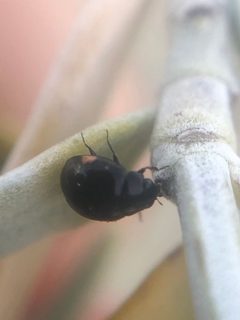
Hyperaspis pleuralis is a small lady beetle native to western North America, measuring 1.95–2.85 mm in length. Males are distinguished by yellow coloration on the lateral and anterolateral areas of the pronotum. The exhibits typical Hyperaspis : larvae produce a white waxy coating that camouflages them among scale insects while providing protection from and ants. Both larvae and are specialized predators of scale insects, making them valuable agents in natural and ornamental .
Pronunciation
How to pronounce Hyperaspis pleuralis: /haɪˈpɛr.əs.pɪs pluːˈræ.lɪs/
These audio files are automatically generated. While they are not always 100% accurate, they are a good starting point.
Identification
Distinguished from other Hyperaspis by the specific pattern of male pronotal coloration and the single spot configuration on the . The small size (under 3 mm) and western North American distribution help separate it from similar eastern species. Larvae can be distinguished from actual mealybugs by their more rapid movement when disturbed—mealybugs remain sedentary while Hyperaspis larvae amble away quickly.
Images
Appearance
are small beetles, 1.95–2.85 mm in length. The body is predominantly black. Males have yellow markings on the lateral and anterolateral areas of the pronotum. The are entirely black, or bear a single red or yellow spot. Larvae are covered in a dense white waxy secretion produced by glands along the sides of the body, giving them a mealybug-like appearance.
Habitat
Associated with -infested trees and shrubs in arid and semi-arid regions. Found in supporting its scale insect prey, including crapemyrtle, magnolia, and other woody plants.
Distribution
Western North America: recorded from Arizona, California, Nevada, New Mexico, Texas, Oregon, and Utah.
Seasonality
active during warmer months. Larvae develop through summer and autumn, with adults seeking protected sites beneath bark or in leaf litter by early December. Adults return to plants in spring to oviposit.
Diet
Specialized of scale insects (Coccoidea). Larvae consume and stages; feed on all scale life stages. Documented on crapemyrtle bark scale (Acanthococcus lagerstroemiae) and tuliptree scale (Toumeyella liriodendri).
Life Cycle
Complete . laid near colonies hatch into waxy larvae that develop through several instars, consuming thousands of scale individuals. occurs in autumn, with emerging to feed briefly before . No specific details documented for this .
Behavior
Larvae are active that chew holes in sacs to feed on contents. Both life stages hunt among scale colonies. and larvae may consume several thousand scale insects during development. The waxy larval coating reduces risk from ants and other predators that tend scale colonies for honeydew.
Ecological Role
Important natural enemy of scale insects in western North American . agent that suppresses on native and ornamental plants, reducing plant damage and secondary impacts from and stinging insects attracted to honeydew.
Human Relevance
Beneficial insect for in urban and ornamental landscapes. Frequently misidentified as a pest (mealybug) due to larval appearance, leading to unnecessary applications that harm potential. Conservation recommended by avoiding broad-spectrum insecticides on -infested plants.
Similar Taxa
- Hyperaspis spp.Other in share waxy larvae and black-and-red or black-and-yellow coloration; distinguished by specific spot patterns, size, and geographic range
- mealybugs (Pseudococcidae)Larvae are mimics—distinguished by behavioral response to disturbance (rapid movement vs. sedentary) and association with prey rather than plant sap feeding
- Cryptolaemus montrouzieriAnother waxy lady beetle of mealybugs and ; introduced with different coloration (predominantly red with black spots)
Misconceptions
Larvae are commonly mistaken for mealybug pests due to their white waxy covering, leading to destructive applications. The waxy coating is protective, not a sign of plant-feeding pest status.