
Hyperaspis dissoluta
Crotch, 1873
dissolute lady beetle
Hyperaspis dissoluta is a small lady beetle native to western North America. measure 2.0–2.75 mm and are characterized by black with yellow or red markings. The is a specialized of scale insects, with larvae that produce a distinctive white waxy coating for protection. Two are recognized: H. d. dissoluta and H. d. nevadica, differing in size and elytral pattern.
Pronunciation
How to pronounce Hyperaspis dissoluta: //haɪˈpɛrəspɪs dɪˈsɒluːtə//
These audio files are automatically generated. While they are not always 100% accurate, they are a good starting point.
Identification
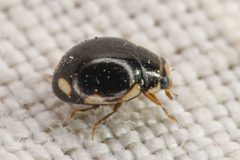
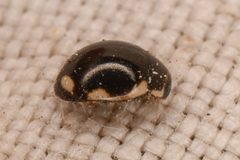
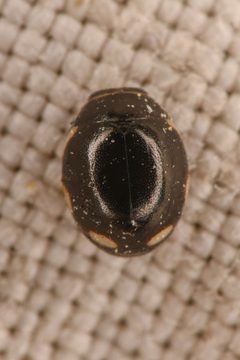
are distinguished from other Hyperaspis by the specific pattern of yellow markings on black . The two differ in size and spot configuration: ssp. dissoluta has a lateral vitta plus spot, while ssp. nevadica has a single elongate spot. Larvae are frequently misidentified as mealybugs due to their white waxy covering; they can be distinguished by their more active when disturbed—larvae move quickly, whereas mealybugs remain sedentary.
Images
Appearance
are small, oval beetles with shiny black . The nominate H. d. dissoluta has a lateral vitta and spot on each elytron, while H. d. nevadica bears a single yellow elongate spot. Males have a yellow lateral border on the pronotum. The pronotal border is black or yellow in ssp. dissoluta. Body length ranges from 2.0–2.75 mm (ssp. dissoluta) to 2.30–3.10 mm (ssp. nevadica). Larvae are covered in dense white wax secreted from lateral glands, giving them a mealybug-like appearance.
Habitat
Associated with trees and shrubs infested with scale insects, particularly crapemyrtle and magnolia. Found in urban and suburban landscapes, parks, and natural areas where plants occur.
Distribution
Western North America: California, Arizona, Nevada, Idaho, Oregon, Washington, and Utah. H. d. dissoluta occurs in California, Idaho, Oregon, and Washington; H. d. nevadica occurs in Nevada, Arizona, California, Idaho, Utah, and Washington.
Seasonality
are active from spring through autumn. Larvae develop through summer, pupate in autumn, and adults emerge before winter. Adults overwinter in protected locations beneath bark or in leaf litter, returning to plants in spring to reproduce.
Diet
Specialized of scale insects (Coccoidea). Larvae consume and stages; feed on adult scales. Documented prey includes crapemyrtle bark scale (Acanthococcus lagerstroemiae) and tuliptree scale (Toumeyella liriodendri).
Host Associations
- Acanthococcus lagerstroemiae - preycrapemyrtle bark scale
- Toumeyella liriodendri - preytuliptree scale
- Lagerstroemia - crapemyrtle plant
- Magnolia - magnolia plant
Life Cycle
are laid in spring on or near -infested plants. Larvae hatch and feed on scale insects, producing waxy secretions for protection. Larvae pass through four instars, consuming thousands of scale individuals during development. occurs on the plant or in nearby protected locations. emerge in late summer to autumn, feed briefly, then seek sites. or partially depending on climate.
Behavior
Larvae are active that move among colonies. When disturbed, larvae amble away quickly— that distinguishes them from sedentary mealybugs. The waxy larval coating appears to deter aggression, allowing larvae to forage in ant-tended scale colonies. are also active hunters, searching bark and foliage for scale prey.
Ecological Role
Important agent of insect . Both larvae and contribute to suppression of pest scales in urban and natural . The waxy larval coating represents an evolutionary to exploit -tended scale resources without triggering ant defensive .
Human Relevance
Beneficial insect for biological pest control. Frequently misidentified and killed due to larval resemblance to mealybugs. Conservation is encouraged in programs for crapemyrtle and other ornamental plants. No negative impacts documented.
Similar Taxa
- Hyperaspis spp.Other in share black-and-spotted color pattern; distinguished by specific configuration of elytral markings and geographic range
- Mealybugs (Pseudococcidae)Larvae are mimics—distinguished by active movement when disturbed and presence on -infested plants rather than feeding directly on plant tissue
- Other CoccinellidaeMany lady beetles have spotted patterns; Hyperaspis distinguished by small size, specific spot arrangement, and association with scale insects
Misconceptions
Larvae are commonly mistaken for mealybugs or other plant pests and killed with . This is a harmful misconception—proper identification reveals them as beneficial that should be conserved.
More Details
Subspecies differentiation
H. d. dissoluta (Crotch, 1873) and H. d. nevadica (Casey, 1899) show consistent differences in body size and elytral pattern that may reflect to different plants or climatic conditions across their ranges.
Wax production function
The white waxy coating of larvae is produced by specialized glands along the body sides. This secretion chemically and physically resembles the waxy coverings of mealybugs and scale insects, providing camouflage and protection from aggression when foraging in ant-tended colonies.