
Hyperaspis disconotata
Mulsant, 1850
disk-marked lady beetle
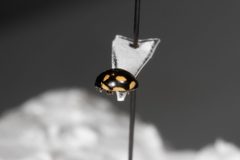
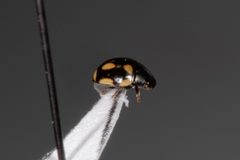
Hyperaspis disconotata, commonly known as the disk-marked lady , is a small predatory beetle in the Coccinellidae. measure approximately 2.30–2.80 mm in length and are characterized by five yellow spots on the . The is native to North America, with records from Alberta, Quebec, Massachusetts, Minnesota, New York, and Wisconsin. As a member of the Hyperaspis , it is a specialized of scale insects, contributing to of these plant pests.
Pronunciation
How to pronounce Hyperaspis disconotata: /ˌhaɪpəˈræspɪs ˌdɪsˌkɒnəˈteɪtə/
These audio files are automatically generated. While they are not always 100% accurate, they are a good starting point.
Identification
can be distinguished from other small lady beetles by the specific pattern of five yellow spots on the . The small size (under 3 mm) helps separate it from larger Coccinellidae. Larvae are frequently misidentified as mealybugs due to their white waxy coating; they can be distinguished by their more active when disturbed—larvae move quickly, whereas mealybugs remain relatively stationary. The waxy covering also serves as a defense against aggression, unlike the waxy secretions of true scale insects which are primarily protective coverings.
Images
Appearance
are small beetles, 2.30–2.80 mm in length. The bear five distinct yellow spots. The overall body coloration is dark with contrasting pale markings. Larvae produce a conspicuous white waxy coating from glands along their sides, giving them a mealy or woolly appearance that superficially resembles mealybugs or scale insects.
Habitat
Associated with trees and shrubs infested with scale insects, particularly magnolia and crapemyrtle. and larvae are found on bark and branches where insect colonies establish. adults seek protected locations beneath bark or in leaf litter.
Distribution
North America. Documented from Alberta and Quebec in Canada, and from Massachusetts, Minnesota, New York, and Wisconsin in the United States. GBIF records also indicate presence in Manitoba and New Brunswick, Canada.
Seasonality
are active during spring and summer, laying on -infested plants. Larval development occurs through summer and autumn, with adults emerging in late autumn. Adults overwinter in protected locations and return to plants the following spring.
Diet
Specialized of scale insects (Coccidae). Larvae feed on and scale within waxy egg sacs. continue to consume scale insects. A single larva may consume several thousand immature scale insects during development.
Host Associations
- crapemyrtle bark scale - preyAcanthococcus lagerstroemiae; significant prey item in eastern North America
- tuliptree scale - preyToumeyella liriodendri; documented prey on magnolia
Life Cycle
Complete with , larva, pupa, and stages. Eggs are laid on -infested trees in spring. Larvae develop through summer, feeding actively on scale insects while concealed beneath their waxy coating. occurs in autumn, with adults emerging to feed briefly before seeking sites. Adults overwinter in bark crevices or leaf litter, becoming active again in spring to mate and oviposit.
Behavior
Larvae exhibit rapid escape when disturbed, unlike the sedentary mealybugs they resemble. Both larvae and are active , with larvae chewing holes in sacs to consume contents. The waxy larval coating appears to deter , allowing larvae to forage in ant-tended scale colonies. Adults and larvae are and visible on bark surfaces when scale are abundant.
Ecological Role
Important agent of insect . By preying on eruptive scale insect pests, Hyperaspis disconotata helps regulate herbivore populations and reduce plant damage. The contributes to natural suppression of crapemyrtle bark scale, an pest in eastern North America. Consumption of scales also reduces honeydew production and subsequent growth, indirectly benefiting plant health.
Human Relevance
Beneficial insect for horticulture and urban forestry. Provides natural of pests on ornamental trees and shrubs, reducing need for applications. Frequently misidentified and inadvertently killed due to larval resemblance to mealybugs. Conservation of this is encouraged by avoiding broad-spectrum insecticides on scale-infested plants.
Similar Taxa
- mealybugs (Pseudococcidae)Larvae covered in white wax, superficially resembling mealybugs; distinguished by active movement when disturbed and predatory
- crapemyrtle bark scale (Acanthococcus lagerstroemiae)Larvae resemble the white waxy sacs and coverings of this insect; distinguished by mobility and predatory mouthparts
- other Hyperaspis speciesSimilar size, , and ; spot patterns vary among , with H. disconotata specifically having five yellow spots
Misconceptions
Larvae are commonly mistaken for mealybugs or insect pests and are inadvertently killed by applications targeting these pests. The white waxy coating is protective camouflage, not a sign of plant-feeding pest status.
More Details
Conservation importance
This exemplifies the value of accurate insect identification in . Its effectiveness against crapemyrtle bark scale, an pest spreading in eastern North America, makes it a significant natural enemy worth protecting.
Taxonomic note
The specific epithet 'disconotata' refers to the spotted or marked disk () pattern. The was described by Mulsant in 1850.