
Tenebroides mauritanicus
(Linnaeus, 1758)
cadelle, cadelle beetle
, the , is a stored-product pest in the Trogossitidae. are exclusively , feeding on other insects including flour beetles and false powderpost beetles, while larvae consume grain products and transition to predatory as they develop. The is notable for its longevity, with adults surviving over 50 days and larvae over 120 days without food. It is the only member of Trogossitidae known to infest stored grain, causing significant damage through both direct feeding and by gnawing holes in packaging that expose food to other pests.
Pronunciation
How to pronounce Tenebroides mauritanicus: /tɛnɛˈbrɔɪdiːz ˌmɔːrɪˈtænɪkəs/
These audio files are automatically generated. While they are not always 100% accurate, they are a good starting point.
Identification
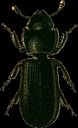
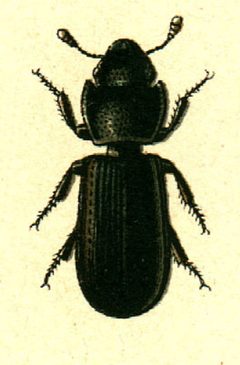
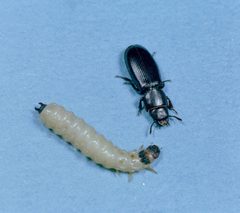
measure 6–12 mm in length with a slightly flattened, elongated body resembling a carabid . The body is shiny black or dark brown with reddish brown legs and . The is disproportionately large with broad temples behind nearly flattened . The head and pronotum are coarsely punctured. A deep constriction separates the head from the . Prominent sharp claws are adapted for biting and gnawing. Larvae can reach 20 mm in length.
Images
Habitat
Primarily ; found in storehouses, granaries, flour factories, and storage facilities. overwinter in wood boards and sawdust. Less commonly encountered in wild .
Distribution
Probably originated in North Africa; now through human via exported grain products and dunnage. Present in Europe (likely since Roman times), Turkey (Bursa Province), China (Fujian Province), the Azores (Faial, São Miguel, Terceira), Serbia, and Austria.
Seasonality
First emerge in early June under natural conditions in temperate regions. Overwinters as adults or larvae.
Diet
Larvae feed on stored foods including nuts, grains, dried fruit, soybeans, and corn; juveniles transition to live animal prey as they develop. are exclusively , preying on other insects including Tribolium (flour beetles), Rhyzopertha (false powderpost beetles), and sometimes adults.
Life Cycle
Females lay approximately 1000 in groups of about 50, loosely placed among food products. Eggs hatch in 4–10 days depending on temperature. Larvae pass through 5 instars with development averaging 171 days on grain (range 67–342 days total for one ). Pupal stage averages 12 days. Preoviposition period averages 15 days. Sex ratio is 2 females:1 male. Overwinters as in wood cavities or as larvae.
Behavior
Can survive extended periods without food: over 50 days, larvae over 120 days. Adults bore into wood to create cavities. Larval of food products through peeling activity and . Adults use sharp claws to gnaw holes in packaging materials.
Ecological Role
Stored-product pest with destructive impact on grain commodities. facilitate secondary by other pest through packaging damage.
Human Relevance
Significant economic pest of stored grain and food products; larvae destroy soft parts of wheat and oats, while damage packaging and bore into wood structures. Larvae historically infested ships' biscuits, earning the nickname "bargemen" from sailors.
Similar Taxa
- Carabidae (ground beetles) resemble carabids in general body form; distinguished by large with broad temples, deep neck constriction, and association.
- Tribolium spp. (flour beetles)Co-occurs in stored grain; distinguished by larger size (6–12 mm vs. 3–4 mm), diet, and ability to bore into wood.