
Tenebroides
Piller & Mitterpacher, 1783
Cadelles
Species Guides
16- Tenebroides americanus
- Tenebroides bimaculatus
- Tenebroides collaris(bark-gnawing beetle)
- Tenebroides corticalis(Twisted Bark-gnawing Beetle)
- Tenebroides crassicornis
- Tenebroides floridanus
- Tenebroides laticollis
- Tenebroides marginatus
- Tenebroides mauritanicus(cadelle)
Tenebroides is a of bark-gnawing beetles in the Trogossitidae, containing at least 20 described . The genus includes both native forest-dwelling species and economically significant stored product pests. (the ) is the most extensively studied species, being a major pest of stored grain worldwide. Other species such as T. collaris occur in natural including bark and decaying wood.
Pronunciation
How to pronounce Tenebroides: /tɛˈnɛbrɔɪˌdiːz/
These audio files are automatically generated. While they are not always 100% accurate, they are a good starting point.
Identification
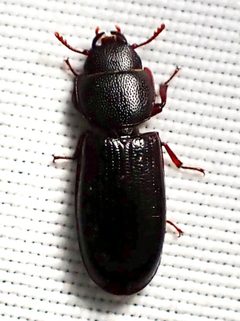
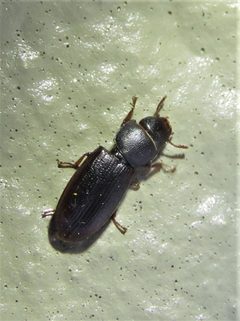
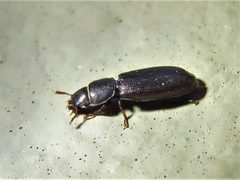
are elongate, somewhat flattened beetles with a and prominent . The body form is characteristic of Trogossitidae, with that may be or smooth depending on . Larvae are elongate and somewhat flattened with well-developed legs, differing from the often legless or reduced-legged larvae of many other . Specific identification to species level requires examination of genitalia and other microscopic characters.
Images
Habitat
varies by : T. mauritanicus occurs in stored grain facilities, flour factories, and warehouses; T. collaris and related species inhabit bark, decaying wood, and forest litter. T. mauritanicus overwinters in wood boards and sawdust within storage structures.
Distribution
The has a broad distribution. T. mauritanicus originated in Africa and has spread to high temperate and cold zones worldwide, including China (Fujian Province) and Turkey (Bursa Province). T. collaris occurs in North America with documented records from Montana, USA. Distribution records from GBIF indicate presence in Denmark, Norway, and Sweden.
Seasonality
T. mauritanicus emerge beginning of June under natural conditions in Turkey. occurs as adults (primarily) or larvae. Activity patterns in storage facilities are continuous year-round due to controlled conditions.
Diet
T. mauritanicus feeds on grain, soybean, and corn in storage. Larvae feed on these stored products and produce peeling and that contaminate food. Diet of other Tenebroides in natural is poorly documented but likely includes fungi, other insects, and decaying organic matter based on -level patterns.
Life Cycle
T. mauritanicus: hatch in approximately 4 days; larvae pass through 5 instars with mean development of 171 days on grain; pupal stage averages 12 days; preoviposition period averages 15 days; total development averages 206 days (range 67–342 days) for one . as or larvae. Sex ratio female:male 2:1. Other : details not documented.
Behavior
T. mauritanicus and larvae both occur in storage environments. Larvae produce peeling and fecal of stored products. Adults are attracted to , which has been used for collection and monitoring.
Ecological Role
T. mauritanicus is an important storage pest with significant destructive power, causing food and economic damage in grain storage systems. Native forest-dwelling likely function as , fungivores, or saprophages in dead wood and bark , though specific ecological roles are undocumented.
Human Relevance
T. mauritanicus () is a significant stored product pest of international importance, infesting grain, flour, and other stored commodities. It causes direct damage through feeding and indirect damage through with and cast skins. The is subject to pest management in food storage and processing facilities. Other Tenebroides species have no documented economic impact.
Similar Taxa
- ByturusPhylogenetically closest to T. mauritanicus based on mitochondrial analysis; both belong to Cleroidea but in different (Trogossitidae vs. Byturidae)
- Other TrogossitidaeShare bark-gnawing habits and elongate body form; require genitalia examination for definitive separation
Sources and further reading
- BugGuide
- Wikipedia
- GBIF taxonomy match
- iNaturalist taxon
- NCBI Taxonomy
- Catalogue of Life
- Studies on the Biology and Distribution of Cadelle, Tenebroides mauritanicus (L.) (Coleoptera: Trogossitidae) in Bursa, Turkey
- The Bark-Gnawing Beetles of Montana, USA (Coleoptera: Trogossitidae, Peltidae, and Lophocateridae), Including New Substantial Distributional Records for Tenebroides collaris (Sturm)
- The complete mitochondrial genome of Tenebroides mauritanicus Linnaeus, 1758 (Coleoptera: Trogossitidae).