
Tarsostenus
Spinola, 1845
checkered beetles
Species Guides
1Tarsostenus is a of small checkered beetles in the Cleridae, established by Spinola in 1845. The genus comprises six described distributed across Papua New Guinea, New Caledonia, and Australia, with one species (T. univittatus) being in distribution. Members are specializing on wood-boring beetles, particularly bostrichids and anobiines. The genus is characterized by distinctive morphological features including an oblong pronotum with glabrous streaks and with ten rows of punctations.
Pronunciation
How to pronounce Tarsostenus: /tɑrˈsɒstɛnəs/
These audio files are automatically generated. While they are not always 100% accurate, they are a good starting point.
Identification
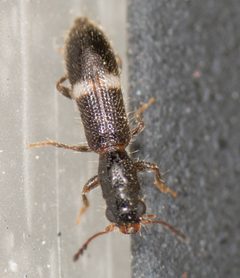
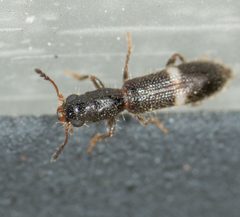
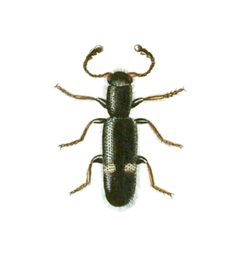
Distinguished from other clerid by the combination of: oblong pronotum with glabrous discal streaks and absence of lateral ; ten rows of elytral punctations; and unguis without denticle. The transverse white elytral band present in several provides additional visual cue. Size range (3.5–8.0 mm) and slender oblong body form separate it from more robust or rounded clerid genera.
Images
Appearance
Oblong beetles measuring 3.5–8.0 mm in length and 1.0–2.0 mm in width. Pronotum distinctly oblong with glabrous streaks on the disc and lacking lateral . Elytral disc bears ten rows of punctations. Unguis (claw) lacks a denticle. Several exhibit a transverse white band positioned halfway along the .
Habitat
Associated with wood-boring in timber and wooden structures. Documented from lumber and furniture derived from multiple tree including ash, hickory, persimmon, white oak, pecan, Cercis siliquastrum, Corymbia maculata, Ficus retusa, Schinus terebinthifolius, and Triplochiton sclerodendron. T. hilaris collected from Eucalyptus trees. T. kanak collected from rainforest vegetation.
Distribution
Papua New Guinea (T. antehelvis); New Caledonia (T. bicolor, T. kanak, T. tricolor); Australia (T. hilaris); (T. univittatus). GBIF records indicate presence in Northern Europe and Southern Europe.
Diet
on wood-boring beetles. T. univittatus preys on bostrichids including Lyctus, Sinoxylon, Xylobiops, and Trogoxylon, as well as anobiines. T. hilaris associated with cerambycid-infested Eucalyptus.
Host Associations
- Lyctus - preybostrichid wood-borer
- Sinoxylon - preybostrichid wood-borer
- Xylobiops - preybostrichid wood-borer
- Trogoxylon - preybostrichid wood-borer
- anobiines - preywood-boring beetles
- cerambycids - preylonghorn beetles, associated with T. hilaris on Eucalyptus
Behavior
Predatory targeting wood-boring beetles. T. univittatus has been found in borer-infested lumber and wooden furniture, indicating active searching or of infested wood. T. kanak collected by beating vegetation, suggesting at least some may be found in foliage.
Ecological Role
of wood-boring beetles, potentially functioning as a agent in timber and wooden products. May help regulate of economically significant pests including powderpost beetles (Lyctus spp.) and furniture beetles.
Human Relevance
T. univittatus has documented presence in commercial lumber and wooden furniture, where it preys on pest beetles. Potential value as a natural biocontrol agent in stored timber and wood products. No documented negative impacts to human interests.
Similar Taxa
- Other Cleridae generaTarsostenus distinguished by unique combination of oblong pronotum with glabrous streaks, ten elytral punctation rows, and denticle-lacking unguis; most other clerids have different pronotal shapes, punctation patterns, or claw
More Details
Taxonomic history
established by Spinola in 1845. Recent revisions by Opitz in 2016 described three new from Papua New Guinea and New Caledonia (T. antehelvis, T. bicolor, T. kanak), expanding the genus from three to six species.
Collection methods
Specimens collected through examination of borer-infested wood and lumber, beating vegetation in rainforest , and from Eucalyptus trees bearing cerambycid beetles.