
Sinoxylon
Duftschmid, 1825
Species Guides
3- Sinoxylon anale(horned powder-post beetle)
- Sinoxylon ceratoniae(horned powder-post beetle)
- Sinoxylon unidentatum(conifer auger beetle)
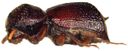
Sinoxylon is a of wood-boring beetles in the Bostrichidae, with a nearly distribution spanning Europe, Africa, Asia, the Americas, and Oceania. in this genus are associated with diverse plants including bamboo, rubber, cassava, and allspice. Several species have been introduced to new regions through international trade in wood packaging materials, with documented establishment in Greece and Brazil.
Pronunciation
How to pronounce Sinoxylon: //sɪˈnɒksɨlɒn//
These audio files are automatically generated. While they are not always 100% accurate, they are a good starting point.
Identification
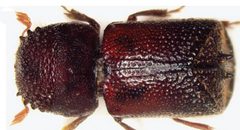
Members of Sinoxylon can be distinguished from other Bostrichidae by their cylindrical body form and association with the tribe Sinoxylini. -level identification requires examination of antennal club structure, pronotal armature, and elytral declivity characteristics. Sinoxylon anale and S. unidentatum are particularly difficult to distinguish and require careful morphological examination.
Images
Habitat
Associated with woody plants and wood products; larvae develop in dead or dying wood, bamboo, and processed timber materials.
Distribution
Native to Europe, the Afrotropical region, the Australian region, the Near East, the Nearctic, the Neotropical region, North Africa, and the Oriental region. Documented occurrences include: Europe (Italy, Poland, Spain, UK, Greece), Asia (China, Hong Kong, India, Indonesia, Israel, Japan, Malaysia, Pakistan, Philippines, Singapore, Sri Lanka, Thailand, Vietnam, Iran), Africa (Kenya, Liberia, Madagascar, Malawi, Mauritius, Reunion, Rodrigues Island, Seychelles, Somalia, Sudan, Tanzania, Togo), North America (Canada, USA - Florida, Hawaii), Central America and Caribbean (Barbados, Belize, Rica, Haiti, Jamaica), South America (Brazil, Venezuela), and Oceania (American Samoa, Australia, New Zealand, Niue).
Diet
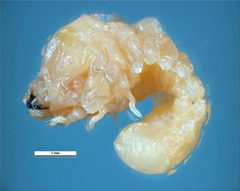
Larvae bore into and feed on wood and woody stems of living, dying, or dead plants. of some have been observed feeding on wood.
Host Associations
- Bambusa - larval major for S. conigerum
- Hevea brasiliensis - larval major for S. conigerum
- Manihot esculenta - larval major for S. conigerum
- Pimenta dioica - larval for S. anale
Life Cycle
Complete with , larval, pupal, and stages. Larvae are wood-borers that tunnel through plant material. Development occurs within the host plant, with adults emerging through exit holes.
Behavior
are capable of and to new materials. Some have been intercepted in international trade, particularly in wood packaging materials, indicating human-mediated dispersal .
Ecological Role
Decomposers of dead and dying wood; some act as pests of living trees and economically important crops. Serve as for associated organisms including mites and fungi.
Human Relevance
Several are economic pests of timber, bamboo products, and agricultural crops including rubber and cassava. Sinoxylon anale and S. unidentatum have been introduced to new regions via international trade and are subject to phytosanitary interception. Documented damage to allspice . Associated with bassiana, a fungal biocontrol agent with potential for management applications.
Similar Taxa
- Other Bostrichidae generaSinoxylon is distinguished by tribal placement in Sinoxylini and specific combinations of antennal and pronotal characteristics; other bostrichid may share cylindrical form but differ in detailed
- DinoderusBoth are bamboo-boring Bostrichidae, but Dinoderus typically have different antennal club structure and are more narrowly associated with bamboo
More Details
Invasion biology
Sinoxylon anale and S. unidentatum are considered almost with likely native origin in the Oriental Region. Their spread to Greece and Brazil demonstrates establishment capacity in new environments following introduction via wood packaging materials.
Associated organisms
Sinoxylon pugnax a specialized mite in the Dolichocybidae in Iran. Sinoxylon anale is associated with the fungus bassiana, which shows against this and potential for .
Sources and further reading
- BugGuide
- Wikipedia
- GBIF taxonomy match
- iNaturalist taxon
- NCBI Taxonomy
- Catalogue of Life
- Sinoxylon conigerum . [Distribution map].
- The Role of Some Factors Affecting Infestation of Certain Host Plants by Sinoxylon sudanicum Lesne Beetle (Coleoptera: Bostrichidae).
- First record of Sinoxylon anale and S. unidentatum in Greece, with an updated account on their global distribution and host plants (Coleoptera: Bostrichidae)
- Characterization and virulence of Beauveria bassiana associated with auger beetle ( Sinoxylon anale ) infesting allspice ( Pimenta dioica )
- Establishment of Sinoxylon anale Lesne (Coleoptera, Bostrichidae) in Brazil: Identification, Host Plants, Distribution, and Damage
- <p><strong>A new species of the family Dolichocybidae Mahunka, 1970 (Acari: Heterostigmata) associated with <em>Sinoxylon pugnax</em> Lesne (Insecta: Coleoptera: Bostrichidae) from Iran</strong></p>