
Sinoxylon anale
Lesne, 1897
horned powder-post beetle, auger beetle
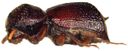
Sinoxylon anale is a wood-boring in the Bostrichidae, commonly known as horned powder-post beetles or auger beetles. The has a broad intercontinental distribution spanning Australia, North America, Southern Asia, and Europe. It develops in dead or dying woody material and has been recorded as a pest in agricultural and nursery settings. Recent studies have documented its establishment in Brazil and first record in Greece, with expanding associations including allspice, jabuticaba, and various native and woody plants.
Pronunciation
How to pronounce Sinoxylon anale: /sɪˈnɒksɪlɒn ˈæneɪl/
These audio files are automatically generated. While they are not always 100% accurate, they are a good starting point.
Identification
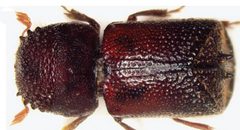
Members of Sinoxylon are distinguished from other Bostrichidae by the presence of paired, horn-like projections on the pronotum in males. Identification to level requires examination of antennal club structure, pronotal armature, and genitalia. S. anale can be separated from the similar S. unidentatum by detailed morphological characters; of the COI gene has been used to confirm identifications in recent studies.
Images
Habitat
Develops in dead branches and woody material; collected in ethanol-baited traps and ultraviolet-light traps. Found in nurseries, plantations, and natural areas with standing or fallen dead wood.
Distribution
Australia; North America; Southern Asia; Europe. Established recorded in Brazil (São Paulo state: Laranjal Paulista and Piracicaba municipalities) and Greece (Piraeus harbor, intercepted in wood packaging from China).
Diet
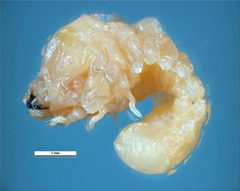
Wood-boring; larvae and develop in dead wood and phloem of plants.
Host Associations
- Pimenta dioica - pestallspice plantations
- Plinia cauliflora - pestjabuticaba; attacks trees after death by Cerambycidae larvae
- Piptadenia gonoacantha - pau-jacaré; dry branches
- Inga vera - inga; dry branches
- Dracaena fragrans - pau-d'água; , dry branches
Life Cycle
Larvae and develop in dead branches of plants. Specific developmental stages and duration not documented in available sources.
Behavior
Probably attacks young trees after they have been killed by other insects, specifically long-horned beetle larvae (Cerambycidae). attracted to ethanol baits and UV light.
Ecological Role
Wood decomposer in dead branches; pest in nursery and plantation settings. Subject to natural biocontrol by fungus bassiana.
Human Relevance
Economic pest of allspice and jabuticaba nurseries. Subject to interceptions in international wood packaging material. Potential with expanding global distribution.
Similar Taxa
- Sinoxylon unidentatumSimilar and distribution; distinguished by antennal club, pronotal armature, and genitalia characters
- Other BostrichidaeSinoxylon males uniquely possess paired horn-like pronotal projections
Sources and further reading
- BugGuide
- Wikipedia
- GBIF taxonomy match
- iNaturalist taxon
- NCBI Taxonomy
- Catalogue of Life
- Bugs and Bees, Bees and Bugs | Bug Squad
- The Making of a Bee Garden at UC Davis | Bug Squad
- Bombyliidae | Beetles In The Bush | Page 2
- Establishment of Sinoxylon anale Lesne (Coleoptera, Bostrichidae) in Brazil: Identification, Host Plants, Distribution, and Damage
- Characterization and virulence of Beauveria bassiana associated with auger beetle ( Sinoxylon anale ) infesting allspice ( Pimenta dioica )
- First record of Sinoxylon anale and S. unidentatum in Greece, with an updated account on their global distribution and host plants (Coleoptera: Bostrichidae)