
Phyllotreta
Chevrolat, 1836
flea beetles
Species Guides
18- Phyllotreta aeneicollis(Bronzy Brassica Flea Beetle)
- Phyllotreta albionica(cabbage flea beetle)
- Phyllotreta armoraciae(Horseradish Flea Beetle)
- Phyllotreta bipustulata(woodland flea beetle)
- Phyllotreta chalybeipennis
- Phyllotreta conjuncta
- Phyllotreta constricta
- Phyllotreta cruciferae(crucifer flea beetle)
- Phyllotreta denticornis
Phyllotreta is a of flea beetles (Chrysomelidae: Alticini) comprising at least 300 described worldwide. Species are almost exclusively associated with plants in Brassicaceae and related in the order Brassicales, with 18% of species feeding on multiple families within this order. Many species are economically significant agricultural pests, particularly of crucifer crops including canola, cabbage, and turnip. The genus has independently colonised Brassicaceae and exhibits adaptations to the characteristic chemical defences (glucosinolates) of these host plants.

Pronunciation
How to pronounce Phyllotreta: /ˌfɪloʊˈtriːtə/
These audio files are automatically generated. While they are not always 100% accurate, they are a good starting point.
Identification
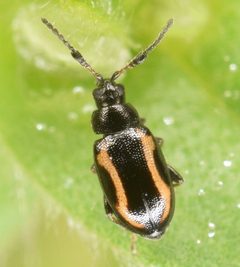
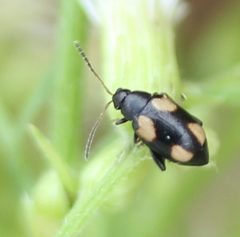
Small beetles, typically black or metallic, with enlarged hind adapted for jumping. Body shape generally elongate-oval. Many exhibit longitudinal stripes or other patterns on . Distinguished from related flea beetle by combination of tarsal formula, antennal structure, and male genitalia characteristics; accurate identification to species level often requires examination of .
Images
Habitat
Agricultural fields, gardens, and natural areas where plants in Brassicaceae and related occur. sites include field margins, shelterbelts, and other protected locations.
Distribution
; recorded across Europe, Asia, North America, and other regions. Specific distribution varies by .
Seasonality
of temperate overwinter and emerge in spring; activity patterns closely tied to plant .
Diet
Specialised feeding on Brassicaceae and related in order Brassicales (Capparaceae, Cleomaceae, Resedaceae, Tropaeolaceae). feed on leaves, often skeletonising tissue; larvae typically feed on roots or leaf petioles depending on .
Host Associations
- Brassicaceae - primary plantsalmost all specialised on this
- Capparaceae - plantsminor for some
- Cleomaceae - plantsminor for some
- Resedaceae - plantsminor for some
- Tropaeolaceae - plantsminor for some
- Microctonus vittatae - braconid of ; parasitised individuals emerge earlier from
Life Cycle
overwinter in protected sites. Spring followed by feeding, mating, and oviposition. Larval development occurs on plants, with feeding location varying by (foliage, roots, or petioles). typically in soil. Multiple per year possible in favourable conditions.
Behavior
jump readily when disturbed, using enlarged hind legs. Some exhibit border- patterns, gradually moving across fields from margins. Parasitised adults have been observed to emerge earlier from sites than unparasitised individuals.
Ecological Role
Herbivores specialised on Brassicaceae; significant agricultural pests reducing crop yields through foliar feeding and larval root damage. Serve as for including Microctonus vittatae.
Human Relevance
Major economic pests of crucifer crops worldwide. P. cruciferae and P. striolata are particularly significant pests of canola/rapeseed, cabbage, turnip, and other Brassicaceae crops. Damage includes skeletonised leaves, stunted growth, and plant death under heavy . Subject of extensive research, including evaluation of neonicotinoid .
Similar Taxa
- PsylliodesBoth are flea beetles (Alticini) associated with Brassicaceae; Phyllotreta colonised Brassicaceae independently and differs in morphological details of tarsal structure and male genitalia
- AlticaBoth are flea beetles with jumping hind legs; Phyllotreta distinguished by specialisation on Brassicaceae and specific morphological characters
Sources and further reading
- BugGuide
- Wikipedia
- GBIF taxonomy match
- iNaturalist taxon
- NCBI Taxonomy
- Occasional Pests - AgriLife Extension Entomology
- The Drugs (Neonicotinoids) Don’t Work 3 - Buglife Blog - Buglife
- Phyllotreta striolata . [Distribution map].
- AN EFFECT OF PARASITISM BY MICROCTONUS VITTATAE (HYMENOPTERA: BRACONIDAE) ON EMERGENCE OF PHYLLOTRETA CRUCIFERAE AND PHYLLOTRETA STRIOLATA (COLEOPTERA: CHRYSOMELIDAE) FROM OVERWINTERING SITES
- Figure 1 from: Gikonyo MW, Biondi M, Beran F (2019) Adaptation of flea beetles to Brassicaceae: host plant associations and geographic distribution of Psylliodes Latreille and Phyllotreta Chevrolat (Coleoptera, Chrysomelidae). In: Schmitt M, Chaboo CS, Biondi M (Eds) Research on Chrysomelidae 8. ZooKeys 856: 51-73. https://doi.org/10.3897/zookeys.856.33724
- Phyllotreta cruciferae . [Distribution map].
- Biology of Phyllotreta (Alticinae), with emphasis on Hungarian and middle European species