
Phyllotreta cruciferae
(Goeze, 1777)
crucifer flea beetle, canola flea beetle, rape flea beetle
is a flea beetle and significant agricultural pest of cruciferous crops, particularly canola, rapeseed, and other Brassica . are small, black, and shiny with enlarged hind adapted for jumping. The species overwinters as adults in leaf litter and topsoil, emerging in early spring to feed on plants. vary by region and year, with one to two annually depending on thermal accumulation.
Pronunciation
How to pronounce Phyllotreta cruciferae: /ˌfɪloʊˈtɹiːtə ˈkɹuːsɪˌfɛriː/
These audio files are automatically generated. While they are not always 100% accurate, they are a good starting point.
Identification
Distinguished from similar flea beetles by its uniform black coloration without stripes or markings; Phyllotreta striolata has distinct longitudinal . The is slightly smaller than some . Jumping when disturbed is diagnostic for the . Examination of genitalia may be required for definitive separation from closely related .
Images
Appearance
are small, black, and shiny beetles approximately 2-3 mm in length. The body is compact and oval. Hind are enlarged, providing the jumping ability characteristic of flea beetles. are short and .
Habitat
Agricultural landscapes dominated by cruciferous crops; sites include leaf litter and the upper 2.5 cm of soil in windbreaks, fencerows, and cultivated areas. are restricted primarily to cruciferous vegetation during the growing season.
Distribution
Europe and Northern Asia (excluding China), North America (Canada and USA). Specific records from Austria, Belgium, Britain, Bulgaria, Czechoslovakia, Denmark, France, Germany, Greece, Hungary, Ireland, Italy, Netherlands, Poland, Portugal, Romania, Spain, Switzerland, Yugoslavia, Cyprus, India, Iran, Iraq, Israel, Jordan, Lebanon, Syria, Turkey, Algeria, Egypt.
Seasonality
emerge from sites in early spring. Peak adult movement occurs shortly after , primarily within 2 m of the ground and oriented toward plants. One to two per year depending on region and thermal conditions; single generation documented in southwestern Ontario in 1974, two generations in 1975.
Diet
Foliage of cruciferous plants ( Brassicaceae). Strong feeding preference for Brassica juncea (Indian mustard) and Sinapis alba (white mustard) among tested seedlings. Also feeds on B. napus, B. oleracea, B. rapa, Raphanus sativus, rutabaga, and Chinese cabbage. preference varies with seedling age.
Host Associations
- Brassica juncea - preferred Indian mustard; strong feeding preference in laboratory and field studies
- Sinapis alba - preferred White mustard; strong feeding preference
- Brassica napus - Rapeseed/canola
- Brassica oleracea - Cabbage, broccoli, kale
- Brassica rapa - Turnip, field mustard
- Raphanus sativus - Radish
- Lepidium sativum - Garden cress
- Microctonus vittatae - Braconid ; solitary endophagous of
Life Cycle
Overwinters as in leaf litter and topsoil. Preoviposition period ranges from 3.8 days at 32°C to 22 days at 20°C. to adult development requires 24 days at 30°C to 54 days at 20°C; developmental threshold approximately 11°C with 456 degree days required. Number of varies: one generation in cooler years/regions, two generations when thermal accumulation permits.
Behavior
jump readily when approached or disturbed, using enlarged hind legs. In autumn, beetles infest field borders and gradually move across fields, feeding and killing plants sequentially. Spring is followed by oriented movement toward plants, primarily at heights within 2 m of ground. Parasitized adults emerge earlier from sites than unparasitized individuals.
Ecological Role
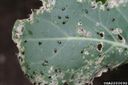
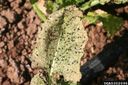
Specialized herbivore of Brassicaceae; significant agricultural pest causing economic damage to canola and related crops. for Microctonus vittatae, which may regulate . Feeding damage skeletonizes leaves, causing bleached appearance before plant death.
Human Relevance
Major economic pest of canola, rapeseed, and vegetable Brassica crops. Feeding by creates characteristic shot-hole damage to leaves; heavy kill seedlings and reduce yield. Management includes clean to reduce sites, applications, and breeding. monitoring uses models with predictable to ±3.7 days.
Similar Taxa
- Phyllotreta striolataSimilar size and ; distinguished by distinct longitudinal on , whereas P. cruciferae is uniformly black and shiny. P. striolata has narrower range.
- Phyllotreta nemorumEuropean with similar ; may require examination of genitalia for definitive identification.
- Bagrada hilarisDifferent (Pentatomidae) but similar range on Brassicaceae; much larger (5-7 mm), with distinctive color pattern, does not jump.
More Details
Thermal biology
Developmental thresholds of approximately 17°C for oviposition and 11°C for -to- development have been established. Heat unit summations from soil temperatures predict adult with high .
Plant resistance
High trichome on certain Brassica villosa accessions provides physical resistance by preventing beetles from settling to feed; this trichome-based resistance does not involve chemical deterrents.
Superparasitism effects
When multiple Microctonus vittatae larvae occur in a single , development of the surviving is prolonged compared to solitary .
Sources and further reading
- BugGuide
- Wikipedia
- GBIF taxonomy match
- iNaturalist taxon
- NCBI Taxonomy
- Occasional Pests - AgriLife Extension Entomology
- Bug Eric: The Bagrada Bug
- Stinking Here and There: Invasive Stink Bug Goes From Crops to Homes
- Phyllotreta cruciferae . [Distribution map].
- AN EFFECT OF PARASITISM BY MICROCTONUS VITTATAE (HYMENOPTERA: BRACONIDAE) ON EMERGENCE OF PHYLLOTRETA CRUCIFERAE AND PHYLLOTRETA STRIOLATA (COLEOPTERA: CHRYSOMELIDAE) FROM OVERWINTERING SITES
- Host Preferences of the Flea Beetles Phyllotreta cruciferae and P. striolata (Coleoptera: Chrysomelidae) for Crucifer Seedlings
- ANTIBIOSIS OF PREFERRED AND NON-PREFERRED HOST-PLANTS FOR THE FLEA BEETLE, PHYLLOTRETA CRUCIFERAE (GOEZE) (COLEOPTERA: CHRYSOMELIDAE)
- A WILD BRASSICA FROM SICILY PROVIDES TRICHOME-BASED RESISTANCE AGAINST FLEA BEETLES, PHYLLOTRETA CRUCIFERAE (GOEZE) (COLEOPTERA: CHRYSOMELIDAE)
- The influence of vegetational diversity on the population ecology of a specialized herbivore, Phyllotreta cruciferae (Coleoptera: Chrysomelidae)
- DELAYED DEVELOPMENT OF MICROCTONUS VITTATAE (HYMENOPTERA: BRACONIDAE) IN SUPERPARASITIZED ADULTS OF PHYLLOTRETA CRUCIFERAE (COLEOPTERA: CHRYSOMELIDAE)
- Prefeeding Behavior of the Crucifer Flea Beetle, Phyllotreta cruciferae, on Host and Nonhost Crucifers
- BIOLOGY OF THE CRUCIFER FLEA BEETLE, PHYLLOTRETA CRUCIFERAE (COLEOPTERA: CHRYSOMELIDAE), IN SOUTHWESTERN ONTARIO