
Psylliodes
Latreille, 1829
flea beetles
Species Guides
9- Psylliodes affinis(Potato Flea Beetle)
- Psylliodes chalcomera(flea beetle)
- Psylliodes chrysocephala(cabbage-stem flea beetle)
- Psylliodes convexior(hop flea beetle)
- Psylliodes credens
- Psylliodes cucullata
- Psylliodes napi(turnip flea beetle)
- Psylliodes picina
- Psylliodes punctulata
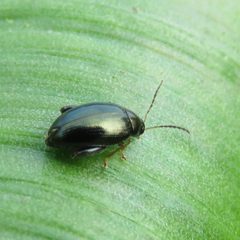
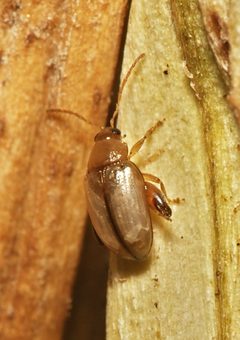
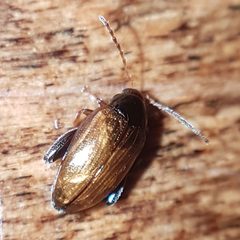
Psylliodes is a large of flea beetles comprising approximately 200 described worldwide. Members are characterized by enlarged hind adapted for jumping, a trait shared with other Alticini. Approximately half of all species are specialized feeders on Brassicaceae, with the remainder associated with roughly 24 other plant . Several species are economically significant agricultural pests, including the cabbage stem flea beetle (P. chrysocephala) and potato flea beetle (P. affinis). The genus includes rare species such as the Lundy Cabbage Flea Beetle (P. luridipennis), a globally Critically restricted to a single island off the coast of England.
Pronunciation
How to pronounce Psylliodes: //sɪˈlioʊdiːz//
These audio files are automatically generated. While they are not always 100% accurate, they are a good starting point.
Identification
Psylliodes are distinguished from related flea beetle primarily by genitalic characters and subtle external that requires expert examination. The genus can be separated from the superficially similar Phyllotreta by differences in male genitalia and tarsal structure. Species-level identification within Psylliodes is challenging and typically requires examination of morphology, with many species showing subtle differences in coloration, punctation, and body proportions. The metallic bronze coloration of P. luridipennis is distinctive among British species.
Images
Habitat
vary by and plant association. Species feeding on Brassicaceae occur in agricultural fields, habitats, and natural areas where cruciferous plants grow. The P. luridipennis is restricted to steep, wind-sheltered slopes on the eastern side of Lundy Island where its host plant Lundy Cabbage (Coincya wrightii) grows. Psylliodes chrysocephala aestivates during summer in protected microhabitats to avoid heat and desiccation stress.
Distribution
distribution with recorded across Europe, Asia, Africa, and the Americas. The is particularly diverse in the Palearctic region. Specific distribution records include Denmark, Norway, and Sweden. The P. luridipennis is restricted to Lundy Island, Devon, England. Psylliodes chrysocephala occurs in northern Europe where it is a significant pest of winter oilseed rape crops.
Seasonality
of many are active during the growing season of their plants. Psylliodes chrysocephala adults aestivate during summer months, entering a state to survive heat and desiccation stress before resuming activity. The timing of activity is closely tied to host plant , with larvae typically present during periods of active plant growth.
Diet
Herbivorous. Approximately 50% of feed on Brassicaceae; remaining species feed on plants from approximately 24 different including Capparaceae, Cleomaceae, Resedaceae, and Tropaeolaceae. Larvae mine stems, roots, and leaves; feed on foliage. Psylliodes chrysocephala feeds on winter oilseed rape (Brassica napus). Psylliodes luridipennis feeds exclusively on Lundy Cabbage (Coincya wrightii).
Host Associations
- Brassica napus - food plantwinter oilseed rape; of P. chrysocephala
- Coincya wrightii - food plantLundy Cabbage; exclusive of P. luridipennis
- Brassicaceae - food plant for ~50% of
- Capparaceae - food plant for some
- Cleomaceae - food plant for some
- Resedaceae - food plant for some
- Tropaeolaceae - food plant for some
Life Cycle
Complete with , larva, pupa, and stages. Eggs are laid in soil at the base of plants. Larvae are stem and leaf miners, feeding internally on plant tissues. occurs in the soil. Adults emerge and feed on host plant foliage. In Psylliodes chrysocephala, adults enter during summer, a state characterized by altered metabolic regulation including transport dynamics mediated by specific transporter proteins (Tret-1 and Tret-2).
Behavior
possess enlarged hind enabling -like jumping when disturbed, the characteristic giving the group its . Psylliodes chrysocephala adults undergo summer to avoid heat and desiccation stress, during which they exhibit reduced metabolic activity and altered distribution between and . Disruption of trehalose transport causes compensatory increases in feeding activity in pre-aestivation beetles.
Ecological Role
Herbivores that can significantly impact plant through larval mining and foliar feeding. Several are economically important agricultural pests of crucifer crops. The P. luridipennis represents a rare example of co- with its host plant, illustrating tight evolutionary specialization. Some species have been investigated as potential agents for thistles.
Human Relevance
Several are significant agricultural pests. Psylliodes chrysocephala (cabbage stem flea beetle) is a major pest of winter oilseed rape in northern Europe. Psylliodes affinis (potato flea beetle) damages potato crops. Psylliodes punctulatus and P. convexior are known as hop flea beetles. Psylliodes chalcomera has been investigated as a agent for musk thistle. The P. luridipennis is a conservation priority and flagship species for conservation in Britain.
Similar Taxa
- PhyllotretaBoth are flea beetle in tribe Alticini with jumping hind legs and similar body form; distinguished by male genitalia and tarsal structure
- AlticaAnother flea beetle with enlarged hind ; Psylliodes generally smaller with different plant associations and genitalic
Sources and further reading
- BugGuide
- Wikipedia
- GBIF taxonomy match
- iNaturalist taxon
- NCBI Taxonomy
- Catalogue of Life
- Learning the Insect Lingo While Working Abroad
- In Search of Britain’s Endemics - Buglife Blog - Buglife
- One island. One beetle. One-of-a-kind. - Buglife Blog - Buglife
- Brazil Bugs #12 – Desafio de identificação #5 | Beetles In The Bush
- Studies on the biology and ecology of the Duboisia flea beetle Psylliodes parilis Weise, (Chrysomelidae, Coleoptera) in Duboisia plantations
- Figure 1 from: Gikonyo MW, Biondi M, Beran F (2019) Adaptation of flea beetles to Brassicaceae: host plant associations and geographic distribution of Psylliodes Latreille and Phyllotreta Chevrolat (Coleoptera, Chrysomelidae). In: Schmitt M, Chaboo CS, Biondi M (Eds) Research on Chrysomelidae 8. ZooKeys 856: 51-73. https://doi.org/10.3897/zookeys.856.33724
- Reciprocal roles of two trehalose transporters in aestivating cabbage stem flea beetles ( Psylliodes chrysocephala )
- Host Specificity of Psylliodes chalcomera1 , a Candidate for Biological Control of Musk Thistle 3