
Phyllotreta bipustulata
(Fabricius, 1801)
woodland flea beetle
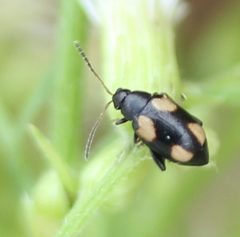
Phyllotreta bipustulata, commonly known as the woodland flea beetle, is a of flea beetle in the Chrysomelidae. It is native to North America and has been recorded in Canadian provinces including Manitoba, Ontario, and Québec. As a member of the flea beetle group, it possesses enlarged hind adapted for jumping. The species is part of a containing several economically significant agricultural pests, though specific details about this particular species' remain limited.
Pronunciation
How to pronounce Phyllotreta bipustulata: /ˌfɪloʊˈtriːtə ˌbaɪpʊˈstjuːlɑːtə/
These audio files are automatically generated. While they are not always 100% accurate, they are a good starting point.
Identification
Members of the Phyllotreta are small beetles, typically 1.5–3.5 mm in length, with enlarged hind that enable their characteristic jumping . The epithet "bipustulata" (meaning "two-spotted") suggests the presence of two distinct spots or markings on the , though this should be verified against specimens. Accurate identification to species level within Phyllotreta requires examination of genitalia and detailed comparison with related species such as P. cruciferae and P. striolata.
Images
Habitat
The "woodland flea beetle" suggests association with wooded or forest-edge environments, though specific preferences for this are not well documented. Related Phyllotreta species often occur in areas with Brassicaceae plants.
Distribution
Documented from North America, with specific records from the Canadian provinces of Manitoba, Ontario, and Québec. The full extent of its range within North America has not been comprehensively mapped.
Behavior
Like other flea beetles, possesses enlarged hind adapted for jumping, which serves as an escape response when disturbed. This saltatorial locomotion is characteristic of the tribe Alticini.
Similar Taxa
- Phyllotreta cruciferaeAnother North American flea beetle that shares similar size, jumping ability, and general ; both occur in similar geographic regions and may utilize related plants.
- Phyllotreta striolataClosely related with overlapping distribution in North America; distinguished by subtle differences in elytral and coloration patterns.
- Phyllotreta nemorumEuropean that has been introduced to North America; similar in size and habit, requiring careful examination for accurate differentiation.
More Details
Taxonomic note
The was originally described by Fabricius in 1801. The Phyllotreta is taxonomically complex, with ongoing revisions clarifying species boundaries and geographic distributions.
Data limitations
This has relatively few documented observations (24 records on iNaturalist as of source date), indicating it may be undercollected, genuinely rare, or frequently misidentified with .