
Plateumaris
C.G. Thomson, 1859
spade reed beetles
Species Guides
15- Plateumaris aurifera(Gold reed beetle)
- Plateumaris balli(Ball's reed beetle)
- Plateumaris diversa
- Plateumaris dubia(long-horned leaf beetle)
- Plateumaris flavipes(Flavous-footed reed beetle)
- Plateumaris frosti(Frost's reed beetle)
- Plateumaris fulvipes(Fulvous-footed reed beetle)
- Plateumaris germari(Germar's reed beetle)
- Plateumaris metallica(Metallic reed beetle)
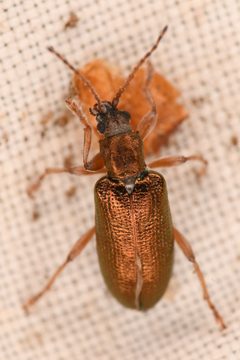
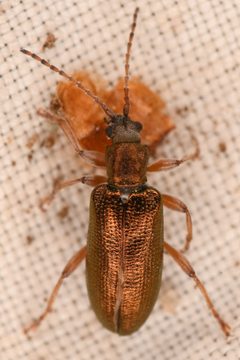
Plateumaris is a of aquatic leaf beetles in the Chrysomelidae, Donaciinae, distributed across the Holarctic region. The genus comprises approximately 27 globally, with 17 described in North America and 10 in the Palaearctic. are found along margins of water bodies on emergent aquatic plants, while larvae develop submerged on plant roots. Species are recognized by diagnostic morphological features including the lack of above the procoxa and rounded, declivous elytral apices with a sinuate sutural area. Females possess a strongly sclerotized, shovel-like ovipositor that often protrudes from the , giving rise to the "spade reed beetles".
Pronunciation
How to pronounce Plateumaris: /ˌplætɛʊˈmɛərɪs/
These audio files are automatically generated. While they are not always 100% accurate, they are a good starting point.
Identification
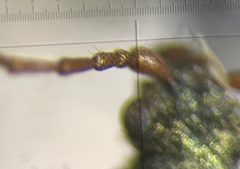
of Plateumaris are distinguished from other Donaciinae by the absence of above the procoxa. The elytral apices are rounded and declivous, with the sutural area apically sinuate. Females exhibit a diagnostic strongly sclerotized ovipositor shaped like a pointed shovel, often visibly protruding from the . The is further characterized by polygonal tibiae, thick short , strong overlapping the , and inserted before the .
Images
Habitat
occur along margins of water bodies on emergent aquatic plants, often in large . Larvae and pupae develop submerged, attached to the roots of aquatic vegetation. Suitable include wetlands, peat bogs, and other limnic environments with emergent vegetation.
Distribution
Holarctic distribution. Palaearctic region: 10 , with some occurring across the entire region and others restricted to more limited ranges including Japan (2 species). Nearctic region: 17 described species in North America. Specific Palaearctic records include the Amur region (East Siberia), Carniola (West Slovenia), Austria, and Japan.
Diet
Larvae feed on roots of aquatic plants. plant include Cyperaceae and Poaceae. are associated with emergent aquatic vegetation; specific adult feeding habits are not documented.
Host Associations
- Cyperaceae - larval plantroots used for larval development
- Poaceae - larval plantroots used for larval development
- aquatic plants with aerenchyma - respiratory larvae tap aerenchyma for underwater respiration
Life Cycle
Larvae develop submerged on roots of aquatic plants. Respiration occurs through two hollow abdominal hooks connected to the tracheal system, which tap into plant aerenchyma, enabling permanent underwater residence. are terrestrial. occurs attached to plant roots underwater.
Behavior
Larvae use specialized hollow abdominal hooks to pierce plant aerenchyma for underwater respiration. are often difficult to deliberately capture in their and are frequently collected as by-catch.
Ecological Role
Indicators of limnic and wetland health. are declining due to anthropogenic changes including peat extraction, drainage, and wetland degradation.
Human Relevance
are threatened by peatland destruction and wetland degradation. The Bog Reed (Plateumaris discolor, now synonymized with P. sericea) has been highlighted in conservation literature as a characteristic of peat bog requiring protection.
Similar Taxa
- DonaciaBoth are aquatic Donaciinae with larvae developing on aquatic plant roots; Plateumaris distinguished by lack of above procoxa and female shovel-like ovipositor
- MacropleaOther Donaciinae with aquatic larvae; Plateumaris differs in elytral apex shape and female ovipositor
More Details
Taxonomic complexity
The Palaearctic of Plateumaris have undergone extensive taxonomic revision due to intraspecific variation and large distributions. At least 80 plus five were described historically, with 70 names now allocated as synonyms. Recent revisions established new synonymies: P. tenuicornis = P. consimilis, P. sulcifrons = P. rustica, P. caucasica = P. sericea; and confirmed P. discolor and P. sericea sibirica as synonyms of P. sericea.
Geographic variation
In P. constricticollis (Japan), body and ovipositor sizes show geographic , with larger sizes in areas of greater snow depth, suggesting climatic .
Sources and further reading
- BugGuide
- Wikipedia
- GBIF taxonomy match
- iNaturalist taxon
- NCBI Taxonomy
- Catalogue of Life
- Don't get bogged down with peat... - Buglife Blog - Buglife
- Revision of the Palaearctic species of the genus Plateumaris C. G. Thomson, 1859 (Coleoptera, Chrysomelidae, Donaciinae)
- Geographic variation in body and ovipositor sizes in the leaf beetle Plateumaris constricticollis (Coleoptera: Chrysomelidae) and its association with climatic conditions and host plants
- Original descriptions of Palaearctic species of the genus Plateumaris C. G. Thomson, 1859 (Coleoptera, Chrysomelidae, Donaciinae) and their translations.