
Donacia
Fabricius, 1775
Species Guides
29- Donacia assimilis
- Donacia biimpressa
- Donacia caerulea
- Donacia piscatrix
- Donacia rufescens
- Donacia cincticornis(Girdle-horned Pond Lily Leaf Beetle)
- Donacia confluenta(Confluent reed beetle)
- Donacia cuprea(Copper Aquatic Leaf Beetle)
- Donacia dissimilis
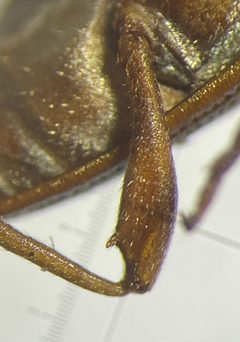
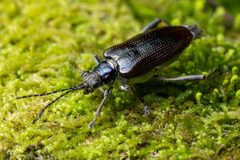
Donacia is a large of aquatic leaf beetles in the Donaciinae. are active, capable of sustained , and possess adaptations for both aerial and submerged existence. The genus is distinguished by a elytral apex and a pubescent area above the procoxa. Larvae develop on submerged portions of aquatic plants, while adults inhabit surface parts of the same vegetation. The genus contains approximately 113 described arranged into 15 proposed subgenera, with major radiations in the Nearctic and Palaearctic regions.
Pronunciation
How to pronounce Donacia: //dɔˈna.t͡ʃi.a//
These audio files are automatically generated. While they are not always 100% accurate, they are a good starting point.
Identification
Donacia is recognized by the elytral apex and the presence of a pubescent area above the procoxa. Like other Donaciinae, have densely pubescent undersides and long . These characters separate the from related aquatic chrysomelid genera.
Images
Habitat
Aquatic environments associated with emergent and floating vegetation. inhabit surface parts of aquatic plants. Larvae occur on submerged portions of plants in freshwater systems.
Distribution
Nearctic, Palaearctic, and Australasian regions. The subgenus Donacia (Donacia) s. str. contains 10 Nearctic and 5 Palaearctic ; Donacia (Donacocia) contains approximately 21 Nearctic and 75 Palaearctic species; Donacia (Cyphogaster) contains about 6 Australasian species. Specific records include South Korea, Eastern Siberia (Krasnoyarskii Krai), and southwestern Turkey.
Diet
feed on the upper of plants; some may consume pollen. Larvae feed on sap from submerged portions of aquatic plants.
Host Associations
- Nymphaea - water lilies
- Nymphoides -
- Ondinea -
- Cyperaceae - sedges
- Sagittaria - Alismataceae
- Sparganium - Typhaceae
- Potamogeton - pond weed
Life Cycle
Both and larval stages have been described for multiple . Larvae are aquatic and develop on submerged plant tissues. Adults are capable of extended submersion due to a . Oviposition in Korean species exhibit three distinct patterns (Pattern I, II, III).
Behavior
are active and readily take . Adults can remain submerged for extended periods using a for respiration. Larvae are believed to breathe oxygen from plant vessels as well as cutaneously. Male combat has been documented in D. crassipes. Feeding patterns in Korean show three distinct types (Type I, II, III).
Human Relevance
Some are of conservation concern; Donacia aquatica is noted as endangered in regional assessments.
Similar Taxa
- Other Donaciinae generaDonacia is distinguished by elytral apex and pubescent area above procoxa, whereas related lack these specific character combinations.
More Details
Subgeneric classification
The is divided into 15 proposed subgenera. The three largest are Donacia (Donacia) s. str., Donacia (Cyphogaster), and Donacia (Donacocia).
Respiratory adaptations
The allows to exploit both aerial and submerged , a functional trait that separates them from purely terrestrial chrysomelids.
Sources and further reading
- BugGuide
- Wikipedia
- GBIF taxonomy match
- iNaturalist taxon
- NCBI Taxonomy
- Catalogue of Life
- Northern Ireland, invertebrate finds in review 2023 - Buglife Blog - Buglife
- Figure 8 from: Kim JY, Han Y-D, Lee JE (2025) A new species of the genus Donacia Fabricius (Coleoptera, Chrysomelidae, Donaciinae) from South Korea: morphology, ecology, and COI gene analysis. ZooKeys 1261: 83-99. https://doi.org/10.3897/zookeys.1261.169034
- Figure 5 from: Kim JY, Han Y-D, Lee JE (2025) A new species of the genus Donacia Fabricius (Coleoptera, Chrysomelidae, Donaciinae) from South Korea: morphology, ecology, and COI gene analysis. ZooKeys 1261: 83-99. https://doi.org/10.3897/zookeys.1261.169034
- Figure 6 from: Kim JY, Han Y-D, Lee JE (2025) A new species of the genus Donacia Fabricius (Coleoptera, Chrysomelidae, Donaciinae) from South Korea: morphology, ecology, and COI gene analysis. ZooKeys 1261: 83-99. https://doi.org/10.3897/zookeys.1261.169034
- Figure 4 from: Kim JY, Han Y-D, Lee JE (2025) A new species of the genus Donacia Fabricius (Coleoptera, Chrysomelidae, Donaciinae) from South Korea: morphology, ecology, and COI gene analysis. ZooKeys 1261: 83-99. https://doi.org/10.3897/zookeys.1261.169034
- Figure 1 from: Kim JY, Han Y-D, Lee JE (2025) A new species of the genus Donacia Fabricius (Coleoptera, Chrysomelidae, Donaciinae) from South Korea: morphology, ecology, and COI gene analysis. ZooKeys 1261: 83-99. https://doi.org/10.3897/zookeys.1261.169034
- Figure 7 from: Kim JY, Han Y-D, Lee JE (2025) A new species of the genus Donacia Fabricius (Coleoptera, Chrysomelidae, Donaciinae) from South Korea: morphology, ecology, and COI gene analysis. ZooKeys 1261: 83-99. https://doi.org/10.3897/zookeys.1261.169034
- Figure 9 from: Kim JY, Han Y-D, Lee JE (2025) A new species of the genus Donacia Fabricius (Coleoptera, Chrysomelidae, Donaciinae) from South Korea: morphology, ecology, and COI gene analysis. ZooKeys 1261: 83-99. https://doi.org/10.3897/zookeys.1261.169034
- To be or not to be a synonym – revision of the Donacia clavareaui-fukiensis complex (Coleoptera, Chrysomelidae, Donaciinae)
- Effects of temporal and spatial variations in food availability on life cycle and palatability of a chrysomelid Beetle(Donacia cinerea)
- Male combat and mating behavior of Donacia crassipes Fabricius and other chrysomelids (Coleoptera, Chrysomelidae, Donaciinae)
- A new species of the genus Donacia Fabricius (Coleoptera, Chrysomelidae, Donaciinae) from South Korea: morphology, ecology, and COI gene analysis
- Taxonomic studies on Donacia Fabricius, 1775 (Coleoptera, Chrysomelidae, Donaciinae) of Southwestern Turkey with notes on their geographic distributions, habitats and host plant associations
- Figure 3 from: Kim JY, Han Y-D, Lee JE (2025) A new species of the genus Donacia Fabricius (Coleoptera, Chrysomelidae, Donaciinae) from South Korea: morphology, ecology, and COI gene analysis. ZooKeys 1261: 83-99. https://doi.org/10.3897/zookeys.1261.169034
- DONACIA AUSTRALASIAEBLACKBURN: THE SOLE REPRESENTATIVE OF THE SUBFAMILY DONACIINAE (COLEOPTERA: CHRYSOMELIDAE) IN AUSTRALIA AND NEW GUINEA
- NEW RECORDS OF DONACIA FABRICIUS, 1775 (COLEOPTERA: CHRYSOMELIDAE: DONACIINAE) FROM KRASNOYARSKII KRAI (RUSSIA)
- Chromosome-Level Genome Assembly of Donacia provosti.