
Donacia caerulea
Olivier, 1795
Donacia caerulea is an aquatic leaf beetle in the Chrysomelidae, Donaciinae. It is native to North America, with confirmed records from Canadian provinces including Manitoba, New Brunswick, and Ontario. Like other members of its , it is associated with freshwater aquatic where its larvae develop on submerged vegetation.
Pronunciation
How to pronounce Donacia caerulea: //doʊˈneɪʃə sɛˈruːliə//
These audio files are automatically generated. While they are not always 100% accurate, they are a good starting point.
Identification
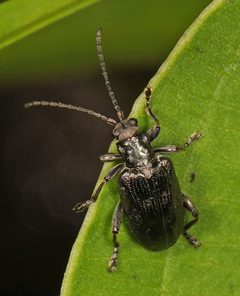
Members of Donacia can be distinguished from other Chrysomelidae by their aquatic lifestyle and association with submerged macrophytes. Within the , -level identification typically requires examination of subtle morphological characters including body proportions, coloration, and male genitalia. D. caerulea exhibits the characteristic metallic coloration common to many Donacia species.
Images
Habitat
Aquatic freshwater including ponds, lakes, and slow-moving waters with submerged vegetation. Larvae are aquatic and develop on submerged macrophytes; are found on emergent aquatic plants.
Distribution
North America. Confirmed records from Manitoba, New Brunswick, and Ontario in Canada. Distribution likely broader but specific records limited in available sources.
Life Cycle
with aquatic larval stages. Larvae are aquatic and develop on submerged vegetation. emerge and are found on emergent aquatic plants. Specific details of -laying and sites for this are not documented in available sources.
Similar Taxa
- Other Donacia speciesMany Donacia share similar aquatic habits and metallic coloration; reliable identification requires detailed morphological examination or keys.
More Details
Taxonomic note
Authority: Olivier, 1795. The has been accepted in taxonomic databases including GBIF and NCBI .
Data gaps
Detailed morphological descriptions, precise requirements, plant associations, and details for D. caerulea specifically are not available in the provided sources. Most information at the level may not apply to this particular .
Sources and further reading
- BugGuide
- Wikipedia
- GBIF taxonomy match
- iNaturalist taxon
- NCBI Taxonomy
- A Summit to Save the Butterflies | Bug Squad
- Northern Ireland, invertebrate finds in review 2023 - Buglife Blog - Buglife
- Bees vs wasps: what's the difference? - Buglife Blog - Buglife
- Tingidae | Beetles In The Bush
- Beauties in the Bog - Buglife Blog - Buglife
- Provisional checklist of European butterfly larval foodplants