
Plateumarini
Böving, 1922
Genus Guides
2- Plateumaris(spade reed beetles)
- Poecilocera
Plateumarini is a tribe of leaf beetles within the Donaciinae, established by Böving in 1922. Members of this tribe are aquatic or semi-aquatic beetles associated with freshwater . The tribe is distinguished from the related tribe Donaciini by morphological features of the larval stage, particularly in the structure of the respiratory siphon. Plateumarini contains the Plateumaris, which is the primary genus in this group.
Pronunciation
How to pronounce Plateumarini: //ˌplæt.juːˈmær.ɪ.naɪ//
These audio files are automatically generated. While they are not always 100% accurate, they are a good starting point.
Identification
Distinguished from the tribe Donaciini by larval , specifically the structure of the caudal respiratory siphon. In Plateumarini, the siphon has a different arrangement of and associated structures compared to Donaciini. may be separated from Donaciini by more subtle differences in body proportions and antennal structure, though these can be variable. The Plateumaris (sole genus in Plateumarini) can be recognized by the combination of: body more elongate than most Donacia; pronotum with lateral margins clearly visible from above and distinctly constricted at base; relatively short, not reaching beyond middle of ; and elytra with more regular, less confused punctation. Definitive identification to tribe level often requires larval examination or dissection of adult genitalia.
Images
Appearance
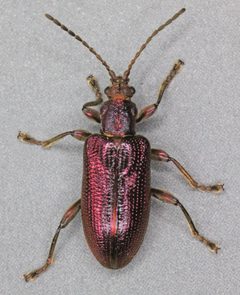
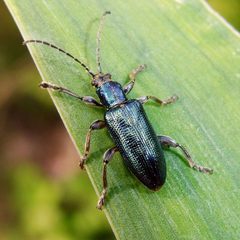
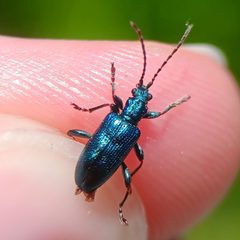
are elongate-oval leaf beetles with a somewhat flattened profile. The body is typically metallic in coloration, often coppery, bronze, or bluish-green. are and moderately long, extending beyond the pronotum but not greatly elongated. The pronotum is distinctly narrower than the at the base, with lateral margins that are visible from above. Elytra are completely covering the , with regular punctation and often with subtle longitudinal . Legs are adapted for clinging to aquatic vegetation, with that bear swimming hairs. Larvae possess a respiratory siphon that is structurally distinct from that of Donaciini, with specific differences in the arrangement of spiracular openings.
Habitat
Freshwater aquatic and semi-aquatic environments including ponds, lakes, slow-moving rivers, and marshes. and larvae are closely associated with submerged and emergent aquatic vegetation. Larvae develop in the stems and roots of aquatic plants, particularly in the submerged portions. typically feature clear, vegetation-rich water with stable conditions. Both lotic and lentic systems are occupied, though slow-flowing or still waters appear preferred.
Distribution
Holarctic distribution, occurring in the Palearctic and Nearctic regions. In the Palearctic, present across Europe, northern Asia, and extending into Japan. In the Nearctic, found across northern North America including Canada and the northern United States. Distribution corresponds broadly to temperate and zones with suitable aquatic . Records are scattered and many regions remain under-surveyed.
Seasonality
are active during the warmer months, typically from late spring through summer. Peak activity varies with latitude, occurring earlier in southern portions of the range. Larval development occurs through summer months. stage varies; some likely overwinter as adults, others may have larvae that complete development in spring. Specific timing is poorly documented for most species.
Diet
Larvae feed internally on the tissues of aquatic plants, including stems and submerged roots. plant associations include various aquatic macrophytes, particularly in such as Potamogetonaceae, Sparganiaceae, and Typhaceae. feed on leaves of aquatic and semi-aquatic plants, creating characteristic feeding damage. Specific host records are limited and many associations remain to be documented.
Host Associations
- Potamogeton - larval plantSubmerged stems and roots
- Sparganium - larval plantSubmerged portions of stems
- Typha - larval and plantVarious submerged and emergent tissues
Life Cycle
are deposited on or near aquatic vegetation, typically on submerged or emergent plant parts. Larvae are aquatic, developing within the tissues of plants. They possess a caudal respiratory siphon that is used to obtain air from the water surface while the body remains within the plant tissue. Larval development includes three instars. occurs within the plant tissue or in mud at the base of plants; the pupal is formed from plant material and silk. emerge in spring or summer and are active swimmers and fliers. The is typically , though this may vary with latitude and local conditions.
Behavior
are capable swimmers, using their fringed hind legs to move through water. They are also strong fliers and can disperse between water bodies. When disturbed, adults often drop from vegetation into water and swim to submerged cover. Adults frequently rest on emergent vegetation with the body oriented vertically, downward. Larvae remain concealed within plant tissues, feeding internally and only extending the respiratory siphon to the water surface for air. Both adults and larvae are negatively phototactic when disturbed, seeking cover in vegetation or substrate.
Ecological Role
Herbivores that contribute to the processing of aquatic plant . Larval feeding within plant stems can cause damage that may affect plant growth and survival, though levels typically do not cause extensive harm. Serve as prey for various aquatic and semi-aquatic including fish, aquatic insects, and birds. The internal feeding habit of larvae provides a food resource within plant tissues that is accessible to specialized . Contribute to nutrient cycling in freshwater through herbivory and as a food source for higher .
Human Relevance
Occasional minor pests in aquatic plant , including water gardens and managed wetlands. Not considered economically significant. Can serve as indicators of water quality and integrity in freshwater . Some interest from collectors due to metallic coloration. No known medical or veterinary importance.
Similar Taxa
- DonaciiniClosely related tribe within Donaciinae; distinguished by larval siphon structure and subtle morphological differences including body proportions and antennal length
- HaemoniiniRelated tribe in Donaciinae; differ in body shape and antennal structure, larvae have different respiratory adaptations
- Donacia in tribe Donaciini; generally more robust with relatively longer , larvae have structurally different respiratory siphons
More Details
Taxonomic history
The tribe was established by Böving in 1922 based on larval morphological differences from Donaciini. The distinction has been supported by subsequent studies of larval anatomy, though some classifications have treated Plateumarini as a subtribe or synonymized it with Donaciini. Current consensus based on morphological and molecular data supports its recognition as a distinct tribe.
Larval respiration
The structure of the caudal respiratory siphon is the primary diagnostic feature separating Plateumarini from Donaciini. In Plateumarini, the siphon has a terminal pair of with associated structures that differ in arrangement from the spiracular configuration in Donaciini. This difference reflects different evolutionary solutions to the challenge of obtaining air while living within submerged plant tissues.