
Chrysolina
Motschulsky, 1860
leaf beetles
Species Guides
16- Chrysolina auripennis(Gold-winged Leaf Beetle)
- Chrysolina bankii(Bronze Beetle)
- Chrysolina basilaris
- Chrysolina cribraria
- Chrysolina fastuosa
- Chrysolina flavomarginata(Yellow-margined Leaf Beetle)
- Chrysolina hudsonica
- Chrysolina hyperici(Saint John's Wort Beetle)
- Chrysolina inornata
Chrysolina is a large of leaf beetles in the Chrysomelinae, containing numerous distributed primarily across Europe, Asia, and Africa. The genus is notable for its phytophagous species, many of which exhibit strong plant specificity. Several species have been employed as agents against weeds, most notably Chrysolina quadrigemina and C. hyperici for control of Hypericum perforatum (St. John's wort). Some species are of conservation concern, including C. cerealis and C. graminis, which are protected in the United Kingdom. The genus includes both native and introduced , with some species established in North America and Australia.
Pronunciation
How to pronounce Chrysolina: /ˌkrɪsəˈlaɪnə/
These audio files are automatically generated. While they are not always 100% accurate, they are a good starting point.
Identification
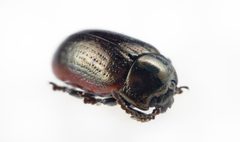
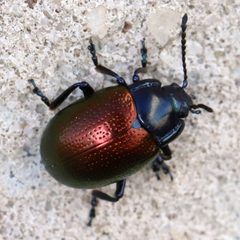
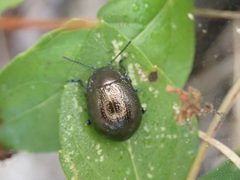
within Chrysolina are generally recognized as small to medium-sized leaf beetles with compact, often rounded or oval bodies. Many species exhibit metallic coloration, including , blue, green, or purple tones. The is distinguished from related chrysomeline genera by a combination of morphological features including antennal structure and male genitalia characteristics, though specific identification to species level often requires examination of these detailed structures. Subgeneric classification within Chrysolina is based on morphological traits and associations.
Images
Habitat
vary by but generally include grasslands, meadows, coastal areas, and areas supporting specific plants. The Tansy (Chrysolina graminis) is restricted to floodplains around York, UK, where its host plant Tanacetum vulgare occurs. Chrysolina picturata and related species inhabit coastal areas in their native southern African range and introduced Australian distribution. Some species are associated with aromatic herbs including rosemary, lavender, and sage.
Distribution
Native distribution spans Europe, Asia, and Africa. A small number of occur in North America, including both native and introduced European species. Introduced are established in Australia, where several species were deliberately released for . Specific distribution records include: Denmark, Norway, Sweden, and Vermont, USA.
Diet
All are phytophagous, feeding on specific plants. Documented host associations include: Hypericum perforatum (St. John's wort), Tanacetum vulgare (tansy), Rosmarinus officinalis (rosemary), Lavandula spp. (lavender), Salvia spp. (sage), Artemisia capillaris, and Chrysanthemoides monilifera. Some species exhibit extreme host specificity, completing development only on a single plant species or .
Host Associations
- Hypericum perforatum - plantprimary for C. hyperici and C. quadrigemina
- Tanacetum vulgare - plant for C. graminis
- Rosmarinus officinalis - plantprimary for C. americana
- Lavandula spp. - plant for C. americana
- Salvia spp. - plant for C. salviae and related
- Artemisia capillaris - plant for C. orochi
- Chrysanthemoides monilifera - plantprimary for C. picturata and C. sp. B
- Chrysanthemoides incana - plantsupports complete development of C. picturata and C. sp. B
Life Cycle
Development includes , larva, pupa, and stages. Larvae and pupae have been described for some , including C. orochi. timing is closely tied to plant . Specific details vary among species and are not comprehensively documented across the .
Ecological Role
Several serve as agents for weeds, reducing plant through larval and feeding. The contributes to regulation of plant composition in native through specialized herbivory. As phytophagous , species may influence plant distribution and abundance.
Human Relevance
Positive: Several used successfully for of weeds, particularly Hypericum perforatum in Australia and California. Negative: Some introduced species, including C. americana (rosemary leaf beetle), may cause damage to ornamental and cultivated herbs. Conservation: C. cerealis and C. graminis are protected species in the United Kingdom, with C. graminis (Tansy ) considered highly endangered and restricted to specific floodplain .
Similar Taxa
- TimarchaBoth are in Chrysomelinae and share similar body forms; Timarcha are generally larger and lack the metallic coloration typical of many Chrysolina
- GastrophysaSimilar leaf beetle and herbivorous habits; distinguished by plant associations and genitalia structure
- PhratoraRelated chrysomeline leaf beetles with similar size and habits; Phratora typically feed on willows and poplars rather than herbs
Sources and further reading
- BugGuide
- Wikipedia
- GBIF taxonomy match
- iNaturalist taxon
- NCBI Taxonomy
- Catalogue of Life
- ESA Entomology Games Are Both Educational and Entertaining | Bug Squad
- Flooding and Bugs – What are the impacts? - Buglife Blog - Buglife
- Save wildlife - close the UK borders to plants - Buglife Blog - Buglife
- Chrysolina americana L.
- Description of a new species of the genus Chrysolina (Coleoptera: Chrysomelidae) from Honshu, and notes on records of Chrysolina aeruginosa in Japan
- Distribution, life history and host specificity of Chrysolina picturata and Chrysolina sp. B (Coleoptera: Chrysomelidae), two biological control agents for Chrysanthemoides monilifera (Compositae)
- The genome sequence of the Tansy Beetle, Chrysolina graminis (Linnaeus, 1758).