
Gastrophysa
Chevrolat in Dejean, 1836
dock leaf beetles, knotweed leaf beetles
Species Guides
4- Gastrophysa cyanea(green dock beetle)
- Gastrophysa dissimilis
- Gastrophysa formosa
- Gastrophysa polygoni(Knotweed Leaf Beetle)
Gastrophysa is a of leaf beetles in the Chrysomelidae, distinguished by pronounced physogastrism in females—swollen, membranous resulting from enlarged reproductive organs. The genus includes approximately nine described , with G. viridula and G. polygoni being the most extensively studied. Members are oligophagous on Polygonaceae, serving as both beneficial agents for weeds and occasional minor pests of cultivated buckwheat. Several species have been introduced to North America and other regions, where they have established widespread .
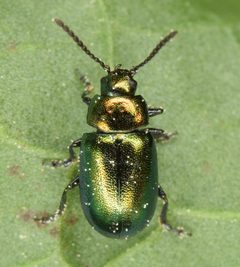
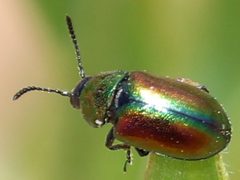
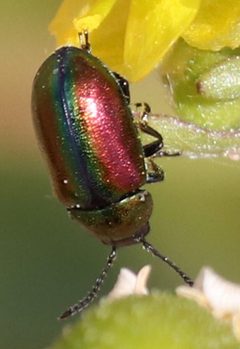
Pronunciation
How to pronounce Gastrophysa: /ɡastrəˈfaɪsə/
These audio files are automatically generated. While they are not always 100% accurate, they are a good starting point.
Identification
Females are immediately recognizable by the physogastric with exposed, flexible membranous segments—no other Chrysomelidae in their range show this degree of abdominal distension. Males require closer examination: Gastrophysa are distinguished from similar chrysomelines by their association with Polygonaceae , small size, and metallic coloration. Larvae can be identified to species by tegument coloration and shape; G. janthina and G. viridula larvae are separable only by labrum .
Images
Appearance
are small to medium-sized leaf beetles, typically metallic green, blue, or bronze in coloration. Females exhibit conspicuous physogastrism: the becomes greatly distended with membranous, flexible tergites and sternites, rendering wing covers () shorter than the abdomen and unable to cover it completely. Males retain normal compact body proportions with elytra covering the entire abdomen. Larvae are soft-bodied with distinct thoracic legs bearing pretarsal adhesive pads and a retractable pygopod at the 10th abdominal segment used for attachment and locomotion.
Habitat
Open, disturbed including agricultural fields, meadows, roadsides, and riparian areas where plants in Polygonaceae occur. Associated with Rumex (docks), Polygonum (knotweeds), Fallopia, and Fagopyrum . Often found in cereal fields and weedy margins where these plants persist.
Distribution
Native to the Palearctic region; several introduced to North America where they are now widely established in northeastern United States and eastern Canada. Records from northern Europe (Denmark, Norway, Sweden), southern Europe (Spain), and South Korea. GBIF distribution records include Denmark, Norway, Sweden, and Vermont, USA.
Seasonality
of emerge in late April to May. Two generations per year typical during spring and summer months; partial third generation has been observed in some years. Oviposition period approximately 44 days for first generation, 25 days for second generation.
Diet
Oligophagous on Polygonaceae. Documented include Rumex spp. (R. crispus, R. obtusifolius, R. confertus), Polygonum spp. (P. aviculare, P. convolvulus), Fallopia spp., and Fagopyrum spp. (buckwheat). Larvae and feed on leaves.
Host Associations
- Rumex crispus - preferred for G. viridula; larval survival and development superior on this compared to R. obtusifolius
- Rumex obtusifolius - for G. viridula; avoid oviposition on plants infested by larvae
- Rumex confertus - for G. viridula and G. polygoni
- Polygonum aviculare - preferred oviposition site for G. polygoni over P. convolvulus; superior larval survival and faster development
- Polygonum convolvulus - for G. polygoni
- Fallopia spp. - weed
- Fagopyrum spp. - cultivated buckwheat; minor pest status
Life Cycle
Holometabolous with , larva, pupa, and stages. Eggs laid on plant leaves. Larvae pass through three instars. occurs after larvae leave host plants. Two per year typical; as adults. ranges from 586–1028 eggs per female, with first generation females often more fecund than second generation.
Behavior
and larvae are folivores on plants. Females mark tracks during locomotion, possibly as part of reproductive . Larvae of G. viridula produce exocrine glandular secretions that repel adults and deter feeding and oviposition; second and third instar larvae particularly effective at deterring adult . Adults avoid plants infested by conspecific larvae even after larvae have departed for . Larval locomotion involves swinging contralateral legs simultaneously while adhering by the pygopod, distinct from the tripod gait of adults. Adults and larvae respond to synthetic volatile organic compounds, with concentration-dependent repellency observed.
Ecological Role
herbivore regulating Polygonaceae . agent for and weedy Rumex, Polygonum, and Fallopia . G. viridula and G. polygoni contribute to suppression of Rumex confertus and other weedy docks. Intraspecific and regulate population densities; larval secretions mediate spatial separation of life stages, potentially reducing and transmission. Susceptible to plant quality changes: rust (Uromyces rumicis) reduces larval survival, development rate, and .
Human Relevance
Beneficial as agents for Polygonaceae weeds in agricultural and natural settings. G. polygoni and G. viridula used or considered for biocontrol of docks and knotweeds. Minor pest of cultivated buckwheat (Fagopyrum), requiring management in buckwheat-producing regions. Susceptible to herbicides used against Polygonaceae; 2,4-D and related compounds can cause significant larval mortality through contaminated food and eliminate by eradicating plants. Harvesting and straw burning in cereal fields can reduce survival, with burning effects most severe when straw is spread before ignition.
Similar Taxa
- GalerucellaSimilar leaf beetle with some feeding on Polygonaceae; distinguished by lack of physogastrism in females and different larval
- CassidaTortoise beetles in same ; some share plants but have flattened, shield-like bodies and different larval defenses (fecal shields rather than exocrine secretions)
- PlagioderaRelated chrysomeline with similar reproductive signaling ; distinguished by association with Salicaceae rather than Polygonaceae
More Details
Physogastrism
The swollen of female Gastrophysa results from massive enlargement of ovaries and reproductive tract, not from feeding or distension with food. This trait gives the its name (Greek: = stomach, physa = bladder).
Nomenclatural note
G. janthina (Suffrian, 1851) has been confused with G. unicolor (Marsham, 1802) in literature; the former name is now applied to the occurring on Rumex in southern Europe.
Research significance
G. viridula serves as a model organism for studies of insect attachment, chemical , and - interactions due to its ease of rearing and well-documented .
Sources and further reading
- BugGuide
- Wikipedia
- GBIF taxonomy match
- iNaturalist taxon
- NCBI Taxonomy
- Catalogue of Life
- Beetle Orientation Responses of Gastrophysa viridula and Gastrophysa polygoni (Coleoptera: Chrysomelidae) to a Blend of Synthetic Volatile Organic Compounds
- Factors Affecting Gastrophysa viridula Populations (Coleoptera: Chrysomelidae) in Different Habitats
- Introduced leaf beetles of the Maritime Provinces, 8: Gastrophysa polygoni Linnaeus (Coleoptera: Chrysomelidae)
- Description of the mature larva of Gastrophysa janthina (Suffrian, 1851) [=G. unicolor auct.] (Coleoptera: Chrysomelidae: Chrysomelinae) and key to the larvae of the European Gastrophysa
- Effect of temperature on development and reproduction in Gastrophysa viridula (Coleoptera: Chrysomelidae)
- Reactions of the Green Dock Beetle, Gastrophysa cyanea (Coleoptera: Chrysomelidae), to Its Host and Certain Nonhost Plants
- Locomotion and attachment of leaf beetle larvae Gastrophysa viridula (Coleoptera, Chrysomelidae)
- Réflexions sur la distribution du genre Gastrophysa Chevrolat. 1837, en Corée méridionale [Col. Chrysomelidae Chrysomelinae]
- Interspecific competition and coexistence of the two chrysomelids, Gastrophysa atrocyanea motschulsky and Galerucella vittaticollis baly (Coleoptera: Chrysomelidae), under limited food resource conditions
- The effects of herbicides on the chrysomelid beetle Gastrophysa polygoni (L.) in the laboratory and field
- The Dynamics of a Chrysomelid Beetle, Gastrophysa viridula, in a Hazardous Natural Habitat
- Influence of larvae of Gastrophysa viridula on the distribution of conspecific adults in the field
- Figure 1 - The strategy of reproductive behavior of a female leaf beetle. 1.1 - female Gastrophysa polygoni L. marking her track (photo by V.N. Makarenkov); 1.2 - a burst of activity of a pair of copulating Gastrophysa polygoni (photo by SI Pavlov); 1.3 - a burst of activity of the male cassida rubiginosa Müll. (photo by S.I. Pavlov); 1.4 - a burst of activity of the female shitonoski-Cassida rubiginosa (photo by S.I.Pavlov); 1.5 - signal of "parting" of the female of the willow blue leaf beetle Plagiodera versicolora Laich. (photo by S.I. Pavlov); 1.6 - signal of the "parting" of the female and the departure of the male of Plagiodera versicolora (photo by SI Pavlov); 1.7 - pulling off the male (raised hind leg) - signal of “parting” of the female of Gastrophysa polygoni (photo by SI Pavlov); 1.8 - egg-laying (the moment the cap is molded) of the hidden head female (photo by V.N. Makarenkov)
- Observations on the biology and ecology of the chrysomelid beetle Gastrophysa polygoni in cereal fields
- The effect of a foliar disease (rust) on the development of Gastrophysa viridula (Coleoptera: Chrysomelidae)