
Gastrophysa cyanea
Melsheimer, 1847
green dock beetle, blue dock beetle
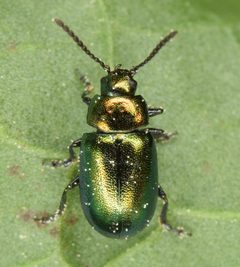
Gastrophysa cyanea is a small leaf beetle in the Chrysomelidae, measuring 4-5 mm with metallic green coloration that may shift to metallic blue in pinned specimens. The is found across North America and is strongly associated with dock plants (Rumex species), particularly curly dock. Females develop conspicuously swollen prior to laying, providing a reliable diagnostic feature. The species emerges in spring and has been the subject of behavioral studies examining plant recognition.
Pronunciation
How to pronounce Gastrophysa cyanea: //ɡæˈstrɒfɪsə saɪˈeɪniə//
These audio files are automatically generated. While they are not always 100% accurate, they are a good starting point.
Identification
are 4-5 mm in length with metallic green ; preserved specimens may appear metallic blue. Females are readily distinguished from males by their swollen, distended during the pre-oviposition period. The lacks the angulate pronotal sides seen in some related chrysomelids. Metallic coloration and small size separate it from most other North American leaf beetles, though it may be confused with other Gastrophysa species; G. cyanea is distinguished from the European G. viridula by geographic range and subtle color differences.
Images
Habitat
Associated with open, disturbed where dock plants (Rumex ) grow, including fields, roadsides, and waste areas. Specific microhabitat requirements beyond host plant presence are not well documented.
Distribution
North America, with records from Canada (Alberta, British Columbia) and the United States. The has also been reported from the Northern Territory of Canada. Precise southern limits of the range are not well defined in available sources.
Seasonality
emerge in spring; activity period likely extends through summer but specific details are limited.
Diet
Specialized feeder on dock plants (Rumex ), with curly dock (Rumex crispus) commonly reported as a . Laboratory studies confirm distinct behavioral reactions to host versus non-host plants, indicating chemical and physical cue recognition.
Host Associations
- Rumex - primary dock including curly dock
- Rumex crispus - primary commonly reported as curly dock
Life Cycle
Complete with , larval, pupal, and stages. Females with swollen indicate approaching oviposition; eggs are laid on or near plants. Larval development occurs on Rumex foliage. Specific details of larval instars and site are not documented in available sources.
Behavior
Exhibits distinct behavioral reactions to plants versus non-host plants, including differential responses to chemical and physical plant cues. This host recognition has been experimentally demonstrated. are active in spring and presumably given typical chrysomelid activity patterns, though specific activity patterns are not detailed.
Ecological Role
Herbivore specializing on Rumex ; likely contributes to of weedy dock in natural and agricultural settings. Specific functions beyond herbivory are not documented.
Human Relevance
Potential minor beneficial role in suppression of weedy Rumex in pastures and agricultural fields. Not reported as a significant agricultural pest or subject to deliberate programs.
Similar Taxa
- Gastrophysa viridulaSimilar (green dock ), size, and association with Rumex; distinguished by Palearctic distribution (Europe, Asia) versus Nearctic distribution of G. cyanea, and subtle differences in coloration
- Gastrophysa polygoniCongeneric with similar and plant associations; precise distinguishing features require examination of genitalia or subtle color pattern differences
- Other small metallic ChrysomelidaeGeneral similarity in size and metallic coloration; distinguished by association with Rumex plants and female abdominal swelling in G. cyanea
Sources and further reading
- BugGuide
- Wikipedia
- GBIF taxonomy match
- iNaturalist taxon
- NCBI Taxonomy
- I don’t think you’re ready for these Jellies: A brief dive into the world of Jellyfish - Buglife Blog - Buglife
- An Introduction to the Wonderful World of Wasps: Meet the Heath Sand Wasp - Buglife Blog - Buglife
- Why did it take 30 years to collect these beetles? | Beetles In The Bush
- predator avoidance | Beetles In The Bush | Page 4
- Florida | Beetles In The Bush | Page 2
- Heliconiidae | Beetles In The Bush
- Reactions of the Green Dock Beetle, Gastrophysa cyanea (Coleoptera: Chrysomelidae), to Its Host and Certain Nonhost Plants