
Gastrophysa polygoni
(Linnaeus, 1758)
Knotweed Leaf Beetle
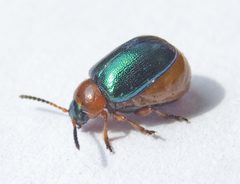
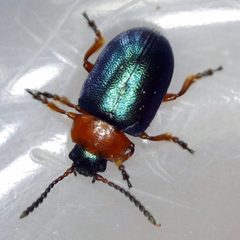
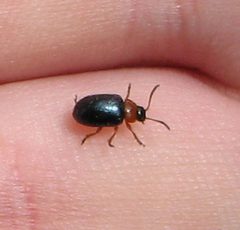
Gastrophysa polygoni is a small leaf beetle in the Chrysomelinae, described by Carl Linnaeus in 1758. reach approximately 5 mm in length and display distinctive coloration: metallic green wing cases (), green-blue body, and orange . The is native to Europe and has become established in North America, where it was introduced early in colonial settlement. It feeds primarily on Polygonaceae plants, serving as a beneficial agent for weeds such as knotweeds and docks, though it occasionally damages cultivated buckwheat. The exhibits complex reproductive including olfactory examination of airspace, track marking by females, and post-copulatory cleaning rituals.
Pronunciation
How to pronounce Gastrophysa polygoni: //ɡæˈstrɒfɪsə pəˈlɪɡoʊnaɪ//
These audio files are automatically generated. While they are not always 100% accurate, they are a good starting point.
Identification
are distinguished by their small size (up to 5 mm), metallic green , green-blue body coloration, and contrasting orange . The combination of these color features separates G. polygoni from similar Gastrophysa . G. viridula (dock leaf beetle) is larger and typically more uniformly green or bronze, lacking the orange thoracic coloration. G. polygoni can be further distinguished by its association with Polygonum and Rumex plants rather than the broader Rumex specialization of G. viridula.
Images
Habitat
Found in open, disturbed including cereal fields, agricultural margins, roadsides, and waste ground where plants of the Polygonaceae occur. In North America, occupies similar anthropogenic habitats in the northeastern United States and eastern Canada.
Distribution
Native to Europe and Northern Asia (excluding China). Introduced to North America where it is widely distributed in the northeastern United States and eastern Canada, including the Maritime Provinces. Present in Belgium and established across much of temperate Europe.
Seasonality
of the emerge in late April to May in temperate regions. Two generations typically occur during spring and summer months, with occasional partial third generations in favorable years. Active primarily in spring and summer.
Diet
and larvae feed on Polygonaceae plants. Primary include Polygonum aviculare (knotgrass), P. convolvulus (black bindweed), Fallopia , and Rumex species (docks and sorrels). Can be a minor pest of cultivated buckwheat (Fagopyrum spp.). Laboratory studies show larval survival and development rates are highest on P. aviculare and P. convolvulus compared to other Polygonaceae.
Host Associations
- Polygonum aviculare - primary Preferred oviposition site; supports highest larval survival and fastest development
- Polygonum convolvulus - primary Supports high larval survival and development, though less preferred for oviposition than P. aviculare
- Fallopia spp. - Weedy , part of beneficial weed control role
- Rumex spp. - Includes docks and sorrels; shared with G. viridula
- Fagopyrum spp. - crop Cultivated buckwheat; minor pest status
Life Cycle
emerge in late April to May. Two per year are typical in temperate regions, with possible partial third generation. Oviposition period lasts approximately 44 days for first generation, 25 days for second generation. ranges from 586 to 1028 per female, generally higher in first generation. Eggs are laid on plant foliage. Larval development is faster and survival higher on preferred Polygonum . occurs in soil.
Behavior
Males perform olfactory examination of airspace from plants to locate females. Females mark tracks with chemical signals during movement. Post-copulatory cleaning of legs and occurs in males. Females signal parting from males by raising hind legs. Both sexes exhibit at meeting points. are repelled by high concentrations of synthetic volatile organic compound blends in laboratory experiments.
Ecological Role
Beneficial agent for Polygonaceae weeds including knotweeds, docks, and sorrels. Contributes to natural suppression of and agricultural weeds without chemical intervention. Serves as prey for and , though rates appear low in field . Minor pest of cultivated buckwheat represents occasional economic conflict.
Human Relevance
Primarily beneficial as a weed agent, reducing of problematic Polygonaceae weeds in agricultural and disturbed . Minor pest status on cultivated buckwheat requires occasional management in buckwheat-growing regions. Subject of research on non-target effects of herbicides and in cereal crops, demonstrating vulnerability to exposure and indirect effects via plant removal.
Similar Taxa
- Gastrophysa viridulaSimilar size and general , but lacks orange , is typically more uniformly green to bronze, and specializes more narrowly on Rumex rather than broader Polygonum/Fallopia/Rumex range of G. polygoni
- Chrysolina graminisSimilar leaf beetle habitus but different color pattern and plant associations (grasses and Lamiaceae, not Polygonaceae)
More Details
Pesticide Sensitivity
Studies demonstrate significant vulnerability to direct exposure. capture 1.3- to 2.5-fold more spray volume than equivalent leaf surface area, leading to estimated 40.7% mortality at full recommended dimethoate field rates. Survivors exhibit reduced . Herbicide applications (2,4-D, CMPP mixtures) reduce indirectly via plant elimination.
Reproductive Biology
Detailed behavioral studies reveal complex mate location and courtship. Males use olfactory examination from elevated positions to detect female trails. Females actively mark movement tracks. Copulatory bursts of activity occur, followed by female-initiated parting signals and male .
Sources and further reading
- BugGuide
- Wikipedia
- GBIF taxonomy match
- iNaturalist taxon
- NCBI Taxonomy
- 'Battus philenor! Battus philenor!' | Bug Squad
- Bug Eric: City Nature Challenge 2023 Recap
- Archive — Bug of the Week
- Eumastacidae | Beetles In The Bush
- Introduced leaf beetles of the Maritime Provinces, 8: Gastrophysa polygoni Linnaeus (Coleoptera: Chrysomelidae)
- Beetle Orientation Responses of Gastrophysa viridula and Gastrophysa polygoni (Coleoptera: Chrysomelidae) to a Blend of Synthetic Volatile Organic Compounds
- The effects of herbicides on the chrysomelid beetle Gastrophysa polygoni (L.) in the laboratory and field
- Observations on the biology and ecology of the chrysomelid beetle Gastrophysa polygoni in cereal fields
- The toxic effects of direct pesticide exposure for a nontarget weed-dwelling chrysomelid beetle (Gastrophysa polygoni) in cereals
- Figure 1 - The strategy of reproductive behavior of a female leaf beetle. 1.1 - female Gastrophysa polygoni L. marking her track (photo by V.N. Makarenkov); 1.2 - a burst of activity of a pair of copulating Gastrophysa polygoni (photo by SI Pavlov); 1.3 - a burst of activity of the male cassida rubiginosa Müll. (photo by S.I. Pavlov); 1.4 - a burst of activity of the female shitonoski-Cassida rubiginosa (photo by S.I.Pavlov); 1.5 - signal of "parting" of the female of the willow blue leaf beetle Plagiodera versicolora Laich. (photo by S.I. Pavlov); 1.6 - signal of the "parting" of the female and the departure of the male of Plagiodera versicolora (photo by SI Pavlov); 1.7 - pulling off the male (raised hind leg) - signal of “parting” of the female of Gastrophysa polygoni (photo by SI Pavlov); 1.8 - egg-laying (the moment the cap is molded) of the hidden head female (photo by V.N. Makarenkov)
- Figure 3 - The strategy of reproductive behavior of the male leaf beetle. 3.1 - premarital search flights of male Cryptocephalus octocosmus Bedel. (photo by V.N. Makarenkov); 3.2 - olfactory examination from a plant of airspace by a male Gastrophysa polygoni (photo by V.N. Makarenkov); 3.3 - "reading" of scent information in the "air cylinder" around the wormwood bush by the male Chrysolinae graminis L. (Fig. SI Pavlov); 3.4 - contact ("step-by-step") search for a female on a fresh track by a male Plagiodera versicolora (photo by SI Pavlov); 3.5 - meeting point - aggregation of leaf beetles - Chrysomela populi L. (photo by O. Pavlova); 3.6 - the ritual of meeting (touching) sexually mature beetles Timarcha tenebricosa F. (photo by S.I. Pavlov); 3.7 - cage (in copuli state) of Agelastica alni L. beetles (photo by OV Pavlova); 3.8 - postbreeding cleaning of the legs and antennae of the male Gastrophysa polygoni (photo by S.I.Pavlov)
- The genome sequence of knotweed leaf beetle, Gastrophysa polygoni (Linnaeus, 1758).