
Cassida
Linnaeus, 1758
Shiny Tortoise Beetles
Species Guides
6- Cassida azurea(Azure tortoise beetle)
- Cassida flaveola(pale tortoise beetle)
- Cassida piperata(Small Tortoise Beetle)
- Cassida relicta(Pink Plains Cassidine)
- Cassida rubiginosa(Thistle Tortoise Beetle)
- Cassida viridis(green tortoise beetle)
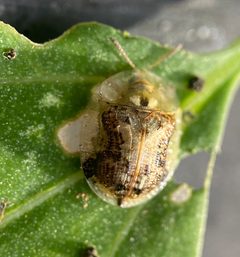
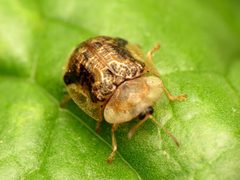
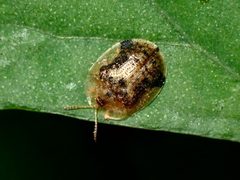
Cassida is a large Old World of tortoise beetles containing at least 430 described , making it the most species-rich genus in the Cassidinae. The genus is characterized by a distinctive tortoise-like body form with expanded and prothorax that form a protective shield over the and appendages. Several species are significant agricultural pests, notably C. vittata and C. nebulosa on sugar beet and spinach. The thistle (C. rubiginosa) has been employed as a agent against Canada thistle. The genus name derives from Latin 'cassis' meaning metal helmet, referencing the protective body shape.
Pronunciation
How to pronounce Cassida: /ˈkas.si.da/
These audio files are automatically generated. While they are not always 100% accurate, they are a good starting point.
Images
Distribution
Old World distribution with greatest diversity in the Palearctic region. Specific distribution varies by : C. rubiginosa is Palearctic in origin and introduced to North America; C. flaveola has Holarctic distribution and is at least partly native to North America; C. piperata is native to East Palaearctic and Indomalayan Regions and recently established in northern Italy (2021-2025).
Life Cycle
Larvae construct defensive shields using their own and , a widespread trait among tortoise beetles. Larvae of C. rubiginosa and related carry these fecal shields on a fork-like caudal appendage. First instar larvae of closely related species such as C. palaestina and C. rubiginosa are morphologically extremely similar and lack clear diagnostic characters.
Behavior
and larvae are defoliators. Larvae use fecal shields as mobile defensive structures against with chewing mouthparts such as lady beetles; this defense is less effective against predators with . Adults can move slowly while grazing or rapidly escape threats by dropping from vegetation. Some overwinter as adults in protected locations such as log piles or building walls.
Ecological Role
Several function as agents for thistles. Cassida rubiginosa reduces thistle competitive ability through defoliation and the rust fungus Puccinia carduorum. As phytophagous beetles, species in this contribute to herbivore pressure on plants and participate in dynamics as prey for various .
Human Relevance
Multiple are agricultural pests: C. vittata and C. nebulosa damage sugar beet and spinach crops. C. rubiginosa has been intentionally introduced as a biocontrol agent for Canada thistle and other thistles in North America. Some species such as C. piperata are non-native invaders with potential to become pests of cultivated plants.
Sources and further reading
- BugGuide
- Wikipedia
- iNaturalist taxon
- NCBI Taxonomy
- Catalogue of Life
- Eaters of thistles: Thistle tortoise beetle, Cassida rubiginosa, and Canada thistle bud weevil, Larinus planus — Bug of the Week
- Northern Ireland, invertebrate finds in review 2023 - Buglife Blog - Buglife
- Little Organisms, Big World: Insect Gut Bacteria Partnerships
- Chrysomelidae | Beetles In The Bush | Page 4
- literature | Beetles In The Bush | Page 5
- Introduced leaf beetles of the Maritime Provinces, 7: Cassida rubiginosa Muller and Cassida flaveola Thunberg (Coleoptera: Chrysomelidae)
- Description of larvae of two closely related species Cassida palaestina Reiche, 1858 and Cassida rubiginosa Müller, 1776 (Coleoptera: Chrysomelidae: Cassidinae)
- Cassida piperata Hope, 1843 (Coleoptera, Chrysomelidae), a non-native beetle, new to Italy and Europe.
- Characteristic of the excretory system in Cassida palaestina Reiche, 1858 (Coleoptera: Chrysomelidae: Cassidinae).