
Cassida rubiginosa
Müller, 1776
Thistle Tortoise Beetle
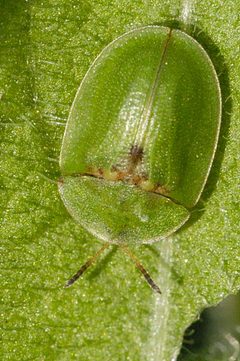
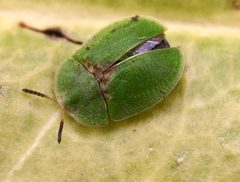
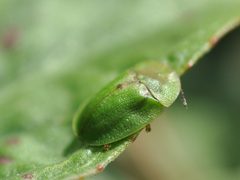
Cassida rubiginosa, commonly known as the thistle tortoise beetle, is a leaf beetle in the Cassidinae native to Europe and Asia that has been introduced to North America, New Zealand, and other regions as a agent for thistles. The derives its from the tortoise-like appearance of , whose and pronotum form a shield-like covering over the body. Both adults and larvae feed on thistle foliage, with larvae possessing a distinctive defensive structure—a forked caudal appendage used to carry accumulated and as a mobile 'fecal shield' that deters . The has demonstrated effectiveness in reducing thistle and seed production, though its range extends beyond the primary target to other Cardueae species.
Pronunciation
How to pronounce Cassida rubiginosa: //ˈkas.si.da ru.bi.ɡiˈnoː.sa//
These audio files are automatically generated. While they are not always 100% accurate, they are a good starting point.
Identification
are recognized by the combination of: broadly oval body with expanded pronotum covering the ; green coloration (despite the 'rusty' name); association with thistles (Cirsium, Carduus). Distinguished from other Cassida by genitalia and subtle elytral characters. Larvae are identifiable by the fecal shield carried posteriorly, a trait shared with other Cassidinae but with species-specific differences in scoli length and shape compared to C. palaestina. In North America, most likely to be confused with other introduced Cassida species; C. flaveola is smaller and more yellowish.
Images
Habitat
Found in open, disturbed where thistles grow, including agricultural fields, pastures, roadsides, and riparian areas. In its native range, occupies similar habitats. In introduced regions, often associated with cultivated lands and grasslands where thistles are problematic. Requires presence of host plants for all life stages.
Distribution
Native to the Palearctic region (Europe and Asia). Introduced and established in North America (first recorded in Canada in 1901, Virginia by 1973, now widespread including Maritime Provinces); New Zealand (established for biocontrol); and potentially other regions where released for thistle control. Records also from Iran and other parts of its expanded range.
Seasonality
emerge in spring and are active through the growing season. Oviposition occurs on plant leaves, often in proximity to adult feeding sites. Larval development occurs through summer; takes place on host plants. Multiple may occur in favorable climates, though specific timing varies by region. In temperate regions, adults likely overwinter, though detailed phenological data varies by location.
Diet
Both and larvae are folivores specialized on thistles (tribe Cardueae/Cynareae). Primary is Cirsium arvense (Canada thistle/Californian thistle). Other documented hosts include Carduus nutans (nodding/musk thistle), Carduus acanthoides (plumeless thistle), Cirsium vulgare (bull thistle), and other Cirsium and Carduus . Laboratory studies show acceptance of Silybum marianum (milk thistle) and Onopordum boissieri, with measurable effects on development time. Some feeding recorded on safflower and sunflower under no-choice conditions, but without oviposition. Host acceptance follows phylogenetic patterns, with strongest preference for plants closely related to Cirsium arvense.
Host Associations
- Cirsium arvense - primary Canada thistle/Californian thistle; main target for biocontrol
- Carduus nutans - Nodding thistle/musk thistle
- Carduus acanthoides - Plumeless thistle/welted thistle
- Cirsium vulgare - Bull thistle
- Silybum marianum - laboratory Milk thistle; supports development but not primary field
- Onopordum boissieri - laboratory Supports development with longer development time than S. marianum
- Carthamus tinctorius - occasional feedingSafflower; limited feeding without oviposition in lab
- Helianthus annuus - occasional feedingCommon sunflower; limited feeding under no-choice conditions only
- Puccinia carduorum - Rust fungus transmitted by activity
Life Cycle
Complete with , five larval instars, pupa, and stages. Eggs are deposited on plant leaves, often covered with excrement. Larvae feed gregariously or solitarily depending on instar, with early instars sometimes showing (circular defensive formations). Development time varies with temperature and host plant: mean total development approximately 27 days on Silybum marianum, 30 days on Onopordum boissieri at laboratory conditions. occurs on host plant. Adult longevity and reproductive output vary with environmental conditions. No reported; likely overwinters as adult in temperate regions.
Behavior
feed on leaf surfaces, creating characteristic scraping damage. When disturbed, adults can move rapidly across leaves or drop to escape. Larvae carry a mobile fecal shield on the forked caudal appendage, which is raised and waved when threatened to deter —effective against chewing predators like lady beetles but less so against piercing-sucking predators like spined soldier bugs. Early instar larvae may aggregate in circular formations () with directed inward and fecal shields outward, a defensive reported in related tortoise beetles. Oviposition typically occurs on plant leaves in close proximity to feeding sites, with females showing strong preference for host plants based on olfactory cues and phylogenetic relatedness to primary host.
Ecological Role
herbivore and agent for thistles. Defoliation reduces plant photosynthetic capacity, , and competitive ability. Feeding by 20 larvae can reduce Canada thistle biomass by 78% and seed production by 94% in controlled conditions. Acts as for plant pathogenic fungi (Puccinia carduorum), potentially enhancing weed suppression. Serves as prey for including lady beetles, spined soldier bugs, and others; larval fecal shields provide partial defense. Contributes to nutrient cycling through herbivory and deposition.
Human Relevance
Primary significance is as a agent for thistles, particularly Cirsium arvense in agricultural and rangeland settings. Accidentally introduced to North America (1901) and deliberately introduced to New Zealand and other regions. Reduces thistle competitiveness in crops and pastures; in wheat-thistle competition experiments, presence increased wheat yield by 46–82%. Concerns exist regarding non-target effects on native thistle , though range appears largely restricted to Cardueae. Not a direct pest of cultivated crops except occasional feeding on safflower and sunflower under confined conditions. No significant medical or veterinary importance.
Similar Taxa
- Cassida palaestinaClosely related vicariant with partially parapatric distribution; larvae nearly identical in early instars, distinguished in last instars by slightly shorter lateral scoli and different ; distinguished by genitalia and subtle external characters
- Cassida flaveolaSmaller, more yellowish introduced tortoise beetle in same ; recently determined to be at least partially native in Holarctic region; associated with different plants
- Labidomera clivicollisAnother green leaf beetle (Chrysomelidae) found on milkweeds; lacks tortoise-like body form and expanded pronotum of Cassida
- Leptinotarsa decemlineataColorado potato beetle, a more familiar chrysomelid; has striped and different body shape, not tortoise-like
More Details
Bacterial Symbiosis
Cassida rubiginosa maintains bacterial that are vertically transmitted to offspring via deposition on in a protected caplet, contributing to nutritional or defensive functions.
Biocontrol History
First discovered in North America in 1901 in Canada, with spread to Virginia by 1973. Established in New Zealand for deliberate of Californian thistle. Effectiveness varies by region and thistle .
Phylogenetic Host Selection
First herbivorous insect demonstrated to show phylogenetic pattern in olfactory plant selection; 66.9% of variation in olfactory recognition and 82.8% in olfactory preference explained by phylogenetic distance from primary host Cirsium arvense.
Temperature Adaptation
Less susceptible to low rearing temperatures than related C. stigmatica, consistent with broader native distribution; however, less adapted to late-season short-day conditions than C. stigmatica.
Sources and further reading
- BugGuide
- GBIF taxonomy match
- iNaturalist taxon
- NCBI Taxonomy
- Little Organisms, Big World: Insect Gut Bacteria Partnerships
- Archive — Bug of the Week
- Eaters of thistles: Thistle tortoise beetle, Cassida rubiginosa, and Canada thistle bud weevil, Larinus planus — Bug of the Week
- Northern Ireland, invertebrate finds in review 2023 - Buglife Blog - Buglife
- Cycloalexy in tortoise beetle larvae | Beetles In The Bush
- pleasing fungus beetles | Beetles In The Bush
- Introduced leaf beetles of the Maritime Provinces, 7: Cassida rubiginosa Muller and Cassida flaveola Thunberg (Coleoptera: Chrysomelidae)
- Description of larvae of two closely related species Cassida palaestina Reiche, 1858 and Cassida rubiginosa Müller, 1776 (Coleoptera: Chrysomelidae: Cassidinae)
- Initial test of a semiartificial diet for the thistle biocontrol beetle, Cassida rubiginosa
- Bio-ecology of Cassida rubiginosa fed on Silybum marianum and Onopordum boissieri in laboratory conditions
- Impact of the biocontrol beetle, Cassida rubiginosa, on the secondary weed target, marsh thistle (Cirsium palustre)
- Plant phylogeny determines host selection and acceptance of the oligophagous leaf beetle Cassida rubiginosa
- Feeding by Cassida rubiginosa (Coleoptera: Chrysomelidae) and the Effects of Defoliation on Growth of Musk Thistles
- Effects of Temperature and Photoperiod on the Immature Development in Cassida rubiginosa Müll. and C. stigmatica Sffr. (Coleoptera: Chrysomelidae)
- Host Impact and Specificity of Tortoise Beetle (Cassida rubiginosa) on Canada Thistle (Cirsium arvense) in Iran
- Oviposition site selection by herbivorous beetles: a comparison of two thistle feeders, Cassida rubiginosa and Henosepilachna niponica
- Seasonal Fluctuation, Age Structure, and Annual Changes in a Population of <I>Cassida rubiginosa</I> (Coleoptera: Chrysomelidae) in a Natural Habitat