
Cassida flaveola
Thunberg, 1794
pale tortoise beetle
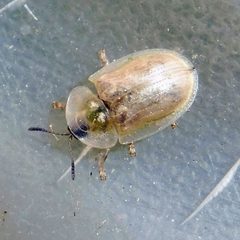
Cassida flaveola, known as the pale tortoise beetle, is a brownish leaf beetle in the Chrysomelidae. It was historically considered an introduced Palearctic in North America, but recent evidence indicates it is at least in part native with a Holarctic distribution. The species has been newly recorded in Nova Scotia and Prince Edward Island in the Maritime Provinces of Canada.


Pronunciation
How to pronounce Cassida flaveola: //ˈkas.si.da flaˈve.o.la//
These audio files are automatically generated. While they are not always 100% accurate, they are a good starting point.
Identification
Distinguished from other Cassida by its brownish coloration and the specific plant associations with Caryophyllaceae species. Similar to other tortoise beetles in general body form but differs in coloration and host plant specificity. The species name 'flaveola' (meaning somewhat yellow) may relate to subtle coloration differences from darker .
Images
Habitat
Associated with vegetation on upper strandlines or sandy/chalky soils; found in coastal and areas supporting its Caryophyllaceae plants.
Distribution
extending east to the Russian Far East; North America with Holarctic distribution (at least in part native); newly recorded in Nova Scotia and Prince Edward Island in the Maritime Provinces of Canada.
Diet
Specialized herbivore feeding on Caryophyllaceae .
Host Associations
- Cerastium vulgatum - plantCaryophyllaceae
- Honckenya peploides - plantCaryophyllaceae
- Malachium aquaticum - plantCaryophyllaceae
- Spergula arvensis - plantCaryophyllaceae
- Spergula nemorum - plantCaryophyllaceae
- Stellaria graminea - plantCaryophyllaceae
- Stellaria media - plantCaryophyllaceae
Behavior
and larvae feed on leaves of plants. Larvae likely construct fecal shields for defense, as is characteristic of the Cassidinae, though this has not been explicitly documented for this .
Ecological Role
Herbivore specializing on Caryophyllaceae; contributes to potential of its plants. May serve as prey for and .
Human Relevance
Subject of taxonomic and zoogeographic interest due to questions about its native versus introduced status in North America. Has potential as a biocontrol agent for weedy Caryophyllaceae .
Similar Taxa
- Cassida rubiginosaSimilar tortoise beetle but differs in coloration (more reddish in C. rubiginosa) and plant associations (C. rubiginosa specializes on thistles, Asteraceae)
- Other Cassida speciesShare general tortoise beetle body form but differ in coloration, plant specificity, and geographic distribution
Misconceptions
Previously considered an introduced Palearctic in North America, but recent evidence indicates C. flaveola is at least in part a native species with a Holarctic distribution. Early records and origins in the Maritime Provinces remain subject to investigation regarding possible human-mediated introduction.
More Details
Taxonomic and Zoogeographic Status
The native versus introduced status of C. flaveola in North America has been debated. A 2008 study in Zootaxa concluded that recent evidence indicates it is at least in part a native with a Holarctic distribution, rather than solely a human-introduced Palearctic species.
Research Needs
Questions remain regarding the presence and origins of C. flaveola in the Maritime Provinces, including whether it may have been introduced via human agency in some areas while being native in others.
Sources and further reading
- BugGuide
- Wikipedia
- GBIF taxonomy match
- iNaturalist taxon
- NCBI Taxonomy
- Meloidae Holdings | Entomology Research Museum
- Eaters of thistles: Thistle tortoise beetle, Cassida rubiginosa, and Canada thistle bud weevil, Larinus planus — Bug of the Week
- Northern Ireland, invertebrate finds in review 2023 - Buglife Blog - Buglife
- Little Organisms, Big World: Insect Gut Bacteria Partnerships
- Chrysomelidae | Beetles In The Bush | Page 4
- Introduced leaf beetles of the Maritime Provinces, 7: Cassida rubiginosa Muller and Cassida flaveola Thunberg (Coleoptera: Chrysomelidae)