
Cassida azurea
Fabricius, 1801
Azure tortoise beetle
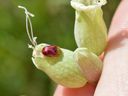
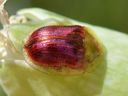
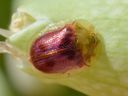
Cassida azurea is a tortoise beetle in the leaf beetle Chrysomelidae, native to Europe and Northern Asia. It was intentionally introduced to North America in 1989 as a agent targeting the weed Silene vulgaris (bladder campion). specificity testing demonstrated extremely narrow feeding preferences, with occurring almost exclusively on S. vulgaris. Field releases in Manitoba, Saskatchewan, and Alberta from 1989–1993 resulted in establishment at 8 of 18 sites, though have remained insufficient to achieve effective weed suppression.
Pronunciation
How to pronounce Cassida azurea: //ˈkæsɪdə əˈzjʊəriə//
These audio files are automatically generated. While they are not always 100% accurate, they are a good starting point.
Identification
As a member of Cassida, this possesses the characteristic tortoise beetle : a highly convex, shield-like body with the pronotum and forming a continuous rounded covering that conceals the and legs from above. The specific epithet "azurea" suggests blue coloration, though precise diagnostic features distinguishing C. azurea from are not documented in available sources. Identification to species level likely requires examination of genitalic structures or other microscopic characters typical of the genus.
Images
Habitat
Associated with Silene vulgaris (bladder campion) in agricultural fields, disturbed ground, and other where this weed occurs. In its native range, occupies similar environments supporting Caryophyllaceae host plants. Canadian release sites were located in prairie provinces with suitable climatic conditions for the host plant.
Distribution
Native to Europe and Northern Asia (excluding China). Introduced and established in North America, specifically in the Canadian provinces of Manitoba, Saskatchewan, and Alberta, following intentional releases from 1989 to 1993. Established confirmed at 8 of 18 release sites as of the mid-1990s assessment.
Diet
Specialized herbivore feeding almost exclusively on Silene vulgaris (bladder campion, Caryophyllaceae). First-instar larvae successfully developed to adulthood only rarely on alternative : one male on Dianthus caryophyllus and one female on Lychnis × haageana (the latter did not oviposit). occurred only when fed on S. vulgaris, with a single exception of one laid on Gypsophila pacifica. First-instar larvae failed to reach adulthood on three native North American Silene , though two adults developed on three other native Silene species.
Host Associations
- Silene vulgaris - primary , essential for bladder campion; target weed for
- Dianthus caryophyllus - rare larval developmentone male developed to adulthood in no-choice experiment
- Lychnis × haageana - rare larval developmentone female developed but did not oviposit
- Gypsophila pacifica - marginal oviposition single laid, no further development documented
- Native North American Silene spp. - variable larval developmentfirst-instar larvae failed on three ; two developed on three other species
Life Cycle
Holometabolous development with , larval, pupal, and stages. First-instar larvae feed on foliage; development to adulthood is prolonged and rarely successful on non-target plants. Fecal shield construction by larvae has been documented in but not explicitly confirmed for this . Adults overwinter and resume feeding and in spring. Field in Canada persisted for 3–6 years post-release, suggesting at least partial success.
Behavior
and larvae feed on leaf tissue of plants. Like other Cassida , larvae likely carry a mobile fecal shield—a forked structure at the bearing accumulated excrement that serves as a chemical and physical defense against with chewing mouthparts. Adults may drop from foliage when disturbed. Movement between host patches likely limited by narrow dietary specialization.
Ecological Role
Herbivore and, in North America, intentionally introduced agent. Functions as a consumer of Silene vulgaris with minimal direct impact on native flora due to high specificity. levels in Canada have remained below thresholds necessary for effective suppression of the target weed, limiting its realized impact.
Human Relevance
Deployed as a agent against Silene vulgaris, an weed in North American agriculture. specificity testing supported regulatory approval for release. Establishment has been confirmed but densities remain insufficient to reduce weed populations effectively. No documented negative economic or ecological impacts from introduction.
Similar Taxa
- Cassida rubiginosaCongeneric tortoise beetle with similar and ; thistle-feeding accidentally introduced to North America; distinguished by association (Cirsium spp. vs. Silene vulgaris) and likely coloration differences
- Cassida nobilisEuropean tortoise beetle with similar shield-like body form; associated with salt-tolerant vegetation on upper strandlines rather than agricultural weeds; distinguished by and plant preferences
More Details
Biological control history
Permission for field release in Canada was granted in 1989 following extensive specificity testing. Releases occurred across 18 sites in three prairie provinces from 1989–1993. Survival documented at 3–6 years post-release, but the has not achieved densities sufficient to reduce bladder campion , representing a case of establishment without effective control.
Symbiont transmission
While not documented specifically for C. azurea, of bacterial via caplets has been demonstrated in the C. rubiginosa. This mechanism may occur in C. azurea given phylogenetic proximity and shared traits within the .
Sources and further reading
- BugGuide
- Wikipedia
- GBIF taxonomy match
- iNaturalist taxon
- NCBI Taxonomy
- Going Native: Do You Know the Native Bees of California? | Bug Squad
- Why Timing Is Everything in Bumble Bee Colonies | Bug Squad
- No Cabbage White Butterfly, No Bumble Bee | Bug Squad
- Eaters of thistles: Thistle tortoise beetle, Cassida rubiginosa, and Canada thistle bud weevil, Larinus planus — Bug of the Week
- Northern Ireland, invertebrate finds in review 2023 - Buglife Blog - Buglife
- Little Organisms, Big World: Insect Gut Bacteria Partnerships
- CASSIDA AZUREA FAB. (COLEOPTERA: CHRYSOMELIDAE): HOST SPECIFICITY AND ESTABLISHMENT IN CANADA AS A BIOLOGICAL CONTROL AGENT AGAINST THE WEED SILENE VULGARIS (MOENCH) GARCKE