
Timarcha
Samouelle, 1819
bloody-nosed beetles
Species Guides
1- Timarcha intricata(Intricate Leaf Beetle)
Timarcha is a of flightless leaf beetles comprising over 100 across three subgenera, with a disjunct distribution spanning the Mediterranean region and western North America. The genus exhibits several unusual traits for Chrysomelidae, including complete apterism (winglessness), , and archaic genital . All species are uniformly black and herbivorous, with plant associations concentrated in Rubiaceae and Plumbaginaceae. The most familiar species is T. tenebricosa, commonly known as the bloody-nosed , named for its defensive .
Pronunciation
How to pronounce Timarcha: //tɪˈmɑːrkə//
These audio files are automatically generated. While they are not always 100% accurate, they are a good starting point.
Identification
Timarcha is distinguished from other Chrysomelinae by the combination of complete winglessness (apterism), without visible , and uniformly black coloration. The is the sole member of tribe Timarchini, which can be recognized by the ring-like tegmen of the male genitalia covered by a setose parameral cap—a plesiomorphic character state unique among Chrysomelinae. The compact, rounded body form and lack of any elytral patterning further separate Timarcha from superficially similar dark leaf beetles.
Images
Appearance
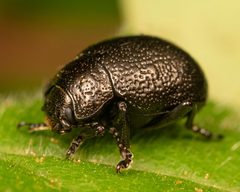
All are uniformly black, flightless beetles with that completely cover the . The body is compact and rounded, with a convex surface. lack functional wings; the elytra are solidly fused along the midline with no separation. Body size varies among species. The is typically smooth to moderately sculptured, with microstructural variation on the and pronotum surface between individuals. are relatively short. in adults is subtle, primarily involving body size and minor cuticular features.
Habitat
Mediterranean and western North American ranging from coastal areas to high mountain elevations. occupy diverse terrestrial environments including rocky slopes, grasslands, and shrublands. High mountain species such as T. lugens occur in alpine zones. Specific microhabitat requirements vary by species and plant distribution.
Distribution
Disjunct Holarctic distribution: primarily circum-Mediterranean (Europe, North Africa, Middle East) with a secondary center in northwestern North America. The geographic pattern suggests ancient origins with subsequent range fragmentation.
Seasonality
Activity patterns vary by and climate. T. rugulosa lomnickii in Poland is monovoltine with and stages . Oviposition occurs in spring and autumn; spring eggs develop without while autumn eggs undergo diapause until the following spring.
Diet
Herbivorous, feeding primarily on plants in Rubiaceae and Plumbaginaceae. Some additionally utilize Brassicaceae and Rosaceae. plant range spans 8 plant families and 20 . Subgenera Metallotimarcha and Americanotimarcha share Ericaceae as a host family; Rubiaceae is shared among subgenera Timarcha, Timarchostoma, and Metallotimarcha.
Host Associations
- Rubiaceae - primary plantmajor for most
- Plumbaginaceae - primary plantmajor for most
- Ericaceae - plantshared by subgenera Metallotimarcha and Americanotimarcha
- Brassicaceae - plantutilized by some
- Rosaceae - plantutilized by some
Life Cycle
Complete with , three larval instars, , and pupa. Larval instars distinguished by body size, mass, color intensity of structures, and morphological details of , mouthparts (, ), and capsule microstructure. First instar larvae possess egg bursters. Pupae exhibit in size and urogomphi structure. timing varies: some show oviposition patterns with differential strategies for spring- versus autumn-laid eggs.
Behavior
Defensive include ( exudation from leg joints), (death feigning), and stomatic regurgitation. These aposematic displays are effective against but not against or commensals. activity pattern. Males demonstrate mate choice based on female parasite load, avoiding heavily infected partners. Male competitiveness correlates negatively with parasite burden. Interspecific sexual behavior with blister beetles (Meloe) has been documented.
Ecological Role
Herbivorous consumers of specific plant , with potential influence on plant . Serve as hosts for protozoan gut that affect individual and mating patterns. Defensive chemistry and aposematism may contribute to deterrence in local .
Human Relevance
T. tenebricosa (bloody-nosed ) is the most widely known , recognized for its dramatic defensive . The has contributed to understanding of phylogeography, molecular , and the evolutionary dynamics of flightlessness in beetles. Some species occur in anthropogenic .
Similar Taxa
- Other Chrysomelinae leaf beetlesTimarcha differs in complete apterism, , and unique genital ; other retain functional wings and separable elytra
- Tenebrionidae (darkling beetles)Superficially similar black, compact beetles, but Timarcha has clubbed typical of Chrysomelidae and lacks the defensive glandular structures common in Tenebrionidae
Sources and further reading
- BugGuide
- Wikipedia
- iNaturalist taxon
- NCBI Taxonomy
- Catalogue of Life
- Timarcha Latreille: A strange beetle and a living fossil
- Molecular systematics and time-scale for the evolution of Timarcha, a leaf-beetle genus with a disjunct Holarctic distribution
- Ecology of the high mountain chrysomelid Timarcha lugens Rosenhauer (Chrysomelinae)
- Descriptions of the Developmental Stages and Notes on Biology of Timarcha Rugulosa Lomnickii Mill. (Coleoptera: Chrysomelidae)
- Les races de Timarcha punctella Latreille (Col. Chrysomelidae) au Maroc (suite). (Col. Chrysomelidae) au Maroc
- The species of Timarcha Samouelle, 1819 described by Linnaeus (Coleoptera, Chrysomelidae)
- Assortative pairing with respect to parasite load in the beetle Timarcha maritima (Chrysomelidae)
- Incongruent nuclear and mitochondrial phylogeographic patterns in the Timarcha goettingensis species complex (Coleoptera, Chrysomelidae)
- Strange Love 2: The Second Case of Interspecific Sexual Behavior Between Meloe Linnaeus and Timarcha Latreille (Coleoptera: Meloidae, Chrysomelidae)