
Chelymorpha
Chevrolat, 1836
Argus tortoise beetles, tortoise beetles
Species Guides
3- Chelymorpha cassidea(Argus tortoise beetle)
- Chelymorpha cribraria(Common Sieve Tortoise Beetle)
- Chelymorpha phytophagica
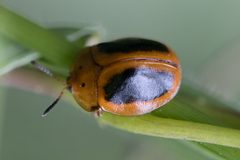
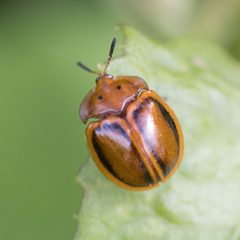
Chelymorpha is a of tortoise beetles in the Chrysomelidae, Cassidinae, containing more than 70 described distributed primarily in the Americas. These beetles are characterized by their domed, tortoise-like body form with the and prothorax forming a protective shield that can be drawn down to cover the and appendages when disturbed. The genus exhibits extensive intraspecific color , with some species showing remarkable variation in elytral coloration and maculation patterns. Chelymorpha species are predominantly associated with plants in the family Convolvulaceae, particularly morning glories (Ipomoea) and bindweeds (Convolvulus), though some species utilize other plants. The genus has been extensively studied for its endosymbiont , color polymorphism maintenance, and larval defensive including .

Pronunciation
How to pronounce Chelymorpha: //ˌkɛliˈmɔrfə//
These audio files are automatically generated. While they are not always 100% accurate, they are a good starting point.
Identification
Chelymorpha are recognized by their strongly convex, tortoise-like body form with the and expanded prothorax forming a continuous shield that extends laterally beyond the body margin. When disturbed, the and all appendages can be retracted beneath this shield, leaving no exposed soft tissues. The elytra are typically smooth or finely punctured, often brightly colored in yellow, orange, red, or metallic hues with variable black maculation patterns. The are short, not reaching the elytral base, with the terminal segments slightly expanded. Species identification is challenging due to extensive color within species and convergent color patterns between species; reliable identification often requires association with plant or examination of genitalic structures.
Images
Habitat
Found in diverse including tropical and subtropical forests, open woodlands, grasslands, and disturbed areas such as agricultural fields and roadsides. Many are associated with early successional habitats where their Convolvulaceae plants thrive. Some species, such as Chelymorpha constellata, have been documented in coastal sand dune .
Distribution
Primarily distributed in the Americas, with the greatest diversity in the Neotropics. Ranges from the southern United States through Mexico, Central America, and South America to Argentina. Some have been introduced or recorded from southern Europe. Specific distribution patterns vary by species; for example, Chelymorpha alternans occurs throughout the Isthmus of Panama with distinct structure, while Chelymorpha cassidea is found in North America.
Diet
and larvae feed on foliage of plants, primarily in the Convolvulaceae. Chelymorpha alternans has been documented feeding on Merremia umbellata in Panama. Some may sequester toxic alkaloids from their host plants, potentially gaining chemical protection from .
Host Associations
- Convolvulaceae - primary plant Most Chelymorpha are specialized on this plant , particularly morning glories (Ipomoea) and bindweeds (Convolvulus)
- Merremia umbellata - plantDocumented for Chelymorpha alternans in Panama
- Convolvulus arvensis - plantField bindweed; for Chelymorpha varians in Argentina, where it has been studied as a potential biocontrol agent for this widespread weed
Life Cycle
Complete with , larva, pupa, and stages. Larvae are case-bearing, constructing protective cases from fecal material and . Early-instar larvae of some exhibit , forming circular defensive with directed inward and exuvial-fecal debris masses directed outward. This provides protection against such as ants and . occurs within the larval case. Some species exhibit reproductive induced by short (12:12 h L:D), with diapause termination apparently governed by an rhythm around 128 days regardless of environmental conditions.
Behavior
When disturbed, withdraw the and all appendages beneath the domed and prothorax, presenting an impenetrable shield to . Larvae of some exhibit , forming circular defensive that create a protective barrier of exuvial-fecal debris masses. Adults may sequester toxic alkaloids from plants, providing chemical defense. Some species show courtship with males attempting to mate with females beginning 16-30 days after .
Ecological Role
Herbivores that can significantly impact plant ; some are considered agricultural pests, such as Chelymorpha constellata on sweet potato and related crops. The serves as a model system for studying insect-plant , host specialization, and the maintenance of genetic . Larvae and provide food for various including mantids, spiders, and ants, though chemical defenses may reduce pressure.
Human Relevance
Some are minor agricultural pests of sweet potato and other Convolvulaceae crops. Chelymorpha varians has been investigated as a potential biocontrol agent for field bindweed (Convolvulus arvensis), a widespread agricultural weed. The is widely used in scientific research on color , - interactions, reproductive , and insect-plant relationships.
Similar Taxa
- ParaselenisBoth are Neotropical tortoise beetle with domed body form and association with Convolvulaceae; Paraselenis typically has more strongly expanded lateral elytral margins and different antennal structure
- AnacassisBoth Cassidinae with tortoise-like form; Anacassis is primarily associated with Asteraceae (Baccharis) rather than Convolvulaceae, and has different elytral margin structure
- CassidaPalearctic tortoise beetle with similar defensive body form; differs in plant associations and geographic distribution
Sources and further reading
- BugGuide
- Wikipedia
- GBIF taxonomy match
- iNaturalist taxon
- NCBI Taxonomy
- Catalogue of Life
- Bugs in Orange and Black III – Argus tortoise beetle, Chelymorpha cassidea; oleander caterpillar, Syntomeida epilais; and wheel bug, Arilus cristatus (MISSING LINKS) — Bug of the Week
- Chrysomelidae | Beetles In The Bush | Page 4
- Bibliography | Beetles In The Bush
- The Life History of Chelymorpha alternans (Coleoptera: Chrysomelidae: Cassidinae) in Panamá
- Description of immatures of Chelymorpha reimoseri Spaeth, 1928 (Coleoptera: Chrysomelidae: Cassidinae: Mesomphaliini)
- Function of the spermathecal muscle in Chelymorpha alternans Boheman (Coleoptera: Chrysomelidae: Cassidinae)
- Biology of Chelymorpha constellata (Klug, 1829) (Chrysomelidae, Cassidinae) in sand dunes at Florianópolis, Island of Santa Catarina, southern Brazil
- Induction and termination of reproductive diapause in a neotropical beetle, Chelymorpha alternans (Coleoptera: Chrysomelidae)
- Variation in contact chemical cues may mediate differential predator response in the colour polymorphic tortoise beetle, Chelymorpha alternans
- Reproductive effects and geographical distributions of twoWolbachiastrains infecting the Neotropical beetle,Chelymorpha alternansBoh. (Chrysomelidae, Cassidinae)
- Effects of Foliar Endophytic Fungi on the Preference and Performance of the Leaf BeetleChelymorpha alternansin Panama
- Inheritance, distribution and genetic differentiation of a color polymorphism in Panamanian populations of the tortoise beetle, Chelymorpha alternans (Coleoptera: Chrysomelidae)
- Variation in Host Plant Usage and Diet Breadth Predict Sibling Preference and Performance in the Neotropical Tortoise Beetle Chelymorpha alternans (Coleoptera: Chrysomelidae: Cassidinae)