
Chelymorpha cassidea
(Fabricius, 1775)
Argus tortoise beetle, milkweed tortoise beetle
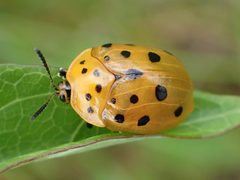
Chelymorpha cassidea is a large tortoise beetle native to North America and the Caribbean, measuring 9–12 mm in length. display variable coloration from yellow to bright red with black spots, and possess a distinctive ability to extend their red beyond the pronotum, creating an appearance likened to the mythological figure Argus. Both larvae and adults feed on foliage of Convolvulaceae plants, including morning glory and sweet potato, and are capable of defoliating entire plants. The overwinters as pupae in soil and emerges in mid-summer.


Pronunciation
How to pronounce Chelymorpha cassidea: //ˌkɛlɪˈmɔrfə ˌkæsɪˈdiːə//
These audio files are automatically generated. While they are not always 100% accurate, they are a good starting point.
Identification
Distinguished from other North American tortoise beetles by its large size (9–12 mm versus 5–8 mm for most relatives) and the distinctive red that can be extended beyond the pronotum. The color pattern of yellow to red with black spots resembles a ladybug (Coccinellidae), but the body shape is more flattened and shield-like. The Chelymorpha is distinguished from the similar genus Deloyala by larger size and different plant associations. Within Chelymorpha, C. cassidea is the only native to North America; the congeneric C. varians occurs in South America and has been considered for of field bindweed.
Images
Habitat
Occurs in meadows, roadsides, and other open where plants grow. Associated with disturbed areas and agricultural fields where Convolvulaceae weeds or crops are present.
Distribution
North America (United States, Canada, Mexico) and the Caribbean. Records indicate presence throughout eastern and central North America, with range extending into the Caribbean region.
Seasonality
active from mid-summer through fall. hatch within approximately 10 days. Larval development takes nearly three weeks. Pupae overwinter in soil, with adults emerging the following mid-summer.
Diet
Folivorous, feeding on leaves of Convolvulaceae. Documented plants include morning glory (Ipomoea spp.), sweet potato (Ipomoea batatas), field bindweed (Convolvulus arvensis), and related in the Ipomoea and Convolvulus. Also recorded feeding on milkweed (Asclepias), raspberry (Rubus), maize (Zea mays), though these may represent incidental or minor associations.
Host Associations
- Ipomoea - primary morning glory
- Ipomoea batatas - primary sweet potato
- Convolvulus arvensis - primary field bindweed
- Asclepias - secondary milkweed; may be misidentification or incidental feeding
- Rubus - secondary raspberry
- Zea mays - secondary maize
Life Cycle
are laid on leaves in clusters of 15–30. Eggs hatch within 10 days. Larvae feed on leaves for approximately three weeks until fully grown. Mature larvae drop to the soil to pupate. Pupae overwinter, with emerging in mid-summer. Adults are active through late summer and fall, with oviposition occurring during this period.
Behavior
and larvae feed openly on leaf surfaces. When disturbed, adults retract and appendages beneath the shield-like and pronotum. The ability to extend the red head forward is a distinctive , possibly serving as a defensive display. Larvae feed until fully grown, then actively leave plants to burrow into soil for .
Ecological Role
Herbivore and defoliator of Convolvulaceae plants. Capable of causing significant damage to plants, including complete defoliation. The 's bright coloration and association with alkaloid-containing host plants suggests aposematic (warning) coloration and possible of plant defensive compounds for protection against . Serves as host for and predatory insects.
Human Relevance
Considered a pest of sweet potato crops and ornamental morning glories. Damage can include complete defoliation of plants. The related South American Chelymorpha varians has been investigated as a potential agent for field bindweed (Convolvulus arvensis), a widespread agricultural weed. The 's striking appearance makes it a subject of interest for naturalists and photographers.
Similar Taxa
- Deloyala guttataAnother North American tortoise beetle with golden coloration that feeds on morning glories; distinguished by smaller size (5–7 mm), more rounded body shape, and iridescent golden coloration without the red extension capability.
- Jonthonota nigripesSmall tortoise beetle (5–6 mm) with black markings on ; feeds on morning glories but much smaller than C. cassidea and with different color pattern.
- Chelymorpha variansSouth American congeneric with highly variable coloration similar to C. cassidea; distinguished by geographic distribution (Argentina and neighboring countries) and association with Convolvulus arvensis as primary .
More Details
Chemical defense
The feeds on morning glory plants containing toxic alkaloids, including nerve poisons lethal to vertebrates. It is hypothesized that the beetle sequesters these alkaloids in its body for protection against , similar to the defensive strategy of and milkweed leaf beetles. This would explain the bright aposematic coloration of .
Etymology
The 'Argus' refers to the mythological Greek giant Argus Panoptes, who was sometimes depicted with 100 . The name was applied because the can extend its red beyond the pronotum, creating the appearance of a single large red eye.
Taxonomic note
The was described by Fabricius in 1775. It is the only member of the Chelymorpha native to North America; other species in the genus occur in Central and South America.
Sources and further reading
- BugGuide
- Wikipedia
- GBIF taxonomy match
- iNaturalist taxon
- Catalogue of Life
- Bugs in Orange and Black III – Argus tortoise beetle, Chelymorpha cassidea; oleander caterpillar, Syntomeida epilais; and wheel bug, Arilus cristatus (MISSING LINKS) — Bug of the Week
- Chrysomelidae | Beetles In The Bush | Page 4
- A tortoise beetle gift | Beetles In The Bush
- Bibliography | Beetles In The Bush