
Mesomphaliini
Hope, 1840
tortoise beetles
Genus Guides
2- Chelymorpha(Argus tortoise beetles)
- Hilarocassis
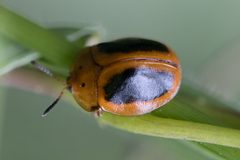
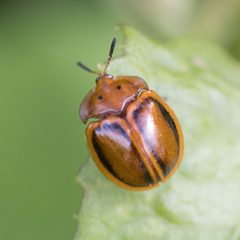
Mesomphaliini is a tribe of tortoise beetles (Cassidinae) erected by Hope in 1840, though some authorities recognize the alternative name Stolaini (Hincks, 1952). The tribe is predominantly Neotropical, with most occurring in the Americas. Some , including Chelymorpha, Stolas, and Cyrtonota, have representatives extending into Europe and Japan. Members exhibit distinctive larval including construction of exuvio-fecal shields and documented subsocial maternal care in at least some species.

Pronunciation
How to pronounce Mesomphaliini: //mɛsɒmˈfæli.aɪˌnaɪ//
These audio files are automatically generated. While they are not always 100% accurate, they are a good starting point.
Images
Distribution
Primarily Neotropical; most occur in the Americas. Some have broader distributions: Chelymorpha and Stolas occur in Europe, Cyrtonota in Japan.
Diet
Herbivorous; some feed on Ipomoea (Convolvulaceae). Documented plants include Ipomoea saopaulista (for Cyrtonota thalassina) and Ipomoea aristolochiifolia (for Paraselenis flava). Larvae and of Cyrtonota sericinus feed on Ipomoea sp. leaves.
Host Associations
- Ipomoea saopaulista (Convolvulaceae) - plantCyrtonota thalassina
- Ipomoea aristolochiifolia (Convolvulaceae) - plantParaselenis flava
- Ipomoea sp. (Convolvulaceae) - plantCyrtonota sericinus
- Eucelatoria spp. (Blondeliini) - of Cyrtonota thalassina, Botanochara sp., Paraselenis flava, and Chelymorpha sp.
- Voria sp. (Voriini) - of Paraselenis flava
Life Cycle
hatch after a period of maternal attendance; larvae pass through multiple instars with documented durations for some . Pupae may retain larval shield components. emerge from pupae. and survival curves have been constructed for Omaspides bistriata covering all stages.
Behavior
Larvae construct and carry exuvio-fecal shields: a telescopic applies onto attached to caudal processes, forming a pyramidal structure covering most of the body. The shield is built, repaired, and moved using only the anus—mouthparts and legs are not involved. Some exhibit subsocial maternal care: females guard , larvae, pupae, and , with changes in and feeding habits documented for both mothers and immatures. Larvae of Cyrtonota sericinus are gregarious.
Ecological Role
Herbivores on Ipomoea and likely other plants; serve as for Tachinidae .
Similar Taxa
- CassidiniAlso Cassidinae tortoise beetles with exuvio-fecal larval shields; distinguished by morphological and tribal-level classification differences
- SpilophoriniShares exuvio-fecal shield construction in larvae; Calyptocephala attenuata builds shield from only (no ), differing from typical Mesomphaliini construction
Sources and further reading
- BugGuide
- Wikipedia
- iNaturalist taxon
- Catalogue of Life
- - Entomology Today
- Maternal care in Omaspides bistriata Boheman (Coleoptera: Chrysomelidae: Cassidinae: Mesomphaliini)
- Description of immatures of Chelymorpha reimoseri Spaeth, 1928 (Coleoptera: Chrysomelidae: Cassidinae: Mesomphaliini)
- New Tachinidae parasitoid records for Mesomphaliini (Coleoptera: Chrysomelidae: Cassidinae) in the Neotropical region
- Natural history notes on Cyrtonota sericinus (Erichson, 1847) in Ecuador (Coleoptera: Chrysomelidae: Cassidinae: Mesomphaliini)
- Description of immatures of Mesomphalia gibbosa (Fabricius, 1781) and Mesomphalia turrita (Illiger, 1801) (Coleoptera: Chrysomelidae: Cassidinae: Mesomphaliini)
- Description of immatures of Stolas aenea (Olivier, 1790) and Stolas nudicollis (Boheman, 1850) (Coleoptera: Chrysomelidae: Cassidinae: Mesomphaliini)
- Revision of Ogdoecosta Spaeth 1909 with description of Ogdoecosta paraflavomaculata López-Pérez, sp. nov. (Coleoptera: Chrysomelidae: Cassidinae: Mesomphaliini)
- Architecture, construction, retention, and repair of faecal shields in three tribes of tortoise beetles (Coleoptera, Chrysomelidae, Cassidinae: Cassidini, Mesomphaliini, Spilophorini)