
Deloyala guttata
(Olivier, 1790)
Mottled Tortoise Beetle
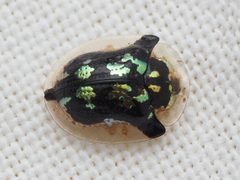
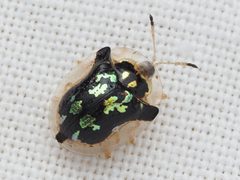
Deloyala guttata, the mottled tortoise beetle, is a tortoise beetle in the Chrysomelidae distributed across the Caribbean, Central America, North America, and South America. The exhibits local to particular plants, with performance tradeoffs observed when feeding on alternative hosts. Larvae construct defensive shields from and carried on the to protect against . display variable golden iridescent coloration.

Pronunciation
How to pronounce Deloyala guttata: /dɛˈlɔɪələ ˈɡʊtəˌtɑː/
These audio files are automatically generated. While they are not always 100% accurate, they are a good starting point.
Identification
Distinguished from other North American tortoise beetles by its golden iridescent coloration with dark mottling, as opposed to the more uniform coloration of Chelymorpha cassidea or the different patterning of Jonthonota nigripes. The combination of body shape, metallic golden ground color, and variable dark maculation is diagnostic. Similar to Chelymorpha varians in South America but distinguished by geographic range and subtle differences in body proportions and maculation pattern.
Images
Habitat
Associated with plants in the Convolvulaceae, particularly morning glories (Ipomoea spp.) and related vines. Occurs in a variety of open including fields, roadsides, gardens, and disturbed areas where host plants grow. Specific microhabitat requirements are tied to the presence of suitable host plants rather than particular vegetation or soil types.
Distribution
Caribbean, Central America, North America, and South America. Within North America, occurs across much of the eastern and central United States and adjacent Canada, extending southward through Mexico and into South America. The broad geographic range encompasses diverse climatic zones from temperate to tropical.
Seasonality
Activity patterns follow the growing season of plants; and larvae are present when Convolvulaceae hosts are actively growing. Specific timing varies by latitude and local climate conditions across the ' broad range.
Diet
Herbivorous; feeds on foliage of plants in the Convolvulaceae. Documented hosts include Ipomoea pandurata (wild potato vine), Ipomoea purpurea (common morning glory), Ipomoea hederacea (ivy-leaved morning glory), Calystegia sepium (hedge bindweed), and Convolvulus arvensis (field bindweed). Performance varies across host , with evidence of local to particular hosts.
Host Associations
- Ipomoea pandurata - primary Wild potato vine; documented as with performance variation across
- Ipomoea purpurea - primary Common morning glory; documented as with performance variation across
- Ipomoea hederacea - primary Ivy-leaved morning glory; documented as with performance variation across
- Calystegia sepium - primary Hedge bindweed; documented as with performance variation across
- Convolvulus arvensis - primary Field bindweed; documented as with performance variation across
Life Cycle
Complete with , larva, pupa, and stages. Development time varies depending on plant quality and temperature. Larvae are mobile and feed on host foliage, constructing characteristic defensive shields from accumulated and that are carried on the and lifted to cover the dorsum when disturbed. occurs on or near the host plant. Multiple per year likely in warmer portions of the range; fewer generations in temperate regions.
Behavior
Larvae exhibit a distinctive defensive : they carry a shield constructed from their own shed skins () and fecal material () on their , which they lift to cover their dorsum when threatened by . This fecal shield provides physical and possibly chemical protection. oviposition behavior shows individual variation influenced by both prior experience (conditioning) and genetic factors. Adults may drop from plants when disturbed, a common defense in tortoise beetles.
Ecological Role
Herbivore specializing on Convolvulaceae; contributes to plant-herbivore dynamics through specialization and local . The demonstrates performance tradeoffs across host plants, suggesting genetic constraints on host range expansion and potential for host race formation. Larval fecal shields may provide or food sources for other organisms, though this has not been documented.
Human Relevance
Occasionally encountered in gardens and agricultural settings where morning glories and bindweeds grow. Not considered a significant economic pest. Used as a model organism in studies of specialization, local , and the evolution of diet breadth in herbivorous insects. The ' striking appearance makes it of interest to naturalists and photographers.
Similar Taxa
- Chelymorpha cassideaLarger North American tortoise beetle with similar body shape but more uniform coloration (often orange or reddish with black spots rather than golden iridescent); associated with the same plant but generally less variable in appearance
- Jonthonota nigripesSmaller North American tortoise beetle with different color pattern (black legs and variable elytral markings); also feeds on morning glories but lacks the distinctive golden iridescence of Deloyala guttata
- Chelymorpha variansSouth American with similar highly variable coloration and maculation; distinguished by geographic range and subtle differences in body shape and proportions
More Details
Research Significance
Deloyala guttata has been extensively studied as a model for understanding specialization and local in herbivorous insects. Research has demonstrated that show performance tradeoffs across host plants, with beetles typically performing better on their natal host . This pattern suggests that host range expansion may be genetically constrained and that the species has potential for host race formation. Studies also show that oviposition is influenced by both conditioning (prior experience) and genetic variation, contributing to individual differences in host use.
Larval Defensive Adaptation
The larval fecal shield is a remarkable example of behavioral and morphological for defense. The shield is constructed progressively as the larva , with each added to the structure along with . The shield is carried on a forked structure at the tip of the and can be raised to cover the larva's back when disturbed. This defense is effective against many and possibly some vertebrates.
Sources and further reading
- BugGuide
- Wikipedia
- GBIF taxonomy match
- iNaturalist taxon
- NCBI Taxonomy
- Catalogue of Life
- A tortoise beetle gift | Beetles In The Bush
- Eumastacidae | Beetles In The Bush
- Tradeoffs in Performance on Different Hosts: Evidence from Within- and Between-Site Variation in the Beetle Deloyala guttata
- TRADEOFFS IN PERFORMANCE ON DIFFERENT HOSTS: EVIDENCE FROM WITHIN‐ AND BETWEEN‐SITE VARIATION IN THE BEETLE DELOYALA GUTTATA
- Conditioning and genetic variation as causes of individual variation in the oviposition behaviour of the tortoise beetle, Deloyala guttata