
Evodinus monticola
(Randall, 1838)
Mountain Flower Longhorn
Species Guides
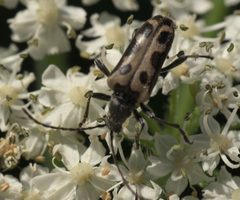
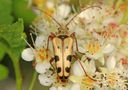
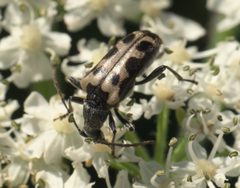
1Evodinus monticola is a of flower longhorn beetle in the Lepturinae. It occurs in montane forests of western North America, from the Sierra Nevada to the Rocky Mountains. The species is associated with coniferous forests and has been recorded feeding on flowers. Two are recognized: the nominate E. m. monticola and E. m. vancouveri.
Pronunciation
How to pronounce Evodinus monticola: /ˌɛvɒˈdaɪnəs mɒnˈtɪkələ/
These audio files are automatically generated. While they are not always 100% accurate, they are a good starting point.
Identification
This can be distinguished from other Evodinus by its distribution in western montane regions. The E. m. vancouveri is restricted to Vancouver Island and adjacent coastal areas, while the nominate subspecies occurs more broadly in interior western North America. Separation from related in the Rhagiini requires examination of antennal structure and elytral punctuation patterns.
Images
Habitat
Montane coniferous forests, particularly those dominated by pine, fir, and spruce . Associated with forest edges and openings where flowering plants occur.
Distribution
Western North America: Canada (British Columbia, Alberta), United States (Washington, Oregon, California, Nevada, Idaho, Montana, Wyoming, Colorado, Utah, Arizona, New Mexico, and eastward to Vermont). The E. m. vancouveri occurs on Vancouver Island and adjacent coastal British Columbia.
Seasonality
are active from late spring through summer, with peak activity typically in June and July. The aligns with flowering periods of plants in montane environments.
Diet
feed on pollen and nectar of various flowers. Specific floral have been documented including dogwood (Cornus), sumac (Rhus), and other montane flowering shrubs and herbs.
Host Associations
- Pinus jeffreyi - associated with forest conifer in much of range
- Abies concolor - associated with forest White fir, common associate in Sierra Nevada
- Cornus - food sourcePollen and nectar source
- Rhus - food sourceSumac, pollen and nectar source
Life Cycle
Complete with , larva, pupa, and stages. Larvae develop in decaying wood of conifers, particularly fir and pine. The likely spans one to two years, with adults emerging in spring and early summer.
Behavior
are and frequently observed visiting flowers. They are capable fliers and may travel between forest patches to locate floral resources. Mating occurs on flowers or nearby vegetation.
Ecological Role
function as of montane flowering plants. Larvae contribute to wood decomposition and nutrient cycling in coniferous forest .
Human Relevance
Occasional visitor to gardens and parks in montane areas. Of minor interest to collectors due to its western montane distribution. Not considered economically significant.
Similar Taxa
- Evodinus interrogationisOverlapping range in western North America; distinguished by elytral maculation pattern and antennal proportions
- Evodinus picipesEastern North American ; distribution but similar requires careful comparison
- Brachyleptura speciesSympatric lepturines with similar flower-visiting ; distinguished by body proportions and antennal structure
More Details
Subspecies
Two are recognized. Evodinus monticola monticola (Randall, 1838) is the widespread nominate form. Evodinus monticola vancouveri Casey, 1913 is restricted to Vancouver Island and adjacent coastal British Columbia, differing in subtle proportions and coloration.
Taxonomic History
Originally described as Leptura monticola by Randall in 1838, the was later transferred to Evodinus. The Evodinus is a member of the tribe Rhagiini, a diverse group of flower-visiting longhorn beetles.
Conservation Status
Not formally assessed by IUCN. The appears secure across its broad montane range, though specific associations with mature coniferous forests may make local vulnerable to forest management practices.
Sources and further reading
- BugGuide
- Wikipedia
- GBIF taxonomy match
- iNaturalist taxon
- NCBI Taxonomy
- Catalogue of Life
- Bug Eric: A Flower Scarab, Euphoria fulgida
- Uncategorized | Blog - Part 29
- Funding from ScottishPower Foundation helps to restore vital habitat to encourage thriving natural ecosystem - Buglife Blog - Buglife
- When life gives you zebra mussels | Blog
- Nevada | Beetles In The Bush | Page 4