
Brachyleptura
Casey, 1913
Species Guides
5- Brachyleptura brevis(Short Long-horned Beetle)
- Brachyleptura circumdata(Dark-shouldered Long-horned Beetle)
- Brachyleptura dehiscens
- Brachyleptura rubrica(Red-winged Longhorn Beetle)
- Brachyleptura vagans
Brachyleptura is a of flower longhorn beetles in the Lepturinae, containing eight distributed across North America. Members are distinguished from other Lepturinae by often abbreviated , though this trait is variably expressed. are and visit flowers, particularly those with white, compound, flat-topped inflorescences. Larvae develop in decaying hardwoods including beech, birch, elm, hickory, and maple.
Pronunciation
How to pronounce Brachyleptura: /brakɪˈlɛptʊrə/
These audio files are automatically generated. While they are not always 100% accurate, they are a good starting point.
Identification
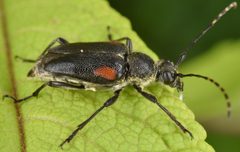
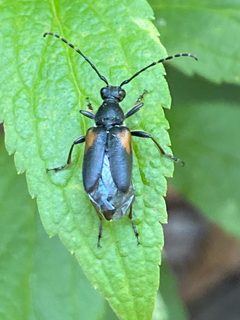
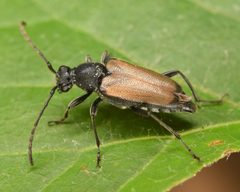
in Brachyleptura are distinguished from other Lepturinae by abbreviated (from Greek 'brachy' meaning short), though this is scarcely evident in some species such as B. rubrica. The shares Lepturinae characteristics: posteriorly tapering elytra, narrow pronotum creating a broad-shouldered appearance, conical , that do not surround the antennal base, and (forward-slanting) . Brachyleptura vagans resembles B. rubrica in form and white-annulated but differs in having elytra that are wholly black except for small red patches behind the humeri.
Images
Habitat
occur on flowers in forested and edge . Larvae develop in dead or decaying hardwood branches, with records from beech, birch, elm, hickory, maple, and Carpinus caroliniana. Wood condition (slightly decayed rather than freshly dead) appears more important than specific tree .
Distribution
Eastern North America, with records from the United States including Missouri, Virginia, and Vermont. The is widespread across the eastern U.S. though individual vary in abundance.
Seasonality
active during summer months; B. rubrica observed in June in Missouri. Activity is , contrasting with the primarily of most other Cerambycidae.
Host Associations
- Hydrangea arborescens - floral primary flower visited by B. rubrica
- Ceanothus americanus - floral collected on this ; preferred by B. vagans
- Cornus drummondii - floral white, compound, flat-topped flowers
- Daucus carota - floral white, compound, flat-topped flowers
- Parthenium integrifolium - floral white, compound, flat-topped flowers
- Carpinus caroliniana - larval single individual reared from punky dead branch
- Fagus - larval hardwood, decaying wood
- Betula - larval hardwood, decaying wood
- Ulmus - larval hardwood, decaying wood
- Carya - larval hardwood, decaying wood
- Acer - larval hardwood, decaying wood
Life Cycle
Larvae develop in dead or decaying hardwood branches. has been recorded from collected wood material. Complete larval development and occur within wood; specific duration unknown.
Behavior
are and visit flowers for feeding and mating. Mating pairs have been observed on floral . Unlike most Cerambycidae, adults are not attracted to lights and are active during daylight hours.
Ecological Role
Larvae function as decomposers in hardwood forest , breaking down dead and decaying wood. may contribute to pollination through flower visitation.
Similar Taxa
- StrangaliaCommon flower longhorns in same region; distinguished by different elytral patterns and floral preferences
- TypocerusFlower longhorns with similar , flower-visiting ; T. deceptus noted as rare associate on same flowers
- AnoploderaHistorical taxonomic confusion; B. champlaini was previously synonymized under Anoplodera vagans
More Details
Etymology
The name combines Greek 'brachys' (short) with 'Leptura' (the type genus of Lepturinae, from Greek 'leptos' meaning narrow), referring to the abbreviated characteristic of the genus.
Taxonomic History
Brachyleptura champlaini was synonymized with Anoplodera vagans by Swaine and Hopping (1928) and later restored as a valid within Brachyleptura by Linsley and Chemsak (1976).
Wood Condition Preference
Larval development appears to require slightly decayed (punky) wood rather than freshly dead material, suggesting a preference for advanced decomposition stages in hardwood substrates.