
Strangalia
Audinet-Serville, 1835
Species Guides
9- Strangalia acuminata(flower longhorn)
- Strangalia antennata
- Strangalia bicolor(Bicolored Flower Longhorn Beetle)
- Strangalia famelica(Slender Flower Longhorn Beetle)
- Strangalia luteicornis(Yellow-horned Flower Longhorn Beetle)
- Strangalia occidentalis(flower longhorn)
- Strangalia sexnotata(Six-spotted Flower Longhorn Beetle)
- Strangalia strigosa(flower longhorn beetle)
- Strangalia virilis(strange virile bycid)
Strangalia is a of longhorn beetles (Cerambycidae) first described by Audinet-Serville in 1835. in this genus are frequently observed on flowers, where feed on pollen and nectar. Several species have been documented visiting flowers of Coreopsis, Gaillardia, Ratibida, and other Asteraceae in prairie and woodland . Some species, such as Strangalia sexnotata and S. virilis, have been recorded in fermenting traps, though this attraction appears less consistent than in related genera.
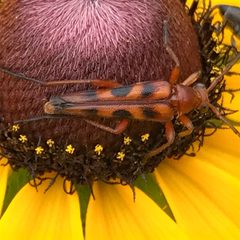
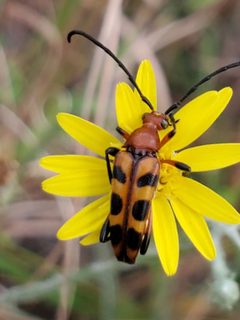
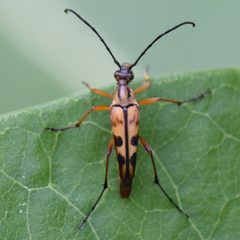
Pronunciation
How to pronounce Strangalia: //strænˈɡeɪliə//
These audio files are automatically generated. While they are not always 100% accurate, they are a good starting point.
Images
Habitat
in this are associated with open woodlands, prairies, and glade . are commonly found on flowering herbaceous vegetation, particularly in areas with abundant Asteraceae. Larval is poorly documented but presumed to involve decaying wood or woody stems of plants.
Distribution
Recorded from North America, Europe (Denmark, Norway, Sweden), and the northeastern United States (Vermont). Within North America, documented from Missouri, Oklahoma, Arkansas, Texas, and Florida.
Seasonality
activity has been observed from June through September, with peak abundance coinciding with flowering of plants. Specific timing varies by and latitude.
Diet
feed on pollen and nectar of flowers. Larval diet is presumed to involve woody plant material, though specific associations remain poorly documented for most .
Host Associations
- Coreopsis tinctoria - feeding siteflowers visited by Strangalia sexnotata
- Coreopsis grandiflora - feeding siteflowers visited by Strangalia
- Gaillardia pulchella - feeding siteflowers visited by Strangalia
- Ratibida columnifera - feeding siteflowers visited by Strangalia
- Ratibida pinnata - feeding siteflowers visited by Strangalia sexnotata
- Torilis arvensis - feeding siteflowers visited by Strangalia virilis
- Hydrangea arborescens - feeding siteflowers visited by Strangalia luteicornis
Behavior
are and frequently observed on flowers. Some have been attracted to fermenting traps (molasses/beer and red wine mixtures), though this is not universal across the . Strangalia sexnotata was documented from fermenting bait for the first time in a 2015 Missouri study, suggesting bait attraction may be underreported.
Ecological Role
function as while feeding on floral resources. Larvae likely contribute to wood decomposition and nutrient cycling in their .
Human Relevance
No significant economic or medical importance documented. are of interest to coleopterists and naturalists due to their flower-visiting and association with native prairie and woodland .
Similar Taxa
- TypocerusSimilar flower-visiting and elongate body form; distinguished by antennal structure and elytral pattern
- StenelytranaSimilar flower-visiting cerambycids; distinguished by coloration and antennal proportions
More Details
Fermenting bait attraction
Strangalia sexnotata was documented from fermenting traps for the first time in a 2015 Missouri study (MacRae), indicating that bait attraction in this may be more widespread than previously recognized but underreported due to limited trapping effort.
Regional endemism
Strangalia virilis is noted as a Texas/Oklahoma specialty, while S. strigosa is recorded as a Florida .