
Saperda tridentata
Olivier, 1795
elm borer
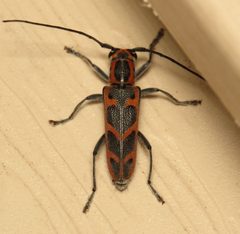
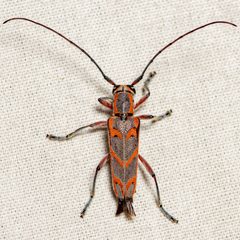
Saperda tridentata, commonly known as the elm borer, is a longhorn beetle (Cerambycidae) native to North America. The was described by Guillaume-Antoine Olivier in 1795. It is notable for its specialized association with elm species (Ulmus), serving as both a direct pest and a of . The 's involves larval tunneling in cambium and sapwood, creating characteristic U-shaped galleries. It also acts as a for the Cenocoelius saperdae.
Pronunciation
How to pronounce Saperda tridentata: //sæˈpɝː.də traɪ.dɛnˈtɑː.tə//
These audio files are automatically generated. While they are not always 100% accurate, they are a good starting point.
Identification
can be distinguished from similar Saperda by association with Ulmus rather than Populus or Salix. The specific epithet 'tridentata' refers to a three-toothed feature, likely of the or , though precise diagnostic characters require examination of . Larvae create U-shaped galleries in cambium and sapwood, with adults emerging through oval exit holes.
Images
Habitat
Associated with elm trees (Ulmus ), particularly in forested and urban environments where trees occur.
Distribution
Known from Canada (Manitoba, New Brunswick, Nova Scotia, Ontario) and the United States. GBIF records confirm presence across North America.
Diet
feed on bark of twigs. Larvae feed on cambium and sapwood of trees.
Host Associations
- Ulmus rubra - larval slippery elm
- Ulmus americana - larval American elm
- Populus tremuloides - larval quaking aspen; reported in some sources
- Populus grandidentata - larval bigtooth aspen; reported in some sources
Life Cycle
Females deposit in cut in bark with . Larvae tunnel in cambium and sapwood, constructing characteristic U-shaped galleries. occurs in constructed in sapwood. emerge through oval exit holes. The likely requires two years.
Behavior
Mating occurs on trees. are active on host material. The acts as a for the fungus Ophiostoma ulmi, the causal agent of .
Ecological Role
The functions as a primary wood-borer in dying or stressed elm trees. It serves as a for the Cenocoelius saperdae. As a of Ophiostoma ulmi, it plays a significant role in the of .
Human Relevance
The elm borer is a pest of native elm and a of , contributing to the decline of elm in North America. Its activity weakens trees and facilitates fungal .
Similar Taxa
- Saperda populneaSimilar but associated with Populus and Salix rather than Ulmus; association is the primary distinguishing feature
- Other Saperda speciesMany Saperda share similar ; precise identification requires examination of records and subtle morphological differences
More Details
Disease vector role
Saperda tridentata acts as a for Ophiostoma ulmi, the fungus causing . This ecological role distinguishes it from many other cerambycid borers that do not transmit .
Parasitoid association
The is a known for Cenocoelius saperdae, a . This relationship has been documented in the literature.
Sources and further reading
- BugGuide
- Wikipedia
- GBIF taxonomy match
- iNaturalist taxon
- NCBI Taxonomy
- Catalogue of Life
- Plant Communication Research: 'Taking Root' | Bug Squad
- Plants Can Eavesdrop, Sense Danger | Bug Squad
- Rick Karban: Do Plants Have Personalities? | Bug Squad
- Rick Karban, UC Davis Expert on Plant Communication, Named ESA Fellow | Bug Squad
- Grasshopper Collections and Survey
- Cerambycidae | Blog
- Observations on the Biology of Saperda tridentata Oliv. and Magdalis armicollis Say (Coleoptera)