
Oberea ocellata
Haldeman, 1847
Sumac stem borer
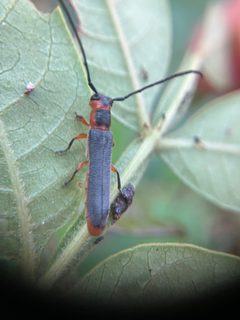
Oberea ocellata is a flat-faced longhorn in the tribe Saperdini, commonly known as the sumac stem borer. It is a documented pest of woody plants, with larvae developing inside stems and causing structural damage. The has a three-year and is distributed across North America.
Pronunciation
How to pronounce Oberea ocellata: /oʊˈbɪriə oʊˈsɛləta/
These audio files are automatically generated. While they are not always 100% accurate, they are a good starting point.
Identification
Distinguished from other Oberea by its specific association with plants and its documented three-year larval development period. are flat-faced longhorn beetles typical of the , with the tribe Saperdini characterized by particular antennal and pronotal features. Larval presence is indicated by distinctive light yellow .
Images
Habitat
Associated with blueberry canes and sumac stems; larvae develop within woody plant tissues. occur in areas where host plants are present.
Distribution
North America; recorded from Ontario, Canada and the United States. Specific distribution details within North America are not fully documented in available sources.
Seasonality
activity in June; larvae hatch approximately two weeks after -laying. Larval development spans three years, with feeding resuming in spring after winter inactivity.
Diet
Larvae feed internally on plant stem tissue, consuming 2–10 inches of stem during their first year. have been observed on willow (Salix nigra), though this may represent a different (O. oculaticollis) with similar appearance.
Host Associations
- blueberry cane - larval laid under bark towards terminal end; larvae bore towards crown
- sumac - larval derives from this association
Life Cycle
Three-year development: laid in June under bark of stems; larvae hatch after two weeks and bore towards the terminal, then reverse direction to burrow in the crown. First-year larvae consume 2–10 inches of stem, become inactive in winter, and resume feeding in spring. Larvae continue feeding through the second year, becoming by end of third year.
Behavior
Larvae drill through stems, creating galleries that can girdle and kill host plant tissue. are relatively sedentary when disturbed, allowing close approach for observation.
Ecological Role
Human Relevance
Notable pest of trees and cultivated blueberries; management requires cutting infested canes below hollow sections to prevent larvae from reaching the crown. Detection facilitated by distinctive light yellow .
Similar Taxa
- Oberea oculaticollisSimilar dark with dense grayish ; distinguished by specific morphological details and associations, though field identification can be challenging
More Details
Pest Management
Control methods focus on mechanical removal of infested stems rather than , as natural enemies do not provide adequate suppression.
Taxonomic Note
The was described by Haldeman in 1847. Some sources place it in tribe Saperdini, while Catalogue of Life lists tribe Obereini; this discrepancy may reflect differing classification systems.