
Mecas marginella
LeConte, 1873
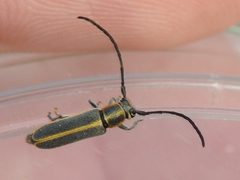
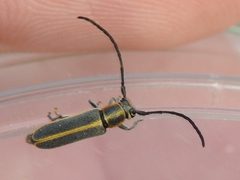
Mecas marginella is a of longhorn beetle ( Cerambycidae) first described by John Lawrence LeConte in 1873. It is native to the United States and belongs to a whose members are commonly known as girdlers due to their habit of girdling plant stems. Like other Mecas species, it likely develops as a stem- and root-borer in plants, though specific details for this species remain poorly documented.
Pronunciation
How to pronounce Mecas marginella: /ˈmiː.kəs ˌmɑːr.dʒɪˈnɛl.ə/
These audio files are automatically generated. While they are not always 100% accurate, they are a good starting point.
Identification
Mecas marginella can be distinguished from other Mecas by subtle differences in elytral markings and body proportions, though precise diagnostic features require examination of . It is smaller than Mecas pergrata and lacks the more pronounced markings of some . Identification to species level typically requires reference to original descriptions or keys for North American Cerambycidae.
Images
Appearance
are approximately 1/2 inch (12 mm) long with a grayish coloration and dense . The body is elongate and cylindrical, typical of the Mecas. are moderately long, extending beyond the body length. The specific epithet 'marginella' likely refers to marginal markings on the , though detailed descriptions of color pattern are sparse in available literature.
Habitat
Associated with grassland and open woodland where plants in the sunflower (Asteraceae) occur. Specific microhabitat preferences are not well documented for this .
Distribution
Known from the United States. Published records are sparse, with the likely occurring in the central and southern Great Plains region based on collection patterns of related species. Exact state-level distribution requires verification from museum specimens.
Seasonality
are likely active during summer months (June–August), based on of . No specific period has been documented for this .
Host Associations
- Asteraceae - larval Inferred from -level association; specific plants unconfirmed for this
Behavior
As with other Mecas , females likely girdle plant stems prior to oviposition, creating a characteristic double girdle that causes the upper stem to die and fall. Larvae bore downward through the pith to the roots where they overwinter. This has been documented for Mecas pergrata and other but requires direct observation for M. marginella.
Ecological Role
As a stem-borer in native Asteraceae, contributes to nutrient cycling and plant . May serve as prey for woodpeckers and other that excavate infested stems.
Similar Taxa
- Mecas pergrataSimilar size, coloration, and ; distinguished by elytral pattern and body proportions
- Mecas femoralisOverlapping distribution; M. femoralis is largely to Florida and has different associations
- Dectes texanusSimilar stem-girdling and gray coloration; Dectes has longer relative to body and different girdling pattern (single girdle near base vs. double girdle higher on stem)
More Details
Taxonomic history
The was described by John Lawrence LeConte in 1873 based on specimens from the United States. LeConte was the foremost American coleopterist of the 19th century, and his descriptions of Cerambycidae remain foundational. The locality and depository require verification from primary literature.
Research needs
Basic including plant range, larval development, and precise geographic distribution remain undocumented. Field studies focusing on Asteraceae stem-borers in the Great Plains would likely clarify the status of this .
Sources and further reading
- BugGuide
- Wikipedia
- GBIF taxonomy match
- iNaturalist taxon
- Catalogue of Life
- Managing Insect Pests of Texas Sunflowers - AgriLife Extension Entomology
- Bug Eric: New Mexico Dragonfly Blitz - Day 4
- Cimbicidae | Beetles In The Bush
- Bug Eric: December 2015
- The one that got away! | Beetles In The Bush
- Bug Eric: More Insects From Sunflowers