
Batyle suturalis
(Say, 1824)
Sutured Longhorn Beetle, sutured flower longhorn
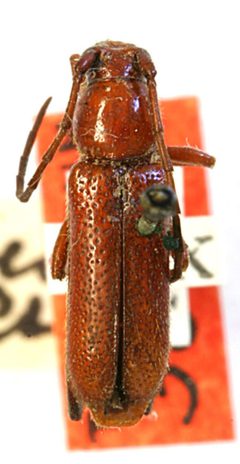
Batyle suturalis is a of longhorned beetle in the Cerambycidae, first described by Thomas Say in 1824. It is a member of the tribe Trachyderini, a group known for bright colors, activity, and attraction to flowers. The species has been documented across much of North America, with records from the United States and Mexico. are frequently observed feeding on flower pollen and nectar, and the species exhibits coloration that may function in a Müllerian mimicry complex with soldier beetles and blister beetles.

Pronunciation
How to pronounce Batyle suturalis: /ˈbætɪli suːˈtjuːrɑːlɪs/
These audio files are automatically generated. While they are not always 100% accurate, they are a good starting point.
Identification
Distinguished from similar longhorned beetles by its black and orange color pattern, which resembles soldier beetles (Chauliognathus spp.) and blister beetles (Epicauta spp.). The long typical of Cerambycidae separate it from these look-alike beetles, which have short antennae. It may be confused with other Trachyderini such as Plionoma suturalis, which shares both a similar name and general appearance, though Plionoma suturalis is more strongly associated with mesquite flowers in the southwestern United States. Batyle suturalis has a broader geographic range and occurs earlier in the season than some related . Crossidius discoideus is another longhorned beetle mimic in the same complex but has different antennal proportions and associations.
Images
Habitat
Occurs in a variety of open including sand dune areas, sand prairies, pinyon-oak-juniper woodlands, mesquite chaparral, and rocky gypsum slopes. Often found in association with flowering vegetation in these habitats. Documented from low elevation sandhill scrub to mid-elevation woodlands.
Distribution
North America, with records from the United States (including Missouri, Oklahoma, Kansas, New Mexico, Colorado, and other states) and Mexico. The has been collected from the Great Plains through the southwestern United States, with specific records from eastern New Mexico, western Oklahoma, Kansas, and Missouri.
Seasonality
are active primarily in spring and early summer. Records indicate activity from May through June, with some individuals continuing into July. One source notes that Batyle suturalis appears just before of soldier beetles explode, suggesting it may be among the earlier members of its mimicry complex to become active.
Diet
feed on pollen and nectar of flowers. Documented floral include Hymenopappus flavescens (collegeflower), Lorandersonia pulchella (southwestern rabbitbrush), Thelesperma magnicamporum (rayless greenthread), Coreopsis lanceolata, Psilostrophe villosa, and various other Asteraceae. Larval diet and host plants are unknown.
Host Associations
- Hymenopappus flavescens - floral Observed feeding on flowers in sand dune
- Lorandersonia pulchella - floral Multiple individuals observed on flowers in mesquite/oak chaparral
- Thelesperma magnicamporum - floral Collected on flowers in sand prairie and pinyon/oak/juniper woodland
- Coreopsis lanceolata - floral Photographed on flowers at Shaw Nature Preserve, Missouri
- Psilostrophe villosa - floral Photographed on flowers at Alabaster Caverns State Park, Oklahoma
- Mimosa nuttallii - floral Observed in Kansas
Life Cycle
Details of stages and development are unknown. As with other Cerambycidae, presumably has wood-boring larvae, though specific plants for larval development have not been documented.
Behavior
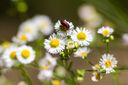
and active during daylight hours. Frequently observed resting on flowers, where feed on pollen and nectar. Multiple individuals may be found on the same plant or flower cluster. Adults appear to be relatively sedentary when on flowers, allowing close approach. Exhibits bimodal daily activity patterns typical of flower-visiting insects, with peak activity during warm, sunny conditions.
Ecological Role
function as through their flower-visiting , though the extent of their contribution to pollination services has not been quantified. As a member of a Müllerian mimicry complex with chemically defended soldier beetles and blister beetles, contributes to education and the protective function of shared warning signals. Larval unknown, but as a wood-boring cerambycid, larvae likely contribute to nutrient cycling in dead wood.
Human Relevance
Of interest to entomologists and coleopterists as a representative of flower-visiting longhorned beetles and as a participant in a well-documented mimicry complex. Occasionally photographed by nature photographers; one detailed account describes techniques for photographing this on flowers, noting challenges with exposure due to contrast between dark body and bright yellow flowers. Not known to be of economic importance.
Similar Taxa
- Plionoma suturalisShares similar name, general appearance as black-and-orange longhorned beetle, and flower-visiting habits, but P. suturalis is more strongly associated with mesquite (Prosopis glandulosa) flowers in southwestern North America and has a more restricted distribution. Batyle suturalis has broader range and geographic distribution.
- Crossidius discoideusAnother longhorned beetle participant in the same Müllerian mimicry complex with soldier beetles. C. discoideus has proportionally longer and is associated with Gutierrezia sarothrae and Isocoma spp. as larval .
- Chauliognathus basalis and C. deceptusSoldier beetles ( Cantharidae) that share the black-and-orange color pattern and are the putative models for the mimicry complex. Distinguished by shorter , softer body, and different family-level characters.
- Epicauta stuartiBlister beetle that shares the black-and-orange warning coloration and is chemically defended with . Distinguished by soft, flexible and short .
More Details
Mimicry complex participation
Batyle suturalis is part of a documented Müllerian mimicry complex in western North America involving multiple . The complex includes soldier beetles (Chauliognathus spp., family Cantharidae), blister beetles (Epicauta stuarti, family Meloidae), net-winged beetles (Calopteron terminale, family Lycidae), and at least two longhorned beetles (Batyle suturalis and Crossidius discoideus). All share a black-and-orange color pattern that advertises chemical defenses or, in the case of some longhorned beetles, may represent if the lacks its own chemical protection.
Photographic documentation
The has been used as a teaching example in macrophotography instruction, specifically regarding challenges of photographing dark, shiny beetles on bright yellow flowers. Technical issues include specular highlights on the 's smooth , overexposure of yellow flowers when properly exposing the dark beetle body, and compositional considerations for ' on flower' photography.