
Plionoma suturalis
(LeConte, 1858)
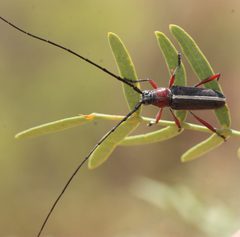
Plionoma suturalis is a longhorned beetle in the tribe Trachyderini, characterized by bright coloration and flower-visiting . The was described by LeConte in 1858 and occurs from Texas west to California and south into northern Mexico. Its 2013 discovery in northwestern Oklahoma represented a significant northeastern range extension of over 200 miles from the nearest previous records in north-central Texas. exhibit bimodal seasonal activity, appearing in spring, disappearing during summer, and reappearing in fall.
Pronunciation
How to pronounce Plionoma suturalis: //plaɪˈoʊnoʊmə suːˈtʊrəlɪs//
These audio files are automatically generated. While they are not always 100% accurate, they are a good starting point.
Identification
Distinguished from the similar Batyle suturalis by belonging to the tribe Trachyderini rather than other cerambycine tribes. Separated from the congeneric Plionoma rubens by geographic distribution and subtle morphological differences. The combination of large size, bright coloration, activity, and strict association with mesquite flowers in the southwestern U.S. and Oklahoma helps identify this . The 2013 Oklahoma specimens were immediately recognizable to experienced collectors despite representing a significant range extension.
Images
Appearance
Large, colorful longhorned beetle with bright coloration typical of the Trachyderini tribe. present: males and females can be distinguished, with females observed feeding on mesquite flowers. The shares the general facies of Trachyderini members—robust body form with vivid patterning.
Habitat
Mesquite chaparral and associated arid . Strongly associated with honey mesquite (Prosopis glandulosa, syn. Neltuma glandulosa) trees, where are found on both living branches and flowers. In Oklahoma, occurs in gypsum-capped mesa landscapes with red clay soils at Gloss Mountains State Park. The habitat has been described as having a 'New Mexican' character despite being in northwestern Oklahoma.
Distribution
Native to southwestern North America. Documented from Texas west to California and south into northern Mexico. The 2013 discovery in Major County, Oklahoma (Gloss Mountains State Park) represented a new state record and significant northeastern range extension—the closest previous records were from Wichita County, Texas, over 200 miles to the south. GBIF records indicate presence in Mexico (MX) and the United States (US).
Seasonality
exhibit bimodal seasonal activity: active during spring months (May-June), absent during summer, then reappearing in fall. In the Lower Rio Grande Valley of south Texas, found on fresh-cut mesquite and huisache (Acacia farnesiana) in fall and on blossoms of fabaceous trees during spring and early summer. Oklahoma records from early June represent the northern extent of spring activity.
Diet
feed on mesquite flowers (Prosopis glandulosa). In the Lower Rio Grande Valley, also observed on huisache (Acacia farnesiana) flowers. Larval diet unknown but presumably develops in woody tissue of plants.
Host Associations
- Prosopis glandulosa - feeding; probable larval Honey mesquite; abundant on flowers and living branches
- Acacia farnesiana - feedingHuisache; documented in south Texas
Life Cycle
Complete with bimodal pattern. Larval development presumably occurs within woody tissue, though specific details unreported. Adults overwinter or aestivate during summer months, with spring and fall activity peaks suggesting either two per year or a single generation with extended adult longevity and summer inactivity.
Behavior
(day-active) with strong attraction to flowers. observed in mating pairs on mesquite trees. Highly abundant at peak activity, with collectors obtaining 'several dozen specimens' in short periods. Exhibits typical trachyderine of visiting blossoms for feeding and mating. In Oklahoma, found on both living branches and flowers of mesquite, suggesting flexible adult movement within trees.
Ecological Role
function as or pollen feeders on mesquite and related leguminous trees. As woodboring larvae, presumably contribute to nutrient cycling in dead or dying woody tissue. The 2013 Oklahoma discovery highlighted the role of under-surveyed regions in understanding true distributions.
Human Relevance
Subject of entomological collecting interest due to bright coloration and relative scarcity in collections. The 2013 Oklahoma record was significant enough to warrant collection of voucher specimens for scientific documentation. Used as example in studies of longhorned beetle trapping efficacy using ethanol and wine-baited jug traps.
Similar Taxa
- Batyle suturalisShares similar name and general appearance but belongs to different tribe; distinguished by tribal assignment and subtle morphological differences
- Plionoma rubens with similar bright trachyderine coloration; the other U.S. in the , distinguished by distribution and minor morphological features
More Details
Nomenclature note
The plant Prosopis glandulosa has been synonymized as Neltuma glandulosa in some recent sources; both names appear in literature documenting this .
Historical collecting context
The Wichita County, Texas records from 1956 were the nearest previous occurrences, but no specimens had been collected there subsequently, leading Lingafelter & Horner (1993) to consider the ' status in north-central Texas as doubtful. The Oklahoma discovery confirmed ongoing persistence in the region.
Research significance
This was specifically mentioned in a 2023 study evaluating ethanol and wine-baited jug traps for Cerambycidae, having been previously recorded as a new state record from the same Gloss Mountains locality.
Sources and further reading
- BugGuide
- Wikipedia
- GBIF taxonomy match
- iNaturalist taxon
- Catalogue of Life
- Cerambycidae | Beetles In The Bush | Page 10
- First collecting trip of the season! | Beetles In The Bush
- Another new record for northwestern Oklahoma | Beetles In The Bush
- May | 2023 | Beetles In The Bush
- The ever-increasing diversity of Oklahoma beetles | Beetles In The Bush