
Plionoma
Casey, 1912
Species Guides
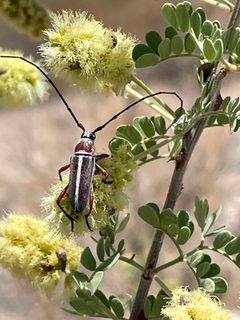
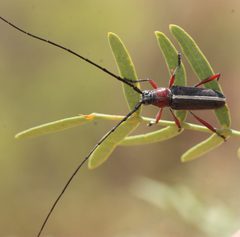
2Plionoma is a of longhorned beetles ( Cerambycidae) in the tribe Trachyderini, containing three : P. basalis, P. rubens, and P. suturalis. Members of this genus are notable for their bright coloration, activity, and strong association with flowers. P. suturalis has been documented feeding on mesquite flowers and exhibits bimodal seasonal activity, with appearing in spring, disappearing during summer, and reappearing in fall. The genus occurs primarily in the southwestern United States and northern Mexico, with P. suturalis representing a significant northeastern range extension into Oklahoma.
Pronunciation
How to pronounce Plionoma: /plaɪˈɒnəma/
These audio files are automatically generated. While they are not always 100% accurate, they are a good starting point.
Identification
Plionoma can be distinguished from other Trachyderini by their large size, robust build, and bright coloration. P. suturalis specifically is recognized by its distinctive sutural markings. The tribe Trachyderini as a whole is characterized by bright colors, attraction to flowers, and tendencies. Species-level identification within Plionoma requires examination of specific morphological features not detailed in available sources.
Images
Habitat
Associated with mesquite (Prosopis glandulosa) and other woody vegetation in arid and semi-arid regions. P. suturalis has been found in mesquite chaparral and on mesquite trees in gypsum-capped mesa environments.
Distribution
Southwestern United States (Texas west to California) and northern Mexico. P. suturalis has been documented as far northeast as Major County, Oklahoma, representing a range extension of over 200 miles from the nearest previous records in Wichita County, Texas.
Seasonality
Bimodal seasonal activity pattern: active in spring months, absent during summer, and reappearing in fall. In the Lower Rio Grande Valley of Texas, found on fresh-cut mesquite and huisache in fall and on fabaceous tree blossoms in spring and early summer.
Diet
feed on flowers, specifically documented feeding on mesquite (Prosopis glandulosa) flowers. Larval diet unknown but presumed to develop in woody given characteristics.
Host Associations
- Prosopis glandulosa - feeding on flowersDocumented feeding on mesquite flowers; also associated with fresh-cut mesquite in fall
Behavior
and attracted to flowers. Mating pairs have been observed on plants. exhibit rapid movement when disturbed, as documented when a female P. suturalis escaped male mate guarding by dropping 10 feet down a tree trunk, with the male rapidly pursuing.
Ecological Role
Flower-visiting likely contributing to pollination of plants. Member of Trachyderini, a tribe known for bright coloration and flower association.
Human Relevance
Subject of entomological study due to range extensions and bimodal activity pattern. P. suturalis collection in Oklahoma represented a new state record and significant range extension, highlighting the value of field surveys in understudied areas.
Similar Taxa
- BatyleBoth belong to Trachyderini and share bright coloration, habits, and flower-visiting . Batyle suturalis specifically was initially confused with Plionoma suturalis in early photographic records.
- Trachyderini (tribe members generally)Shared characteristics of bright colors, attraction to flowers, and activity; however, Plionoma tend to be larger and more robust than many other trachyderines.
Sources and further reading
- BugGuide
- Wikipedia
- GBIF taxonomy match
- iNaturalist taxon
- Catalogue of Life
- Cerambycidae | Beetles In The Bush | Page 10
- First collecting trip of the season! | Beetles In The Bush
- May | 2023 | Beetles In The Bush
- Another new record for northwestern Oklahoma | Beetles In The Bush
- The ever-increasing diversity of Oklahoma beetles | Beetles In The Bush
- Calopterygidae | Beetles In The Bush