
Molorchus longicollis
LeConte, 1873
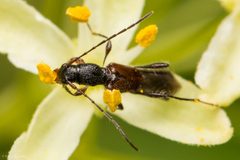
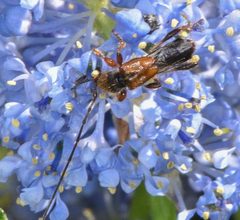
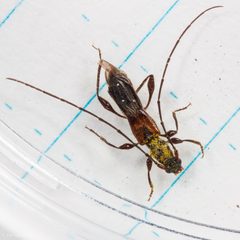
Molorchus longicollis is a small longhorned beetle ( Cerambycidae) in the Cerambycinae, described by John Lawrence LeConte in 1873. The Molorchus is notable for -mimicry, with resembling small ants in appearance and —a form of . in this genus are frequently encountered on flowers of various flowering trees, particularly in spring. Molorchus longicollis occurs in western North America, with records from Alberta and British Columbia in Canada and additional localities in the western United States.
Pronunciation
How to pronounce Molorchus longicollis: /məˈlɔrkəs lɒŋɪˈkɒlɪs/
These audio files are automatically generated. While they are not always 100% accurate, they are a good starting point.
Identification
Distinguished from other Molorchus by its longer pronotum (neck region). The Molorchus can be separated from similar -mimicking cerambycids such as Euderces by specific antennal and body proportions, though precise differentiating characters for M. longicollis require examination of type material or specialized literature. The western distribution helps separate it from eastern Molorchus species.
Images
Habitat
Associated with flowering trees; likely found on blossoms. Larval presumably dead or dying wood of hardwood trees, consistent with Cerambycidae.
Distribution
Western North America: recorded from Alberta and British Columbia, Canada; additional records in western United States (California and other western states per GBIF).
Seasonality
Spring activity period inferred from congeneric patterns; Molorchus bimaculatus is common in early spring on flowering trees.
Behavior
likely visit flowers for feeding and/or mating, as documented for congeneric . -mimicking includes rapid, erratic movements characteristic of small ants.
Ecological Role
Presumed of flowering trees through flower visitation; larval wood-boring contributes to nutrient cycling in forest .
Similar Taxa
- Molorchus bimaculatusSimilar small -mimicking cerambycid, common in eastern North America during early spring on flowering trees; distinguished by distribution (eastern vs. western) and likely pronotal proportions
- Euderces spp.Another of -mimicking cerambycids frequently found on flowers; distinguished by antennal structure and body proportions
- Tilloclytus geminatus-mimicking cerambycid with similar habits; distinguished by different pronotal shape and less consistent association with flowers
More Details
Taxonomic history
Described by John Lawrence LeConte in 1873, a prolific American entomologist who described numerous North American Coleoptera
Genus-level characteristics
The Molorchus belongs to tribe Molorchini in Cerambycinae; members are among the smallest cerambycids and exhibit with ants in multiple lineages