
Elaphidion mucronatum
(Say, 1824)
Spined Oak Borer
Elaphidion mucronatum is a longhorned beetle in the Cerambycidae, commonly known as the spined oak borer. Despite its , it is one of the most wood-boring beetles in North America, developing in dead wood of numerous tree across multiple plant families. The species is frequently encountered in the eastern and central United States, where are attracted to fermenting baits and can be observed in mate-guarding situations on tree trunks.
Pronunciation
How to pronounce Elaphidion mucronatum: /ˌɛləˈfɪdiən ˌmjuːkroʊˈnɛɪtəm/
These audio files are automatically generated. While they are not always 100% accurate, they are a good starting point.
Identification
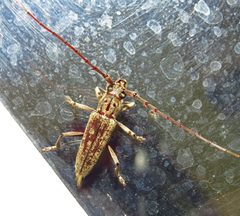
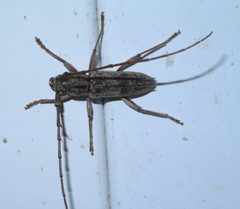
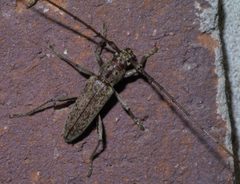
Distinguished from other Elaphidion by the mucronate (spined) angles of the pronotum. The species can be separated from the similar E. scudderi by details of antennal structure and pronotal . The "spined oak borer" is misleading for identification purposes, as the species is highly and not restricted to oak. are readily attracted to fermenting baits, which can aid in detection and collection.
Images
Habitat
Develops in dead wood of various hardwood trees. are found in wooded including bottomland forests, upland forests, and woodland edges. Frequently encountered on tree trunks, especially at night when attracted to lights or during mate-guarding activities.
Distribution
Eastern and central North America. Records from Ontario, Canada; throughout the eastern and central United States; and Mexico.
Seasonality
are active primarily during the warmer months. Based on fermenting trap records, peak activity occurs from June through September. Adults have been observed in mate-guarding situations in late spring and summer.
Diet
Larvae feed on dead wood of various tree . Documented larval include pawpaw (Asimina triloba), with also reared from dead wood of this plant. The species is highly , utilizing numerous hardwood species across multiple plant .
Host Associations
- Asimina triloba - larval Dead wood; only reared from pawpaw by collector, though two other cerambycids (Eupogonius pauper, Urgleptes querci) also reported from this
Life Cycle
Complete with , larval, pupal, and stages. Larvae are wood-borers that develop in dead wood of trees. Adults emerge from dead branches or trunks. Specific details of egg-laying and larval development duration are not documented.
Behavior
are attracted to fermenting baits, with 254 individuals documented from molasses/beer and red wine traps in a single Missouri study—making it the most abundant cerambycid captured by this method. Males engage in mate-guarding , positioning themselves above females on tree trunks with the female caged between the male's legs. Females have been observed attempting to escape mate-guarding by rapidly descending tree trunks, with males pursuing and recapturing them. The pair moves in unison on tree trunks with minimal physical contact between individuals.
Ecological Role
Decomposer that contributes to nutrient cycling by breaking down dead wood. Larval tunneling in dead branches and trunks facilitates wood decomposition. Serves as prey for various including birds and other insects. The ' polyphagy allows it to utilize dead wood resources across diverse forest types.
Human Relevance
No significant economic importance. Occasionally collected by entomologists for study. The is common enough in some areas (e.g., southeast Missouri) that it is frequently encountered by collectors. are readily captured in fermenting traps used for surveying longhorned beetles.
Similar Taxa
- Elaphidion scudderiSimilar slender body form and pronotal spines; distinguished by antennal structure and pronotal details
- Eupogonius pauperAlso highly and reared from pawpaw dead wood; belongs to different with different antennal and body proportions
- Urgleptes querciAlso highly and reported from pawpaw; smaller size and different pronotal structure
Misconceptions
The "spined oak borer" is misleading, as the is not restricted to oak (Quercus) but is one of the most wood-boring beetles in North America, utilizing numerous hardwood species across multiple plant .
More Details
Mate-guarding behavior
Detailed observations by Kent Fothergill documented that mate-guarding in this involves active female resistance. Females were observed escaping from under males by rapidly descending tree trunks (10 feet vertically in one observation), with males pursuing at high speed to recapture them. This challenges the traditional interpretation of mate-guarding as solely a male reproductive strategy, suggesting potential reproductive costs for females.
Fermenting bait attraction
The is exceptionally attracted to fermenting baits. In a 2015 Missouri study, 254 individuals were captured in molasses/beer and red wine traps—more than any other cerambycid species and representing 45% of all longhorned beetles collected by this method. This makes it a reliable for trap effectiveness.