
Anelaphus villosus
(Fabricius, 1793)
Twig Pruner
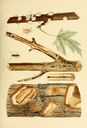
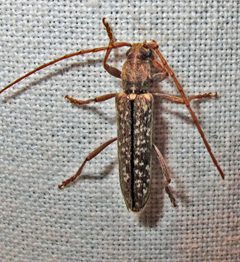
Anelaphus villosus, commonly known as the twig pruner, is a longhorn beetle ( Cerambycidae) found in eastern North America. The is notable for its distinctive larval : larvae bore into living twigs and branches of deciduous trees, then cut through the wood internally before , causing the branch tips to fall. The cut surface is characteristically smooth and concave, distinguishing it from similar twig-damaging beetles. Anelaphus parallelus has been synonymized with this species.

Pronunciation
How to pronounce Anelaphus villosus: //ˌænəˈlæfəs ˈvɪloʊsəs//
These audio files are automatically generated. While they are not always 100% accurate, they are a good starting point.
Identification
are small to medium-sized longhorn beetles with the typical elongated body form of Cerambycidae. The most reliable identification comes from examining pruned twigs: larvae cut the branch internally near the base, producing a smooth, concave cut surface. This distinguishes it from the twig girdler (Oncideres cingulata), where adults cut twigs leaving a ragged, chewed edge, and from the hickory spiral borer (Agrilus arcuatus), which leaves a spiral-patterned cut. holes in the bark of pruned branches may also indicate presence.
Images
Habitat
Occurs in deciduous forests and woodlands, particularly areas with oak trees. Associated with living branches of deciduous trees, especially oaks (Quercus spp.), where larvae develop. Found in dry-mesic upland forests, riparian woodlands, and forest edges.
Distribution
Eastern half of the United States and southeastern Canada. Documented from Manitoba, New Brunswick, and Nova Scotia in Canada. GBIF records indicate presence in Caribbean and North America.
Seasonality
emerge in spring. Field observations indicate larval activity in branches during growing season, with pruned twigs found in late summer through fall. One source notes adults should be molted and preparing for winter hibernation by late fall.
Diet
Larvae feed on living wood of deciduous tree twigs and branches, primarily oaks. Specific plants include Quercus shumardii (Shumard's oak), Quercus velutina (black oak), and other Quercus .
Host Associations
- Quercus shumardii - larval living branches
- Quercus velutina - larval living branches
- Quercus - larval -level association with oaks
Life Cycle
Females deposit in living twigs or branches. Larvae bore into the wood and feed within the living branch, creating galleries. Before , larvae cut through the wood internally near the branch base, leaving only a thin outer layer of bark intact. The branch eventually breaks and falls. Larvae pupate within the fallen branch or in the portion remaining attached to the tree. emerge through round exit holes in the bark.
Behavior
Larvae are specialized that prune branches through internal cutting. This causes distinctive branch drop that can be detected on the forest floor. are likely or , as is typical for many cerambycids, though specific adult activity patterns are not well documented in the provided sources.
Ecological Role
As a twig pruner, larvae contribute to natural branch pruning in forest . The fallen branches provide and food for other organisms, including saproxylic beetles and decomposers. The is part of the guild of wood-boring beetles that facilitate nutrient cycling in deciduous forests.
Human Relevance
Considered a minor pest of pecan and other hardwood trees in managed settings. The branch pruning can be mistaken for storm damage or other causes. Control recommendations include collecting and destroying fallen branches to reduce . The is of interest to entomologists and naturalists for its distinctive larval .
Similar Taxa
- Oncideres cingulataTwig girdler - (not larvae) cut twigs, leaving ragged, chewed edges rather than smooth concave cuts
- Agrilus arcuatusHickory spiral borer - larvae cut branch ends in characteristic spiral pattern, not smooth concave cut
More Details
Synonymy
Anelaphus parallelus was determined to be a taxonomic synonym of A. villosus and is now treated as the same .
Rearing
Pruned branches with intact bark can be placed in boxes to rear for identification and study.
Sources and further reading
- BugGuide
- Wikipedia
- GBIF taxonomy match
- iNaturalist taxon
- NCBI Taxonomy
- Catalogue of Life
- Insects that feed on twigs and branches - AgriLife Extension Entomology
- Oedemeridae | Beetles In The Bush
- “62nd” Annual “Season-Opener-Birthday-Bug-Collecting-Trip” | Beetles In The Bush
- Alydidae | Beetles In The Bush
- Melanthiaceae | Beetles In The Bush