
Gnaphalodes trachyderoides
Thomson, 1861
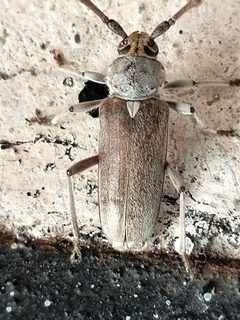
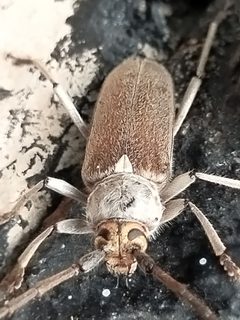
A longhorn beetle and the sole in its , characterized by a robust, somewhat flattened body and that are notably shorter than those of many cerambycids. The species name 'trachyderoides' references its resemblance to the genus Trachyderes. It occurs from the southwestern United States through Mexico and Central America.
Pronunciation
How to pronounce Gnaphalodes trachyderoides: /ˌnæfəˈloʊdiːz ˌtrækɪdəˈrɔɪdiːz/
These audio files are automatically generated. While they are not always 100% accurate, they are a good starting point.
Identification
Distinguished from other North American cerambycines by the combination of: short (especially in females), broad flattened body, expanded genae, and pronotum with lateral spines. Resembles Trachyderes but differs in antennal structure (scape without cicatrix) and details of pronotal armature. The Gnaphalodes is , so species identification equates to genus recognition. Separated from similar robust cerambycids (e.g., some Stenaspis, Trachyderes) by the exposing abdominal tergites and the antennal scape lacking a cicatrix.
Images
Habitat
Arid and semi-arid regions including desert scrub, thorn forest, and tropical dry forest. Associated with woody vegetation, particularly leguminous trees and shrubs. often found on plants or attracted to lights.
Distribution
Southwestern United States (Arizona, southern California, New Mexico, western Texas), Mexico, and Central America (Guatemala, Belize, Honduras, El Salvador, Nicaragua, Rica, Panama). Records indicate presence in Middle America and North America with specific country records for Belize and Costa Rica.
Seasonality
have been recorded primarily during the warmer months, with peak activity from late spring through early fall (May–October) in northern parts of the range. Activity patterns likely extend year-round in tropical portions of the range.
Host Associations
- Acacia - larval larvae develop in living or dead wood
- Prosopis - larval mesquite utilized for larval development
- Cercidium - larval palo verde and related legumes
Life Cycle
Larvae are wood-borers, developing in trunks and branches of living or recently dead woody plants, primarily leguminous trees. Development likely spans one to two years depending on conditions. occurs in the wood, with emerging through exit holes. Specific details of -laying and larval instar number are not well documented.
Behavior
are or and attracted to artificial light sources. Relatively slow-moving compared to some cerambycids. When disturbed, may drop from vegetation or feign death. Adults have been observed feeding on bark or foliage of plants, though specific feeding habits are poorly documented.
Ecological Role
As a primary wood-borer in living and dead woody legumes, larvae contribute to nutrient cycling and structural degradation of material. May serve as a food source for woodpeckers and other . The is not considered a major economic pest despite its association with valued timber and shade trees.
Human Relevance
Occasional concern in agroforestry systems where leguminous trees (mesquite, acacia) are cultivated. sometimes encountered at lights in residential areas within its range. Not known to plant . No significant cultural or medicinal uses documented.
Similar Taxa
- Trachyderes mandibularisSimilar robust build and coloration, but Trachyderes has distinctly longer , antennal scape with a cicatrix, and different pronotal structure.
- Stenaspis solitariaComparable size and dark coloration with pale markings, but Stenaspis has more elongate body form, longer , and lacks the expanded genae characteristic of Gnaphalodes.
- Derobrachus speciesSome large Derobrachus share the robust build, but possess extremely long (especially males) and different pronotal armature.
Misconceptions
Sometimes misidentified as a Trachyderes due to the species epithet and general resemblance; however, Gnaphalodes is phylogenetically and morphologically distinct. The short have led to occasional confusion with non-cerambycid beetles.
More Details
Taxonomic History
The Gnaphalodes was established by Thomson in 1861 with this as the type and sole representative. The name 'trachyderoides' directly references the superficial similarity to Trachyderes, a more speciose genus of robust cerambycids. The species has not been subdivided into despite its broad geographic range.
Phylogenetic Position
Placed in the tribe Bothriospilini ( Cerambycinae), a group characterized by diverse antennal and pronotal modifications. The status of Gnaphalodes makes it phylogenetically interesting, though molecular data are limited.