
Bothriospilini
Genus Guides
3- Chrotoma
- Gnaphalodes
- Knulliana(banded hickory borer)
Bothriospilini is a tribe of longhorn beetles (Cerambycidae) within the Cerambycinae, comprising 11 with primarily Neotropical distribution. The tribe was established in 1950 by Frederico Lane and is morphologically allied to Torneutini, sharing distinctive abdominal and thoracic cavity characteristics. Several have been subjects of chemical research, with identified from Chlorida and Knulliana. The tribe includes notable species such as Knulliana cincta, the banded hickory borer, which extends into eastern North America.
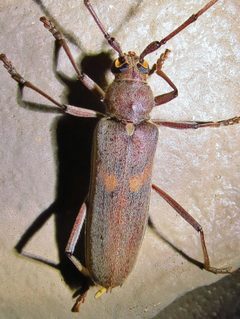
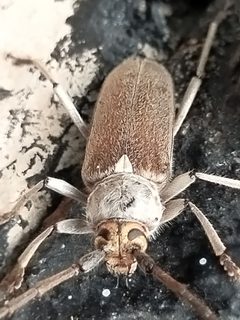
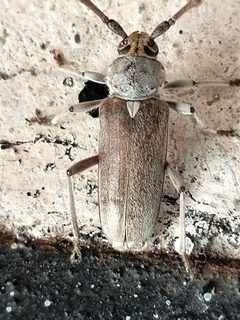
Pronunciation
How to pronounce Bothriospilini: /bɔˌθri.oʊˈspaɪlaɪniː/
These audio files are automatically generated. While they are not always 100% accurate, they are a good starting point.
Identification
Bothriospilini can be distinguished from related tribes by the of the last abdominal segment in females, which is wide and largely braided, and by thigh cavities that are open posteriorly with a laterally open medial cavity. These features are shared with Torneutini, requiring careful examination to separate the two tribes. Timbaraba dispar has with 11 segments and a trapezoidal .
Images
Habitat
Primarily Neotropical; Knulliana cincta occurs on hickory and oak trees in eastern North America, including Texas, Mexico, and the Bahamas. Scapanopygus cinereus has been collected from riverbank in Argentina.
Distribution
Primarily Neotropical. occur in South America (Argentina, Venezuela), with Knulliana cincta extending through eastern North America to Texas and the Bahamas. Specific distributions: Taygayba venezuelensis (Venezuela), Timbaraba dispar (Venezuela), Scapanopygus cinereus (Argentina), Knulliana cincta across eastern and southwestern United States and adjacent Mexico.
Diet
Knulliana cincta larvae bore into hickory and oak trees; other dietary habits are not documented.
Host Associations
- Carya (hickory) - larval Knulliana cincta oviposition and larval development
- Quercus (oak) - larval Knulliana cincta oviposition and larval development
Life Cycle
Knulliana cincta larvae bore into trees, sometimes causing significant damage. Complete details for other are not documented.
Behavior
Knulliana cincta produces audible squeaking when roughly handled. males of Chlorida festiva and Chlorida costata produce the (6E,8Z)-6,8-pentadecadienal. Knulliana cincta males produce methionol and its sulfoxide as .
Human Relevance
Knulliana cincta larvae can cause significant damage to hickory and oak trees. The tribe has been studied for chemical , with the first identified from the tribe being a significant contribution to cerambycid pheromone research.
Similar Taxa
- TorneutiniShares wide, braided last abdominal segment in females and thigh cavities open from behind with laterally open medial cavity; separated by additional morphological characters requiring detailed examination
More Details
Taxonomic history
Proposed by Frederico Lane in 1950 as part of Bothriospilinae; later transferred to Cerambycinae. Ranqueles and Scapanopygus were transferred to Bothriospilini in 2005 based on cladistic analysis (Monné and Napp).
Chemical ecology research
The compound (6E,8Z)-6,8-pentadecadienal from Chlorida festiva and C. costata was the first identified from Bothriospilini. In 2022, methionol and its sulfoxide were identified from Knulliana cincta, expanding known pheromone diversity in the tribe.