
Larainae
J. L. LeConte, 1861
riffle beetles
Genus Guides
2- Lara
- Phanocerus(riffle beetles)
Larainae is a of riffle beetles (Coleoptera: Elmidae) comprising more than 20 and approximately 160 described . Members are fully aquatic beetles inhabiting streams and rivers, with both and larvae restricted to lotic environments. The subfamily has a broad distribution across the Neotropical region, Australia, and New Zealand, with some genera exhibiting disjunct distributions between Australasia and South America. Larainae are distinguished from the other elmid subfamily, Elminae, by morphological features of the larvae and adults, including concealed larval and specialized hydrofuge setation.
Pronunciation
How to pronounce Larainae: /ˈlɛrəˌnaɪ/
These audio files are automatically generated. While they are not always 100% accurate, they are a good starting point.
Identification
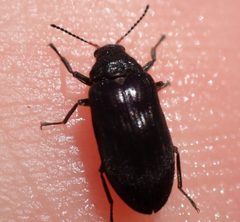
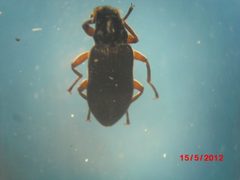
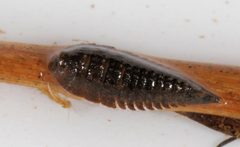
distinguished from Elminae by short, clubbed and dense hydrofuge setation (tomentum) that retains air bubbles when submerged. Larvae distinguished from Elminae by concealed beneath pronotal projection when viewed dorsally; this feature is diagnostic for Larainae larvae. Larvae of different separable by head capsule visibility, pronotal shape, and leg proportions; keys exist for New World and Brazilian genera. Adults of some genera (e.g., Phanocerus) characterized by specific tibial setose patches and pronotal proportions.
Images
Habitat
Exclusively lotic aquatic environments: streams, rivers, and riffles. and larvae found on submerged organic debris including leaf packs, emergent sticks and logs, and streamside vegetation overhanging water. Some inhabit spaces within stream substrates. Recorded from first-order headwater streams to larger river systems. Specific localities include tropical streams in French Guiana, Atlantic Rainforest streams in southeastern Brazil, and tepui summits in Suriname.
Distribution
Neotropical region: South America, Central America, Mexico, and West Indies; Australia (including Tasmania) with three and twelve described ; New Zealand. Disjunct distribution: genus Hydora occurs in both Australasia (Australia, New Zealand) and southern South America. Genus Phanocerus ranges from southern USA (Texas) through Caribbean Islands and Central America to Argentina (excluding Chile).
Seasonality
Reproductive activity observed in March and November for at least some (based on Phanocerus queneyi). Larval presence documented in both dry (August) and rainy (February) seasons, with morphometric variation in body size correlated with seasonal hydraulic conditions.
Diet
, particularly diatoms (based on Hinton 1940 record for Phanocerus). Specific dietary information for most and genera unknown.
Life Cycle
Holometabolous. , larvae, and pupae described for some (e.g., Phanocerus, Hydora). Larvae aquatic, commonly found in leaf packs. Females contain multiple eggs (1–14 observed), indicating multiple oviposition events. Larvae found in association with . presumably occurs in moist riparian environments, though specific details largely unreported.
Behavior
exhibit rapid escape : when disturbed, quickly drop onto water surface to escape; when captured in nets, fly rapidly and may be mistaken for staphylinids or flies. Adults attracted to stream-side lights. When submerged, tomentum retains air bubble around entire body, facilitating underwater respiration. Some (e.g., Phanocerus queneyi) extrude secretions between abdominal ventrites III and IV, potentially as -avoidance mechanism. Adults observed in copula while submerged. Larvae display morphological plasticity in response to hydraulic disturbance, with smaller body sizes associated with periods of greater rainfall and flow.
Ecological Role
Member of riffle beetle in stream ; associated with diverse aquatic fauna including Dryopidae, Elmidae (Elminae), and Lutrochidae. Contribute to algal grazing and nutrient cycling in lotic environments. Serve as indicators of stream water quality and stability.
Human Relevance
Used as bioindicators of stream health and water quality due to specific requirements and sensitivity to hydraulic disturbance. Subject of taxonomic and ecological research; several new described recently from poorly surveyed regions including French Guiana, Suriname, and Australia.
Similar Taxa
- ElminaeOther of Elmidae; distinguished by longer and lack of dense tomentum, larvae distinguished by exposed capsule visible dorsally
- Dryopidae resemble laraine elmids in aquatic and general form; distinguished by different antennal structure and larval
- LutrochidaeAnother of aquatic beetles found in similar stream ; distinguished by different body shape and larval features
Sources and further reading
- BugGuide
- Wikipedia
- iNaturalist taxon
- NCBI Taxonomy
- Catalogue of Life
- The larva of Hydora annectens Spangler and Brown (Coleoptera: Elmidae, Larainae) and a key to New World Larainae larvae
- A new species of laraine elmid from French Guiana (Coleoptera, Elmidae, Larainae)
- Description of the larva of Potamophilops cinereus (Blanchard) from Southeastern Brazil (Coleoptera, Elmidae, Larainae)
- Hexanchorus bifurcatus sp. nov., a new tepui riffle beetle (Coleoptera: Elmidae: Larainae) from Tafelberg, Suriname
- Potamophilops Grouvelle in French Guiana, with additional distributional records for the genus (Coleoptera, Elmidae, Larainae)
- Primeiro registro do gênero e espécie Neblinagena doylei Kodada & Jäch (Coleoptera: Elmidae: Larainae) no Brasil
- A review of the Larainae of Australia with description of seven new species and the new genus Australara (Coleoptera, Byrrhoidea, Elmidae)
- Variation in body size of Phanocerus clavicornis Sharp, 1882 (Coleoptera: Elmidae: Larainae) in Atlantic Rainforest streams in response to hydraulic disturbance
- <i>Hypsilara breweri</i> n.sp. from Venezuela: description of new species with notes on the morphology and phylogenetic relationships of the genus (Coleoptera: Elmidae: Larainae)