
Acmaeodera scalaris
Mannerheim, 1837
ladder buprestid
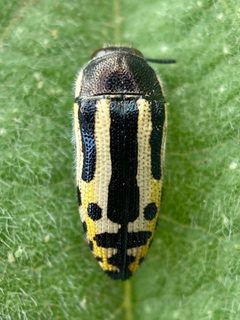
Acmaeodera scalaris, commonly known as the ladder buprestid, is a metallic wood-boring beetle in the Buprestidae. It occurs across Central America and North America. The has been documented visiting flowers of various composite and other plant species, particularly in arid and semi-arid regions of the southwestern United States and northern Mexico.
Pronunciation
How to pronounce Acmaeodera scalaris: //ˌækmiːoʊˈdɛrə skəˈlɛrɪs//
These audio files are automatically generated. While they are not always 100% accurate, they are a good starting point.
Images
Habitat
Found in arid and semi-arid environments including desert grasslands, scrublands, and rocky slopes. Associated with flowering vegetation in dry-mesic conditions. Has been observed in limestone bluff areas and hilltop prairies in Illinois, as well as desert in Arizona and New Mexico.
Distribution
Central America and North America. Documented from the southwestern United States (Arizona, New Mexico, California, Oklahoma, Illinois) and Mexico. GBIF records indicate presence in both Nearctic and Neotropical regions.
Seasonality
Active primarily during late summer and early autumn. Observations from field records indicate peak activity from August through September in southwestern localities, with earlier activity (May-June) in more northern and eastern areas such as Oklahoma and Illinois.
Host Associations
- Hymenothrix wislizeni - flower visitorobserved feeding on flowers
- Heterotheca subaxillaris - flower visitorobserved with other Acmaeodera
- Isocoma tenuisecta - flower visitorobserved on flowers, including unopened
- Allionia incarnata - flower visitorobserved in Box Canyon, Arizona
- Xanthisma gracile - flower visitorobserved in Box Canyon, Arizona
- Solidago - flower visitorobserved on goldenrod flowers
- Heliomeris longifolia - flower visitorobserved at Kitt Peak, Arizona
- Heterotheca fulcrata - flower visitorobserved at Kitt Peak, Arizona
- Hymenothrix wrightii - flower visitorobserved at Kitt Peak, Arizona
- Solidago velutina - flower visitorobserved at Kitt Peak, Arizona
- Gutierrezia microcephala - flower visitorobserved at multiple localities
- Bahia dissecta - flower visitorobserved on Mt. Lemmon, Arizona
- Ageratina herbarea - flower visitorobserved on Mt. Lemmon, Arizona
- Achillea millefolium - flower visitorobserved on Mt. Lemmon, Arizona
- Cirsium - flower visitorobserved on thistle flowers
- Viguiera dentata - flower visitorobserved on Mt. Lemmon, Arizona
- Erigeron neomexicanus - flower visitorobserved in Montosa Canyon, Arizona
- Linum neomexicanum - flower visitorobserved in Montosa Canyon, Arizona
- Heliomeris multiflora - flower visitorobserved in Montosa Canyon, Arizona
- Verbesina enselioides - flower visitorobserved in Montosa Canyon, Arizona
- Heliopsis parvifolia - flower visitorobserved in Montosa Canyon, Arizona
- Machaeranthera tanacetifolia - flower visitorobserved in Montosa Canyon, Arizona
Behavior
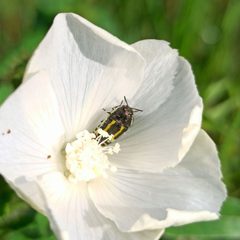
are flower visitors, frequently found feeding on pollen and nectar of yellow-flowered composites and other blooming plants. Often observed in association with other Acmaeodera on shared floral resources. Adults have been collected by sweeping vegetation and beating branches as well as direct observation on flowers.
Ecological Role
flower visitation suggests potential role in pollination of visited plant . Larval presumably involves wood-boring in living or dead woody vegetation, typical of the Buprestidae, though specific plants for larval development are not documented in available sources.
Similar Taxa
- Acmaeodera amplicollisOverlapping distribution and flower visitation habits; both found on Isocoma tenuisecta and other composites in Arizona. A. amplicollis typically larger with broader pronotum.
- Acmaeodera disjunctaSympatric in southwestern deserts and shared flower resources such as Isocoma tenuisecta. A. disjuncta has more contrasting elytral pattern with distinct pale markings.
- Acmaeodera rubronotataFrequently found together on flowers of Hymenothrix wislizeni and other composites. A. rubronotata distinguished by reddish pronotal markings.
- Acmaeodera gibbulaOverlapping range and floral associations, particularly on Heterotheca subaxillaris. A. gibbula generally smaller with different elytral .
- Acmaeodera decipiensShared in Arizona canyons and similar flower-visiting . A. decipiens has distinctive pale elytral markings and has been observed perching on grass stems.
- Acmaeodera parkeriFound sympatrically on Allionia incarnata and other flowers in Box Canyon, Arizona. A. parkeri has distinctive elytral pattern with more extensive pale markings.
- Acmaeodera cazieriCollected together on Allionia incarnata in Box Canyon. A. cazieri has characteristic elytral maculation pattern.
- Acmaeodera aliciaOverlapping distribution in Arizona and shared attraction to Heterotheca subaxillaris flowers.
- Acmaeodera convictaBoth occur in southeastern Arizona; A. convicta distinguished by more contrasting black and yellow pattern and association with different shrub types.
- Acmaeodera tubulusEastern relative with similar ; found on flowers in Oklahoma and Arkansas. A. tubulus has more subdued coloration and occurs in more mesic eastern .
More Details
Collection methods
Documented collection methods include hand-picking from flowers, sweeping vegetation with nets, and beating branches of flowering and non-flowering plants. are active during daylight hours and are most readily found when plants are in bloom.
Taxonomic history
described by Mannerheim in 1837. The specific epithet 'scalaris' refers to ladder-like appearance, presumably of the elytral markings.
Field observations
In the Dripping Spring Mountains of Arizona, four of Acmaeodera were found together on Heterotheca subaxillaris flowers, with A. scalaris among them. At Blue Sky Road near Willcox, Arizona, found on Isocoma tenuisecta in full bloom alongside abundant Crossidius suturalis.