
Acmaeodera rubronotata
Laporte & Gory, 1835
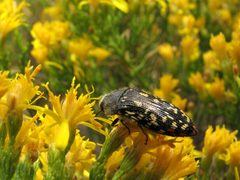
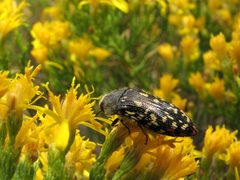
Acmaeodera rubronotata is a metallic wood-boring beetle in the Buprestidae, distributed across Central America and North America. The is one of numerous Acmaeodera species frequently encountered on flowers of yellow composites and other Asteraceae in arid and semi-arid regions. Field observations document visiting flowers of Heterotheca subaxillaris, Xanthisma gracile, Gutierrezia microcephala, and Heliomeris longifolia. The specific epithet 'rubronotata' refers to red markings on the pronotum.
Pronunciation
How to pronounce Acmaeodera rubronotata: //æk.miː.oʊˈdɛr.ə ˌruː.brə.nəˈteɪ.tə//
These audio files are automatically generated. While they are not always 100% accurate, they are a good starting point.
Identification
Acmaeodera rubronotata can be distinguished from by the combination of red pronotal markings (referenced in the specific epithet) and overall body pattern. Within the Acmaeodera, identification typically requires examination of elytral , coloration patterns, and pronotal shape. The species is smaller and more slender than some sympatric congeners such as A. amplicollis. Accurate identification often requires comparison with reference specimens or specialized keys due to the large number of similar-appearing species in this genus.
Images
Habitat
Observed in dry, rocky including limestone bluffs, hilltop prairies, and desert grasslands. are strongly associated with flowering plants in the Asteraceae , particularly yellow composites. The occurs in areas with sparse to moderate vegetation cover, often in association with dry-mesic deciduous forest edges and open prairie remnants.
Distribution
Central America and North America. Documented from the southwestern United States including Arizona, New Mexico, and adjacent regions, extending southward through Mexico. GBIF records indicate presence in the Nearctic and Neotropical regions.
Seasonality
activity documented from late summer through early autumn, with observations in September in Arizona and New Mexico. Peak activity appears to coincide with blooming of composite flowers.
Behavior
are flower visitors, frequently observed feeding on or perched upon flowers of yellow composites and other Asteraceae. Multiple individuals may occur on the same flowering plant. The is a capable flier and readily moves between flowering patches. When disturbed, adults may drop from flowers or take .
Ecological Role
function as while feeding on floral resources. As with other Buprestidae, larvae are wood-borers, though specific larval for this are not documented in available sources.
Similar Taxa
- Acmaeodera gibbulaSimilar size and flower-visiting ; distinguished by elytral pattern and lack of prominent red pronotal markings
- Acmaeodera disjunctaSympatric and co-occurs on similar flowers; differs in coloration and pronotal pattern
- Acmaeodera scalarisOverlapping distribution and ; requires careful examination of body proportions and markings for separation